Case 1: Alzheimer’s disease
What is Alzheimer’s disease (AD)?
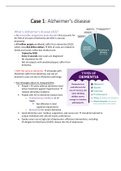
= An irreversible, progressive brain disorder that accounts for
60-70% of all cases of dementia (10-20% is vascular
dementia)
= 47 million people worldwide suffer from dementia (2015)
which costs 818 billion dollars → 85% of costs are related to
family and social, rather dan medical care
- Tripled by 2050
- Every 3 seconds new cases are diagnosed
- No treatment for AD
- Not all subjects with amyloid plaques suffer from
dementia
= NOT the same as dementia → all people with
Alzheimer suffer from dementia, but not all
dementia cases are due to Alzheimer pathology
= Key messages about its rising problem:
• People + 45 years without dementia need
active treatment against hypertension →
reduces dementia incidence
• People with AD or dementia (Lewy) need:
o Cholinesterase inhibitors at all
stages
▪ Not effective in mild
cognitive impairments
o Memantine for severe dementia
• Good dementia care: medical, supportive, and social care → should be tailored to
unique individual and cultural needs, preferences
• Family carers are at high risk of depression: effective interventions, including
STrAtegies for RelaTives (START) reduce the risk of depression,
,Hallmarks
Three hallmarks
1. Brain atrophy
- Shrinkage of the brain → 2 typical places: cerebral cortex + hippocampus
- Enlarged ventricles (fluid filled cavities)
2. Extracellular aggregates of amyloid β (Aβ) plaques
- Amyloid cascade hypothesis synthesizes histopathological and genetic information,
and posits that the deposition of the amyloid-β peptide in the brain parenchyma
initiates a sequence of events that ultimately lead to AD dementia
= Normally: APP gets cleaved by a-secretase
→ sAPP (soluble) and helps neurons grow and
repair
= Due to a mutation gene that codes APP +
PSEN 1/2 (Amyloid Precursor Protein), APP
gets cleaved by β+g-secretase → Aβ (amyloid
beta), non-soluble → very hydrophobic and
sticky oligomerization (aggregation) →
- Aβ plaque formation + deposition
outside of neuron → disrupt signaling
between neurons
- Triggers cascade of formation of
neurofibrillary tangles (NFT’s) inside
the neuron
1. AB40: normal
2. AB42: more pathogenic form → are longer
,→ aggregate stress → PHF (paired
helical filaments) formation (= TAU
proteins) → mediates neuronal
death or affects synaptic
neurotransmission → dementia
3. Intracellular neurofibrillary tangles made of hyperphosphorylated
tau-protein (Tau tangles)
- Tau: normally stabilizes the microtubule in axons
- But due to the formation of Aβ, kinase in the neuron
gets triggered hyper phosphorylates the tau protein
→ gets sticky and changes its shape and gets of the
microtubule → loses its function of stabilization →
gets tangled, clumped together (neurofibrillary
tangles)
Symptoms
- First symptoms: mild cognitive difficulties
• Up to 8 years before a person fulfills the clinical criteria for diagnosis of AD
• Short term memory loss, subtle problems with attentiveness, planning, abstract
thinking
• Effects the most complex activities of daily living (ADL)
- Early stage: increasing impairment of learning and memory
• Shrinking vocabulary, decreased word fluency
- Middle stage: progressive deterioration eventually hinders independence, with
subjects being unable to perform most common activities of daily living.
• Behavioral and neuropsychiatric changes become more prevalent: wandering,
irritability, emotional lability, leading to crying and aggression
• Long term memory becomes impaired, paraphasia (the incorrect word
substitutions), loss of reading and writing skills, failing to recognize close relatives
- Late stage/ final stage/ severe stage: complete dependence on caregivers
, • Language is reduced to simple phrases (even single words), complete loss of
speech, but can still understand and return emotional signals, aggressiveness,
extreme apathy (lack of feeling), exhaustion
Biomarkers
- Imaging biomarkers:
▪ Medial temporal lobe (memory) atrophy
▪ Hippocampal volume: decreasing
→ Via MRI
→ Via PET-scan: PiB (levels of AB) or FDG PET (measures glucose
consumption, the energy metabolism)
- Fluid biomarkers: sample of CSF via lumbar puncture
▪ Decrease of Amyloid B 42 (AB42)
▪ Increase of tTau and pTau (phosphorylated tau)
→ No blood tests
What is Alzheimer’s disease (AD)?
= An irreversible, progressive brain disorder that accounts for
60-70% of all cases of dementia (10-20% is vascular
dementia)
= 47 million people worldwide suffer from dementia (2015)
which costs 818 billion dollars → 85% of costs are related to
family and social, rather dan medical care
- Tripled by 2050
- Every 3 seconds new cases are diagnosed
- No treatment for AD
- Not all subjects with amyloid plaques suffer from
dementia
= NOT the same as dementia → all people with
Alzheimer suffer from dementia, but not all
dementia cases are due to Alzheimer pathology
= Key messages about its rising problem:
• People + 45 years without dementia need
active treatment against hypertension →
reduces dementia incidence
• People with AD or dementia (Lewy) need:
o Cholinesterase inhibitors at all
stages
▪ Not effective in mild
cognitive impairments
o Memantine for severe dementia
• Good dementia care: medical, supportive, and social care → should be tailored to
unique individual and cultural needs, preferences
• Family carers are at high risk of depression: effective interventions, including
STrAtegies for RelaTives (START) reduce the risk of depression,
,Hallmarks
Three hallmarks
1. Brain atrophy
- Shrinkage of the brain → 2 typical places: cerebral cortex + hippocampus
- Enlarged ventricles (fluid filled cavities)
2. Extracellular aggregates of amyloid β (Aβ) plaques
- Amyloid cascade hypothesis synthesizes histopathological and genetic information,
and posits that the deposition of the amyloid-β peptide in the brain parenchyma
initiates a sequence of events that ultimately lead to AD dementia
= Normally: APP gets cleaved by a-secretase
→ sAPP (soluble) and helps neurons grow and
repair
= Due to a mutation gene that codes APP +
PSEN 1/2 (Amyloid Precursor Protein), APP
gets cleaved by β+g-secretase → Aβ (amyloid
beta), non-soluble → very hydrophobic and
sticky oligomerization (aggregation) →
- Aβ plaque formation + deposition
outside of neuron → disrupt signaling
between neurons
- Triggers cascade of formation of
neurofibrillary tangles (NFT’s) inside
the neuron
1. AB40: normal
2. AB42: more pathogenic form → are longer
,→ aggregate stress → PHF (paired
helical filaments) formation (= TAU
proteins) → mediates neuronal
death or affects synaptic
neurotransmission → dementia
3. Intracellular neurofibrillary tangles made of hyperphosphorylated
tau-protein (Tau tangles)
- Tau: normally stabilizes the microtubule in axons
- But due to the formation of Aβ, kinase in the neuron
gets triggered hyper phosphorylates the tau protein
→ gets sticky and changes its shape and gets of the
microtubule → loses its function of stabilization →
gets tangled, clumped together (neurofibrillary
tangles)
Symptoms
- First symptoms: mild cognitive difficulties
• Up to 8 years before a person fulfills the clinical criteria for diagnosis of AD
• Short term memory loss, subtle problems with attentiveness, planning, abstract
thinking
• Effects the most complex activities of daily living (ADL)
- Early stage: increasing impairment of learning and memory
• Shrinking vocabulary, decreased word fluency
- Middle stage: progressive deterioration eventually hinders independence, with
subjects being unable to perform most common activities of daily living.
• Behavioral and neuropsychiatric changes become more prevalent: wandering,
irritability, emotional lability, leading to crying and aggression
• Long term memory becomes impaired, paraphasia (the incorrect word
substitutions), loss of reading and writing skills, failing to recognize close relatives
- Late stage/ final stage/ severe stage: complete dependence on caregivers
, • Language is reduced to simple phrases (even single words), complete loss of
speech, but can still understand and return emotional signals, aggressiveness,
extreme apathy (lack of feeling), exhaustion
Biomarkers
- Imaging biomarkers:
▪ Medial temporal lobe (memory) atrophy
▪ Hippocampal volume: decreasing
→ Via MRI
→ Via PET-scan: PiB (levels of AB) or FDG PET (measures glucose
consumption, the energy metabolism)
- Fluid biomarkers: sample of CSF via lumbar puncture
▪ Decrease of Amyloid B 42 (AB42)
▪ Increase of tTau and pTau (phosphorylated tau)
→ No blood tests