

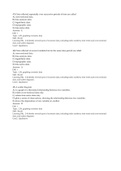
47) Data collected repeatedly over successive periods of time are called
A) cross-sectional data.
B) time-analysis data.
C) logarithmic data.
D) topographic data.
E) time-series data.
Answer: E
Diff: 1
Topic: 2.3b. graphing economic data
Skill: Recall
Learning Obj.: 2-4 Identify several types of economic data, including index numbers, time‐series and cross‐sectional
data, and scatter diagrams.
User2: Qualitative
48) Data collected of several variables but for the same time period are called
A) cross-sectional data.
B) time-analysis data.
C) logarithmic data.
D) topographic data.
E) time-series data.
Answer: A
Diff: 1
Topic: 2.3b. graphing economic data
Skill: Recall
Learning Obj.: 2-4 Identify several types of economic data, including index numbers, time‐series and cross‐sectional
data, and scatter diagrams.
User2: Qualitative
49) A scatter diagram
A) is a graph of a theoretical relationship between two variables.
B) relates cross-sectional data only.
C) relates time series data only.
D) plots a series of observations, showing the relationship between two variables.
E) shows the dependence of one variable on another.
Answer: D
Diff: 1
Topic: 2.3b. graphing economic data
Skill: Recall
Learning Obj.: 2-4 Identify several types of economic data, including index numbers, time‐series and cross‐sectional
data, and scatter diagrams.
User2: Qualitative
, 2.4 Graphic Economics Theories
1) When it is said that variable A depends on variable B, then A is
A) a derivative of B.
B) proportional to B.
C) partially exclusive of B.
D) a function of B.
E) independent of B.
Answer: D
Diff: 1
Topic: 2.4a. functional relations
Skill: Applied
Learning Obj.: 2-5 See that the slope of a line on a graph relating two variables shows the "marginal response" of one
variable to a change in the other.
User2: Qualitative
2) Consider the following equation: Y = 10 + 5X - X2. This equation is an expression of
A) a functional relation between X and Y.
B) two dependent variables in a functional relation.
C) two independent variables in a functional relation.
D) a functional relation in a schedule format.
E) a functional relation in a verbal format.
Answer: A
Diff: 2
Topic: 2.4a. functional relations
Skill: Applied
Learning Obj.: 2-5 See that the slope of a line on a graph relating two variables shows the "marginal response" of one
variable to a change in the other.
User2: Quantitative
3) When considering how a family's level of consumption changes in response to changes in its income,
A) income is the dependent variable and family consumption is the independent variable.
B) consumption is the dependent variable and income is the independent variable.
C) both of the variables are independent.
D) both of the variables are dependent.
E) there is no relationship between the variables.
Answer: B
Diff: 2
Topic: 2.4a. functional relations
Skill: Applied
Learning Obj.: 2-5 See that the slope of a line on a graph relating two variables shows the "marginal response" of one
variable to a change in the other.
User2: Qualitative
A) cross-sectional data.
B) time-analysis data.
C) logarithmic data.
D) topographic data.
E) time-series data.
Answer: E
Diff: 1
Topic: 2.3b. graphing economic data
Skill: Recall
Learning Obj.: 2-4 Identify several types of economic data, including index numbers, time‐series and cross‐sectional
data, and scatter diagrams.
User2: Qualitative
48) Data collected of several variables but for the same time period are called
A) cross-sectional data.
B) time-analysis data.
C) logarithmic data.
D) topographic data.
E) time-series data.
Answer: A
Diff: 1
Topic: 2.3b. graphing economic data
Skill: Recall
Learning Obj.: 2-4 Identify several types of economic data, including index numbers, time‐series and cross‐sectional
data, and scatter diagrams.
User2: Qualitative
49) A scatter diagram
A) is a graph of a theoretical relationship between two variables.
B) relates cross-sectional data only.
C) relates time series data only.
D) plots a series of observations, showing the relationship between two variables.
E) shows the dependence of one variable on another.
Answer: D
Diff: 1
Topic: 2.3b. graphing economic data
Skill: Recall
Learning Obj.: 2-4 Identify several types of economic data, including index numbers, time‐series and cross‐sectional
data, and scatter diagrams.
User2: Qualitative
, 2.4 Graphic Economics Theories
1) When it is said that variable A depends on variable B, then A is
A) a derivative of B.
B) proportional to B.
C) partially exclusive of B.
D) a function of B.
E) independent of B.
Answer: D
Diff: 1
Topic: 2.4a. functional relations
Skill: Applied
Learning Obj.: 2-5 See that the slope of a line on a graph relating two variables shows the "marginal response" of one
variable to a change in the other.
User2: Qualitative
2) Consider the following equation: Y = 10 + 5X - X2. This equation is an expression of
A) a functional relation between X and Y.
B) two dependent variables in a functional relation.
C) two independent variables in a functional relation.
D) a functional relation in a schedule format.
E) a functional relation in a verbal format.
Answer: A
Diff: 2
Topic: 2.4a. functional relations
Skill: Applied
Learning Obj.: 2-5 See that the slope of a line on a graph relating two variables shows the "marginal response" of one
variable to a change in the other.
User2: Quantitative
3) When considering how a family's level of consumption changes in response to changes in its income,
A) income is the dependent variable and family consumption is the independent variable.
B) consumption is the dependent variable and income is the independent variable.
C) both of the variables are independent.
D) both of the variables are dependent.
E) there is no relationship between the variables.
Answer: B
Diff: 2
Topic: 2.4a. functional relations
Skill: Applied
Learning Obj.: 2-5 See that the slope of a line on a graph relating two variables shows the "marginal response" of one
variable to a change in the other.
User2: Qualitative

