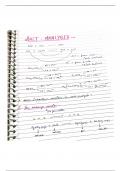
Active transport :
outside
Mdcentration
i
concentration membrane
gradient
higher
concentration iii sienna
Active transport moves substances from a more dilute solution to a more
concentrated solution (against concentration gradient).
Differences between diffusion and active transport :
Diffusion : Active transport:
Particles move down the Particles move against the
concentration gradient. concentration gradient.
Does not require energy Does require energy from
from respiration. respiration.
,Required prac 3 - effects of osmosis on plant tissue :
1. Peel a potato (the skin can effect osmosis).
2. Use a cork borer to produce 3 cylinders of potato, this makes all of
the cylinders the same diameter.
3. Use a scalpel to trim the cylinders to the same length(around 3cm).
4. Measure the length of each cylinder using a ruler and the mass of each
cylinder using a scale.
5. Place each cylinder into a test tube.
6. Add 10cm of a 0.5 molar sugar solution to the first test tube.
7. Add 10cm of 0.25 molar sugar solution to the second test tube.
8. Add 10cm3 of distilled water to the third test tube.
↳ distilled water contains no dissolved substances that could affect the
rate of osmosis.
9. Leave the potato cylinders overnight to allow osmosis to occur.
10. Remove the potato cylinders and gently roll them on a paper towel to
remove any surface moisture.
11. Measure the length and mass of the cylinders again.
12. Calculate the percentage change
↳ x100
Monginatrae
Graph :
of sugar
solution m
In water, the potato cylinder gains mass, as water moves in by osmosis.
Whereas, in concentrated sugar solution the cylinder loses mass, as water
moves out by osmosis.
Where the line crosses the x axis there is no change in mass because the
concentration outside the cell is the same as the concentration inside, so
no overall osmosis occurs.
, Osmosis :
Osmosis is the diffusion of water from a dilute solution to a concentrated
solution through a partially permeable membrane.
dilute sugar concentrated
solution sugarsolution
sugar s
Dilute solutions Concentrated
contain a high solutions contain a
concentration of low concentration of
water. water.
1
Ii
partially
permeable
membrane
Partially permeable membranes allow some molecules to pass through but not
all molecules. There is a higher concentration of water on the left side
and a lower concentration of water on the right side. Therefore, the water
now diffuses from the left hand side to the right. Osmosis is simply the
diffusion of water.
Effects on cells :
Animal cell :
The cytoplasm of cells is a relatively concentrated solution. It contains
a relatively low concentration of water. If the cell is placed in water,
then osmosis will take place, water will move by osmosis from outside the
cell to inside the cell.
The water that comes in the cell will cause it to expand and it could
potentially burst.
If a cell is placed in a very concentrated solution, then water will move
out of the cell by osmosis and the cell will shrink.
Plant cell :
If a plant cell is placed in water, then water will move into it by
osmosis and the cell will expand. The cell wall prevents the cell from
bursting. Instead the cell becomes swollen/turgid.
If it is placed in a concentrated solution, then water moves out of the
outside
Mdcentration
i
concentration membrane
gradient
higher
concentration iii sienna
Active transport moves substances from a more dilute solution to a more
concentrated solution (against concentration gradient).
Differences between diffusion and active transport :
Diffusion : Active transport:
Particles move down the Particles move against the
concentration gradient. concentration gradient.
Does not require energy Does require energy from
from respiration. respiration.
,Required prac 3 - effects of osmosis on plant tissue :
1. Peel a potato (the skin can effect osmosis).
2. Use a cork borer to produce 3 cylinders of potato, this makes all of
the cylinders the same diameter.
3. Use a scalpel to trim the cylinders to the same length(around 3cm).
4. Measure the length of each cylinder using a ruler and the mass of each
cylinder using a scale.
5. Place each cylinder into a test tube.
6. Add 10cm of a 0.5 molar sugar solution to the first test tube.
7. Add 10cm of 0.25 molar sugar solution to the second test tube.
8. Add 10cm3 of distilled water to the third test tube.
↳ distilled water contains no dissolved substances that could affect the
rate of osmosis.
9. Leave the potato cylinders overnight to allow osmosis to occur.
10. Remove the potato cylinders and gently roll them on a paper towel to
remove any surface moisture.
11. Measure the length and mass of the cylinders again.
12. Calculate the percentage change
↳ x100
Monginatrae
Graph :
of sugar
solution m
In water, the potato cylinder gains mass, as water moves in by osmosis.
Whereas, in concentrated sugar solution the cylinder loses mass, as water
moves out by osmosis.
Where the line crosses the x axis there is no change in mass because the
concentration outside the cell is the same as the concentration inside, so
no overall osmosis occurs.
, Osmosis :
Osmosis is the diffusion of water from a dilute solution to a concentrated
solution through a partially permeable membrane.
dilute sugar concentrated
solution sugarsolution
sugar s
Dilute solutions Concentrated
contain a high solutions contain a
concentration of low concentration of
water. water.
1
Ii
partially
permeable
membrane
Partially permeable membranes allow some molecules to pass through but not
all molecules. There is a higher concentration of water on the left side
and a lower concentration of water on the right side. Therefore, the water
now diffuses from the left hand side to the right. Osmosis is simply the
diffusion of water.
Effects on cells :
Animal cell :
The cytoplasm of cells is a relatively concentrated solution. It contains
a relatively low concentration of water. If the cell is placed in water,
then osmosis will take place, water will move by osmosis from outside the
cell to inside the cell.
The water that comes in the cell will cause it to expand and it could
potentially burst.
If a cell is placed in a very concentrated solution, then water will move
out of the cell by osmosis and the cell will shrink.
Plant cell :
If a plant cell is placed in water, then water will move into it by
osmosis and the cell will expand. The cell wall prevents the cell from
bursting. Instead the cell becomes swollen/turgid.
If it is placed in a concentrated solution, then water moves out of the