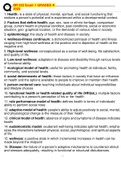
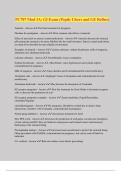
NR 222 Exam 1 GRADED A 2022
NR 222 Exam 1 GRADED A 2022 1. Health: is a state of physical, mental, spiritual, and social functioning that realizes a person's potential and is experienced within a developmental context. 2. Factors that define health: age, sex, race or ethnic heritage, comparison group, current health or physical condition, past conditions, social or economic situation, geo- graphical location, or the demands of various roles in society. 3. epidemiology: the study of health and disease in society 4. wellness-illness continuum: a dichotomized portrayal of health and illness ranging from high-level wellness at the positive end to depletion of health at the negative end. 5. High-level wellness: conceptualized as a sense of well-being, life satisfaction, and quality of life. 6. Low-level wellness: adaptation to disease and disability through various levels of functional ability. 7. ecological model of health: useful for promoting health at individual, family, community, and societal levels. 8. social determnants of health: those factors in society that have an influence on health and the options available to people to improve or maintain their health. 9. person-centered care: teaching individuals about individual responsibilities and lifestyle choices 10. functional health or health-related quality of life (HRQoL): multiple factors contributing to a person's perception of his or her health 11. role performance model of health: defines health in terms of individuals' ability to perform social roles 12. adaptive model of health: people's ability to adjust positively to social, mental, and physiological change is the measure of their health 13. clinical model of health: absence of signs and symptoms of disease indicates health 14. eudaimonistic model: exuberant well-being indicates optimal health. empha- sizes the interactions between physical, social, psychological, and spiritual aspects of life 15. wellness: a positive state in which incremental increases in health can be made beyond the midpoint 16. Disease: the failure of a person's adaptive mechanisms to counteract stimuli and stresses adequately, resulting in functional or structural disturbances. 17. Healthy People 2020 goals: -Attain high quality, longer lives free of pre- ventable disease, disability, injury, and premature death. -Achieve health equity, eliminate disparities, and improve the health of all groups. -Create social and physical environments that promote good health for all. -Promote quality of life, healthy development, and healthy behaviors across all life stages 18. ethnocentrism: to assume that an individual's own perspective is correct and shared by others 19. racism: a devaluing of the beliefs, values, and customs of others 20. levels of prevention: primary, secondary, and tertiary 21. Primary prevention: -precedes disease or dysfunction -a process or behavior toward enhancing health 22. specific protection: such as immunization against a specific disease 23. health promotion: the process of advocating health to enhance the probability that personal, private (professional and business), and public support of positive health practices will become a societal norm 24. The transtheoretical model: 25. . Secondary prevention: providing screening activities and treating early stages of disease to limiting disability by averting or delaying the consequences of advanced disease. 26. Tertiary prevention: - when a defect or disability is permanent and irreversible. - involves minimizing the effects of disease and disability 27. community-based car
Escuela, estudio y materia
- Institución
- NR 222
- Grado
- NR 222
Información del documento
- Subido en
- 24 de octubre de 2022
- Número de páginas
- 8
- Escrito en
- 2022/2023
- Tipo
- Examen
- Contiene
- Preguntas y respuestas
Temas
-
nr 222 exam 1 graded a
-
nr 222 exam 1
-
nr 222 final exam
-
nr 222 exam 1 graded a 2022
-
nr
-
health
-
factors that define health

Documento también disponible en un lote