Summary Corporate Finance
Lecture 1 (05-09-22)
Introduction to Corporate Finance
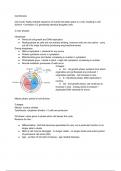
Accounting: Finance:
- Records the past - Discounting future cash flows
- Works with real amounts - Works with forecasts
What is corporate finance?
Investment:
- What long-term investments will you make?
Financing:
- Where will you get long-term financing for your long-term projects?
Working:
- How will you manage your everyday activities?
The financial manager:
Capital budgeting: Responsible for investment decisions
Capital structure: Responsible for financing decisions
Working capital management: Responsible for short-term financial planning
They all oversee accounting and audit function in firm. Ensure the financial welfare of
the firm.
Financial goals:
- Profitability
- Liquidity
- Security
- Independence
The goal of financial management is to manage risk, maximize share prize, and
avoid financial distress maximize shareholder (stakeholder value)
Primary vs. secondary markets:
Primary markets:
- Securities are sold to investors
- Money that is raised goes to issuing firm
- First share issue is called an Initial Public Offering
- Second share issue is called a seasoned offering
Secondary markets:
- Investors trade securities with each other
- Money that is raised goes to seller of securities
- Share prices
The annual report:
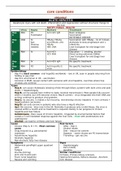
Statement of financial position:
- The balance sheet equation: assets = liabilities + equity
- Net working capital is the difference between current assets and current
liabilities
, - It is important to ensure that net working capital is positive
- Positive net working capital means that enough cash will be available to pay
off liabilities arising
- Book value: based on accounting figures drawn from accounting standards
- Market value: based on prices or market valuations
Income statement:
- Average tax rates: percentage of income that is paid in taxes
- Tax bill divided by your taxable income
- Marginal tax rate: the tax you would pay if you earnt one more unit of
currency
Statement of cash flows:
- Often most important item to take from financial statements
- Total cash flow comes from: operating activities, investing activities,
financing activities
- Cash flow does not equal working capital
- Working capital is a snapshot, cash flow is the earning (ability) over a period
of time
- Cash flow does not equal profit
- Depreciation decreases profit but not the cash flow
Lecture 2 (07-09-22)
Financial statement analysis
Ratio analysis: it is important to be able to analyse a firm’s financial statements and
compare them to other firms
- Profitability ratios
- Market value ratios
- Liquidity ratios (short/long term)
- Financial leverage ratio
- Turnover ratio
Profitability ratios:
Profit margin = net income / sales operating efficiency
Return on asset = net income / total assets asset use efficiency
Return on equity = net income / total equity equity efficiency
Financial leverage:
Debt-equity ratio = debt / equity
Total debt ratio = debt / (equity + debt) = debt / total assets
Equity multiplier = total assets / equity
Market value ratios:
EPS (earnings per share) = net income / shares outstanding
PE (price/earnings) ratio = price per share / EPS
, The Du Pont identity (long form):
ROE = return on equity
ROE is affected by:
- Operating efficiency
- Asset use efficiency
- Financial leverage
The Du Pont identity (short form):
ROE = ROA (return on assets) x assets / equity
The time value of money
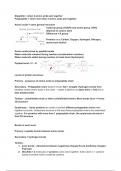
Future value and compounding:
- Future value (FV) the amount an investment is worth after one or more
periods
- Time convention: we are at the end of year 0, next year is end of year 1
Investing for more than one period:
Vt(time) = V0 (1 + r) t
Vt = value after t periods
R = interest rate
Principle: original amount invested
Simple interest: interest earned only on the original principal amount invested
interest made on the original investment
Compound interest: interest earned on both the principal and the interest reinvested
from prior periods
Lecture 1 (05-09-22)
Introduction to Corporate Finance
Accounting: Finance:
- Records the past - Discounting future cash flows
- Works with real amounts - Works with forecasts
What is corporate finance?
Investment:
- What long-term investments will you make?
Financing:
- Where will you get long-term financing for your long-term projects?
Working:
- How will you manage your everyday activities?
The financial manager:
Capital budgeting: Responsible for investment decisions
Capital structure: Responsible for financing decisions
Working capital management: Responsible for short-term financial planning
They all oversee accounting and audit function in firm. Ensure the financial welfare of
the firm.
Financial goals:
- Profitability
- Liquidity
- Security
- Independence
The goal of financial management is to manage risk, maximize share prize, and
avoid financial distress maximize shareholder (stakeholder value)
Primary vs. secondary markets:
Primary markets:
- Securities are sold to investors
- Money that is raised goes to issuing firm
- First share issue is called an Initial Public Offering
- Second share issue is called a seasoned offering
Secondary markets:
- Investors trade securities with each other
- Money that is raised goes to seller of securities
- Share prices
The annual report:
Statement of financial position:
- The balance sheet equation: assets = liabilities + equity
- Net working capital is the difference between current assets and current
liabilities
, - It is important to ensure that net working capital is positive
- Positive net working capital means that enough cash will be available to pay
off liabilities arising
- Book value: based on accounting figures drawn from accounting standards
- Market value: based on prices or market valuations
Income statement:
- Average tax rates: percentage of income that is paid in taxes
- Tax bill divided by your taxable income
- Marginal tax rate: the tax you would pay if you earnt one more unit of
currency
Statement of cash flows:
- Often most important item to take from financial statements
- Total cash flow comes from: operating activities, investing activities,
financing activities
- Cash flow does not equal working capital
- Working capital is a snapshot, cash flow is the earning (ability) over a period
of time
- Cash flow does not equal profit
- Depreciation decreases profit but not the cash flow
Lecture 2 (07-09-22)
Financial statement analysis
Ratio analysis: it is important to be able to analyse a firm’s financial statements and
compare them to other firms
- Profitability ratios
- Market value ratios
- Liquidity ratios (short/long term)
- Financial leverage ratio
- Turnover ratio
Profitability ratios:
Profit margin = net income / sales operating efficiency
Return on asset = net income / total assets asset use efficiency
Return on equity = net income / total equity equity efficiency
Financial leverage:
Debt-equity ratio = debt / equity
Total debt ratio = debt / (equity + debt) = debt / total assets
Equity multiplier = total assets / equity
Market value ratios:
EPS (earnings per share) = net income / shares outstanding
PE (price/earnings) ratio = price per share / EPS
, The Du Pont identity (long form):
ROE = return on equity
ROE is affected by:
- Operating efficiency
- Asset use efficiency
- Financial leverage
The Du Pont identity (short form):
ROE = ROA (return on assets) x assets / equity
The time value of money
Future value and compounding:
- Future value (FV) the amount an investment is worth after one or more
periods
- Time convention: we are at the end of year 0, next year is end of year 1
Investing for more than one period:
Vt(time) = V0 (1 + r) t
Vt = value after t periods
R = interest rate
Principle: original amount invested
Simple interest: interest earned only on the original principal amount invested
interest made on the original investment
Compound interest: interest earned on both the principal and the interest reinvested
from prior periods