Week 4 – Consumer Decision-Making
Guest Lecture: The Value of Psychology – Mischa Coster
Human behavior
Dual Process Theory – Thinking Fast and Slow
• System 1: Fast thinking (quick, effortless, automatic, available)
o 95-99% of the time
• System 2: Slow thinking (slow, rational, deliberate)
• System 2 can override and
correct system 2 if there is
enough cognitive resources and
if additional information is
available
• When people become aware of
a heuristic, they correct their
judgment and can even
overcorrect.
Authority – White Coat
Someone who you consider to be more knowledgeable than you are yourself
Masses
Especially when you identify with them
Biases & Heuristics
• Biases: Thinking errors (but they also serve a purpose)
• Heuristics: Shortcuts
• Noise: Environmental, unpredictable things that happen and influence behavior
Priming
Semantic Priming
Activating a certain mindset that is beneficial for a stimulus/request that you’re making right
after it.
• Example: “Do you consider yourself to be a helpful person?” (29%-->77%
compliance)
Visual Priming
Example: Changing background on a
website (enhancing a comfort
mindset vs. money mindset).
,Anchoring
Giving the target group a reference point (anchor) in their head prior to decision making.
E.g., price
Anchoring: Decoy Effect / Asymmetrical comparison effect
vs.
Persuasion
Social Proof
When in doubt, we look at what (similar) others are doing.
Gaze Cueing
Authority
People tend to follow the lead of a legitimate expert.
,Symbols of authority
- Expensive stuff (e.g., watches, cars, suits, etc.)
- Logos on websites (e.g., Visa, PayPal, DHL, etc.)
Evoking Freedom
A technique that uses our desire to be autonomous by evoking freedom/giving a choice (but
don’t name the alternatives). à Results in more trust and likeability. à Makes people more
inclined to accept your request.
Soft Persuasion
- Status quo bias: We are inclined to interpret any change from the current situation
as a loss.
- Zero risk bias: We are inclined to minimize risk even if there would be more to gain
by taking a bigger risk.
- Reactance bias: When we feel our choices are being limited or we are being
influenced, we develop reactance/resistance.
Persuading (how can we get them to show this behavior?)
VS.
Catalyzing (why aren’t they already doing this by themselves)
The Catalyst – How to change anyone’s mind (Book)
Reactance: Present choices. But: should be limited
Endowment: Show the cost of inaction
Distance: Try to get small sequential commitments (foot-in-the door / baby steps)
Uncertainty: Minimize risk. (Freemium, trial, fee shipping & easy returning of goods.)
Corroborating Evidence: Social proof. Provide proof. Show that similar others have also
done it. Use various reference groups. (Provide proof so that they can make a decision.)
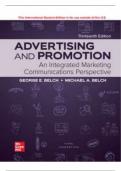
, Chapter 4: Perspectives on Consumer Behavior (Belch & Belch)
Consumer behavior can be defined as the process and activities people engage in when
searching for, selecting, purchasing, using, evaluating, and disposing of products and
services to satisfy their needs and desires.
CONSUMER DECISION-MAKING PROCESS
• Problem/Need recognition
o Occurs when the consumer perceives a need and becomes motivated to
solve the problem.
o Caused by a difference between the consumer’s ideal state and actual state
o Sources of problem recognition:
§ Out of Stock
§ Dissatisfaction
§ New Needs/Wants
§ Related Products/Purchases
§ Marketer-Induced Problem Recognition
§ New Products
o Examining consumer motivations
§ Hierarchy of needs
§ Psychoanalytic Theory
Those who attempt to relate psychoanalytic theory to consumer
behavior believe consumers’ motivations for purchasing are often
very complex and unclear to the casual observer—and to the
consumers themselves. Many motives for purchase and/ or
consumption may be driven by deep motives one can determine only
by probing the subconscious.
§ Motivation research in marketing
• In-depth interviews
• Projective techniques: Efforts designed to gain insights into
consumers’ values, motives, attitudes, or needs that are
difficult to express or identify by having them project these
internal states upon some external object.
• Association tests
Guest Lecture: The Value of Psychology – Mischa Coster
Human behavior
Dual Process Theory – Thinking Fast and Slow
• System 1: Fast thinking (quick, effortless, automatic, available)
o 95-99% of the time
• System 2: Slow thinking (slow, rational, deliberate)
• System 2 can override and
correct system 2 if there is
enough cognitive resources and
if additional information is
available
• When people become aware of
a heuristic, they correct their
judgment and can even
overcorrect.
Authority – White Coat
Someone who you consider to be more knowledgeable than you are yourself
Masses
Especially when you identify with them
Biases & Heuristics
• Biases: Thinking errors (but they also serve a purpose)
• Heuristics: Shortcuts
• Noise: Environmental, unpredictable things that happen and influence behavior
Priming
Semantic Priming
Activating a certain mindset that is beneficial for a stimulus/request that you’re making right
after it.
• Example: “Do you consider yourself to be a helpful person?” (29%-->77%
compliance)
Visual Priming
Example: Changing background on a
website (enhancing a comfort
mindset vs. money mindset).
,Anchoring
Giving the target group a reference point (anchor) in their head prior to decision making.
E.g., price
Anchoring: Decoy Effect / Asymmetrical comparison effect
vs.
Persuasion
Social Proof
When in doubt, we look at what (similar) others are doing.
Gaze Cueing
Authority
People tend to follow the lead of a legitimate expert.
,Symbols of authority
- Expensive stuff (e.g., watches, cars, suits, etc.)
- Logos on websites (e.g., Visa, PayPal, DHL, etc.)
Evoking Freedom
A technique that uses our desire to be autonomous by evoking freedom/giving a choice (but
don’t name the alternatives). à Results in more trust and likeability. à Makes people more
inclined to accept your request.
Soft Persuasion
- Status quo bias: We are inclined to interpret any change from the current situation
as a loss.
- Zero risk bias: We are inclined to minimize risk even if there would be more to gain
by taking a bigger risk.
- Reactance bias: When we feel our choices are being limited or we are being
influenced, we develop reactance/resistance.
Persuading (how can we get them to show this behavior?)
VS.
Catalyzing (why aren’t they already doing this by themselves)
The Catalyst – How to change anyone’s mind (Book)
Reactance: Present choices. But: should be limited
Endowment: Show the cost of inaction
Distance: Try to get small sequential commitments (foot-in-the door / baby steps)
Uncertainty: Minimize risk. (Freemium, trial, fee shipping & easy returning of goods.)
Corroborating Evidence: Social proof. Provide proof. Show that similar others have also
done it. Use various reference groups. (Provide proof so that they can make a decision.)
, Chapter 4: Perspectives on Consumer Behavior (Belch & Belch)
Consumer behavior can be defined as the process and activities people engage in when
searching for, selecting, purchasing, using, evaluating, and disposing of products and
services to satisfy their needs and desires.
CONSUMER DECISION-MAKING PROCESS
• Problem/Need recognition
o Occurs when the consumer perceives a need and becomes motivated to
solve the problem.
o Caused by a difference between the consumer’s ideal state and actual state
o Sources of problem recognition:
§ Out of Stock
§ Dissatisfaction
§ New Needs/Wants
§ Related Products/Purchases
§ Marketer-Induced Problem Recognition
§ New Products
o Examining consumer motivations
§ Hierarchy of needs
§ Psychoanalytic Theory
Those who attempt to relate psychoanalytic theory to consumer
behavior believe consumers’ motivations for purchasing are often
very complex and unclear to the casual observer—and to the
consumers themselves. Many motives for purchase and/ or
consumption may be driven by deep motives one can determine only
by probing the subconscious.
§ Motivation research in marketing
• In-depth interviews
• Projective techniques: Efforts designed to gain insights into
consumers’ values, motives, attitudes, or needs that are
difficult to express or identify by having them project these
internal states upon some external object.
• Association tests