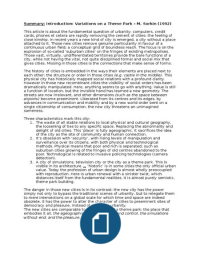
Summary: Introduction: Variations on a Theme Park – M. Sorkin (1992)
This article is about the fundamental question of urbanity: computers, credit
cards, phones et cetera are rapidly removing the cement of cities: the feeling of
close kinship. In recent years a new kind of city is emerged, a city without a place
attached to it. Those new cities remove genuine particularity in favour of a
continuous urban field; a conceptual grid of boundless reach. The focus is on the
explosion of so-called ‘suburban cities’ on the fringes of existing metropolises.
Those vast, virtually, undifferentiated territories provide the bare functions of a
city, while not having the vital, not quite disciplined formal and social mix that
gives cities. Missing in those cities is the connections that make sense of forms.
The history of cities is embedded in the ways their elements are placed next to
each other; the structure or order in those cities (e.g. castle in the middle). This
physical city has historically mapped social relations with a profound clarity.
However in those new recombinant cities the visibility of social orders has been
dramatically manipulated. Here, anything seems to go with anything. Value is still
a function of location, but the invisible hand has learned a new geometry. The
streets are now irrelevant, and other dimensions (such as the space between
airports) become preeminent. Liberated from its centres and its edges, by
advances in communication and mobility and by a new world order bent on a
single citizenship of consumption, the new city threatens an unimagined
sameness.
Three characteristics mark this city:
1. The waste of all stable relations to local physical and cultural geography,
the loosening of ties to any specific space. Replacing the abnormality and
delight of old cities. This ‘place’ is fully ageographic. It sacrifices the idea
of the city as the site of community and human connection.
2. It’s obsession with ‘security’, with rising levels of manipulation and
surveillance over its citizens, with both physical and technological
methods. Physical means that poor and rich is separated; such as
suburban cities growing of the fringes of old centres abandoned to the
poor. Technological is related to invasive policing technologies (camera
detection).
3. A city of simulations, television city or the city as a theme park. This is
visible in its architecture ‘historic’ is in some cities the only official urban
value. Today the profession of urban design is almost wholly preoccupied
with reproduction. Here is urban renewal with a sinister twist, which
distances itself from the fundamental realities. It is almost purely semiotic,
theme park building.
The danger in those new cities is in its contrast: the new city has the power
simply not only to bypass the traditional scenes of urbanity, but to relegate them
to mere intersections on a global scale for which time and space are indeed
obsolete. It has the power to alter the character of cities to preeminent sites of
democracy and pleasure, instead of authentic urbanity.
The new cities are comparable to the meaning of a theme park: the place that
embodies it all, the ageographia, the surveillance and control, the simulations
without end, and the pleasure.
This article is about the fundamental question of urbanity: computers, credit
cards, phones et cetera are rapidly removing the cement of cities: the feeling of
close kinship. In recent years a new kind of city is emerged, a city without a place
attached to it. Those new cities remove genuine particularity in favour of a
continuous urban field; a conceptual grid of boundless reach. The focus is on the
explosion of so-called ‘suburban cities’ on the fringes of existing metropolises.
Those vast, virtually, undifferentiated territories provide the bare functions of a
city, while not having the vital, not quite disciplined formal and social mix that
gives cities. Missing in those cities is the connections that make sense of forms.
The history of cities is embedded in the ways their elements are placed next to
each other; the structure or order in those cities (e.g. castle in the middle). This
physical city has historically mapped social relations with a profound clarity.
However in those new recombinant cities the visibility of social orders has been
dramatically manipulated. Here, anything seems to go with anything. Value is still
a function of location, but the invisible hand has learned a new geometry. The
streets are now irrelevant, and other dimensions (such as the space between
airports) become preeminent. Liberated from its centres and its edges, by
advances in communication and mobility and by a new world order bent on a
single citizenship of consumption, the new city threatens an unimagined
sameness.
Three characteristics mark this city:
1. The waste of all stable relations to local physical and cultural geography,
the loosening of ties to any specific space. Replacing the abnormality and
delight of old cities. This ‘place’ is fully ageographic. It sacrifices the idea
of the city as the site of community and human connection.
2. It’s obsession with ‘security’, with rising levels of manipulation and
surveillance over its citizens, with both physical and technological
methods. Physical means that poor and rich is separated; such as
suburban cities growing of the fringes of old centres abandoned to the
poor. Technological is related to invasive policing technologies (camera
detection).
3. A city of simulations, television city or the city as a theme park. This is
visible in its architecture ‘historic’ is in some cities the only official urban
value. Today the profession of urban design is almost wholly preoccupied
with reproduction. Here is urban renewal with a sinister twist, which
distances itself from the fundamental realities. It is almost purely semiotic,
theme park building.
The danger in those new cities is in its contrast: the new city has the power
simply not only to bypass the traditional scenes of urbanity, but to relegate them
to mere intersections on a global scale for which time and space are indeed
obsolete. It has the power to alter the character of cities to preeminent sites of
democracy and pleasure, instead of authentic urbanity.
The new cities are comparable to the meaning of a theme park: the place that
embodies it all, the ageographia, the surveillance and control, the simulations
without end, and the pleasure.