Understanding Psychopathology notes
College 1: “Nothing more practical than a good theory”
Learning objectives: shortly describing what you are expected to have learned after reading the
literature. First look at the learning objectives, after you’ve read it, read the article.
Examination
6 essay questions. Each of the essay question has two levels, a and b. It covers all the relevant
perspecitves. The focus is not on knowledge perse, it’s more about understanding the mechanisms.
And to apply the knowledge on potentially new situations.
For example: 1a. explain why exposure in vivo could be effective as a treatment for bulimia nervosa.
For example: 1b. explain why the efficacy of exposure exercises might by very limited when only
carried out in the clinic.
THEORIES AND PSYCHOPATHOLOGY
Theories as starting point
Why are theories important/helpful?
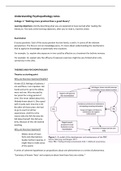
Kirsten (32): feelings of sadness; I
am worthless; I am repulsive. Her
hands and arms up to the elbow
were red raw. Was misused by
her priest for a long period of
time. She never talked about this.
Nobody knew about it. She coped
with it quite well, now she is 32.
But after all those years she had
to go to court to tell her
experiences. And this is the
reason why she felt the way she
felt about herself. She felt very
dirty. Because of this she started
washing.
Why are theories important?
- Makes sense of loose
facts and observations.
- Guides further inquiries. It
might help to make sense
of the world.
A series of coherent hypotheses or propositions about one phenomenon or a series of phenomena.
“Summary of known ‘facts’ and conjecture about how these facts are relates.”
, - About everything (all)
- Psychopathology
- Certain disorders
- Certain aspects/features of disorder.
Making sense of loose facts and observations.
- Understanding the origin of psychopathology.
o Predict who and under what type of conditions (prevention).
- Understanding factors involved in persistence of psychopathology.
o Predict for whom and under what conditions symptoms will or will not persist
(intervention).
We should do something about the feelings of
disgust.
- Cognitive restructuring: correct
dysfunctional appraisals FBC.
- Imagery modification: create effective
competing memory representations.
Some clients were told that your body cells renew
every something a year, so they know that none of their current cells have been in contact with the
perpetrator. They needed a presentation in their head to present this idea of a new skin, e.g.,
stepping out of a diving suit.
“Nothing so practical as a good theory” – Kurt Lewin
A fool can propose more theories than 10 scholars can test in their entire life – Barendregt.
But what are the criteria/characteristics of a “good” theory?
Necessary/desirable features:
External criteria:
- Is consistent with known facts (summary).
- Testable/falsifiable. There need to be a reasonable way that it can be tested and can be
falsified.
- Tested and showed predictive validity.
Internal criteria:
- Internally consistent (no conflicting predictions).
- As simple as possible (parsimony).
- The fewer the number of assumptions the better, because the assumptions are not put to
the test. → Occam’s razor.
,Many different theories in psychopathology
- Complementary (additional):
o Social anxiety disorder
▪ Genetic disorder (behavioural inhibition): people are afraid of certain things.
A potential bigger risk of being afraid in social situations.
▪ Developmental psychological theory (e.g., attachment). You may have failed
to develop a secure attachment, that’s why you act in the wrong way.
▪ Associative learning theory: they were bullied, and that’s why they act in a
certain way. You have a particular view of social interactions.
- “Convertible”:
o Gen x development x learning experiences
- Incompatible? Only one can be the best!
o The case of Panic Disorder.
Panic attack
- Dizziness
- Depersonalization
- Weakness
- Paraesthesia’s
- Shaking/trembling
- Pounding heart
- Breathlessness
- Chest pain
- Gasping for breath
- Transpiration
- Fear of dying
- Fear of going crazy
Psychiatric ‘theory’
CO2 increase rat brain → hyperarousal Locus Coeruleus.
Hyperarousal LC → panic symptoms?
Panic disorder is caused by neurophysiological defect that renders people hypersensitive for increase
in CO2 levels.
How can this theory be tested?
You can induce CO2 levels in people with panic disorder and in people without panic
disorder. The people with panic disorder should panic after this, and the control
group shouldn’t panic, because the people with panic disorder are hypersensitive.
You see in the results that the people with a panic disorder do have hypersensitivity
and that panic disorder is a biological disease. Now they started ‘conceptual
replications’.
, Instead of lactate they used CO2. This really mimics the symptoms of a person with a panic attack.
From this test the same results were found, that the panic disorder people started panicking and the
others didn’t.
Suffocation – alarm theory (Donald Klein): why do I get panic attacks in my sleep? Because
sometimes you start suffocating in your sleep, so you CO2 levels rise, which cause the panic attack.
Hyperventilation (Helen Hornsveld): symptoms
- Dizziness
- Depersonalisation
- Weakness
- Paraesthesia’s
- Shaking/trembling
- Pounding heart
- Breathlessness
- A-typical pain in chest
- Anxiety
Very panic attack like symptoms. When you hyperventilate your CO2 levels drop, because you get
more O2.
So, lowering CO2 → panic attack.
Exit Carr’s Klein theory: when you hyperventilate use a sandwich bag, because you breath more, but
because you’re doing it in the bag you keep your CO2 levels at the same level.
Lowering CO2 → PA, thus PA elicited by hyperventilation?
A leads to B, so, B leads to A?
“Good treatment results in recovery. Patient recovered. Thus, it was a good treatment.” Maybe it
wasn’t the treatment that made the patient recover. And often people only seek help when they’re
really at their maximum of symptoms, so it will only get lower. So, this is not a valid argument the “A
leads to B, so, B leads to A.”
Hyperventilation theory of panic attacks
Reducing CO2 → PA: therefore PA due to hyperventilation?
Next step: is indeed in naturalistic contexts PA accompanied by reduction in CO2 level?
Ambulant assessment (Hornseld & Garsen): “Goodbye to the hyperventilation explanation of PD.”
There was no relations whatsoever between CO2 levels and panic attacks.
Psychiatric CO2 – theory: effective intervention via clonidine (LC inhibition)
Hyperventilation – theory: effective ‘bag’ intervention.
Both predictive value, but:
1. Incompatible.
2. No optimal summary of available data.
College 1: “Nothing more practical than a good theory”
Learning objectives: shortly describing what you are expected to have learned after reading the
literature. First look at the learning objectives, after you’ve read it, read the article.
Examination
6 essay questions. Each of the essay question has two levels, a and b. It covers all the relevant
perspecitves. The focus is not on knowledge perse, it’s more about understanding the mechanisms.
And to apply the knowledge on potentially new situations.
For example: 1a. explain why exposure in vivo could be effective as a treatment for bulimia nervosa.
For example: 1b. explain why the efficacy of exposure exercises might by very limited when only
carried out in the clinic.
THEORIES AND PSYCHOPATHOLOGY
Theories as starting point
Why are theories important/helpful?
Kirsten (32): feelings of sadness; I
am worthless; I am repulsive. Her
hands and arms up to the elbow
were red raw. Was misused by
her priest for a long period of
time. She never talked about this.
Nobody knew about it. She coped
with it quite well, now she is 32.
But after all those years she had
to go to court to tell her
experiences. And this is the
reason why she felt the way she
felt about herself. She felt very
dirty. Because of this she started
washing.
Why are theories important?
- Makes sense of loose
facts and observations.
- Guides further inquiries. It
might help to make sense
of the world.
A series of coherent hypotheses or propositions about one phenomenon or a series of phenomena.
“Summary of known ‘facts’ and conjecture about how these facts are relates.”
, - About everything (all)
- Psychopathology
- Certain disorders
- Certain aspects/features of disorder.
Making sense of loose facts and observations.
- Understanding the origin of psychopathology.
o Predict who and under what type of conditions (prevention).
- Understanding factors involved in persistence of psychopathology.
o Predict for whom and under what conditions symptoms will or will not persist
(intervention).
We should do something about the feelings of
disgust.
- Cognitive restructuring: correct
dysfunctional appraisals FBC.
- Imagery modification: create effective
competing memory representations.
Some clients were told that your body cells renew
every something a year, so they know that none of their current cells have been in contact with the
perpetrator. They needed a presentation in their head to present this idea of a new skin, e.g.,
stepping out of a diving suit.
“Nothing so practical as a good theory” – Kurt Lewin
A fool can propose more theories than 10 scholars can test in their entire life – Barendregt.
But what are the criteria/characteristics of a “good” theory?
Necessary/desirable features:
External criteria:
- Is consistent with known facts (summary).
- Testable/falsifiable. There need to be a reasonable way that it can be tested and can be
falsified.
- Tested and showed predictive validity.
Internal criteria:
- Internally consistent (no conflicting predictions).
- As simple as possible (parsimony).
- The fewer the number of assumptions the better, because the assumptions are not put to
the test. → Occam’s razor.
,Many different theories in psychopathology
- Complementary (additional):
o Social anxiety disorder
▪ Genetic disorder (behavioural inhibition): people are afraid of certain things.
A potential bigger risk of being afraid in social situations.
▪ Developmental psychological theory (e.g., attachment). You may have failed
to develop a secure attachment, that’s why you act in the wrong way.
▪ Associative learning theory: they were bullied, and that’s why they act in a
certain way. You have a particular view of social interactions.
- “Convertible”:
o Gen x development x learning experiences
- Incompatible? Only one can be the best!
o The case of Panic Disorder.
Panic attack
- Dizziness
- Depersonalization
- Weakness
- Paraesthesia’s
- Shaking/trembling
- Pounding heart
- Breathlessness
- Chest pain
- Gasping for breath
- Transpiration
- Fear of dying
- Fear of going crazy
Psychiatric ‘theory’
CO2 increase rat brain → hyperarousal Locus Coeruleus.
Hyperarousal LC → panic symptoms?
Panic disorder is caused by neurophysiological defect that renders people hypersensitive for increase
in CO2 levels.
How can this theory be tested?
You can induce CO2 levels in people with panic disorder and in people without panic
disorder. The people with panic disorder should panic after this, and the control
group shouldn’t panic, because the people with panic disorder are hypersensitive.
You see in the results that the people with a panic disorder do have hypersensitivity
and that panic disorder is a biological disease. Now they started ‘conceptual
replications’.
, Instead of lactate they used CO2. This really mimics the symptoms of a person with a panic attack.
From this test the same results were found, that the panic disorder people started panicking and the
others didn’t.
Suffocation – alarm theory (Donald Klein): why do I get panic attacks in my sleep? Because
sometimes you start suffocating in your sleep, so you CO2 levels rise, which cause the panic attack.
Hyperventilation (Helen Hornsveld): symptoms
- Dizziness
- Depersonalisation
- Weakness
- Paraesthesia’s
- Shaking/trembling
- Pounding heart
- Breathlessness
- A-typical pain in chest
- Anxiety
Very panic attack like symptoms. When you hyperventilate your CO2 levels drop, because you get
more O2.
So, lowering CO2 → panic attack.
Exit Carr’s Klein theory: when you hyperventilate use a sandwich bag, because you breath more, but
because you’re doing it in the bag you keep your CO2 levels at the same level.
Lowering CO2 → PA, thus PA elicited by hyperventilation?
A leads to B, so, B leads to A?
“Good treatment results in recovery. Patient recovered. Thus, it was a good treatment.” Maybe it
wasn’t the treatment that made the patient recover. And often people only seek help when they’re
really at their maximum of symptoms, so it will only get lower. So, this is not a valid argument the “A
leads to B, so, B leads to A.”
Hyperventilation theory of panic attacks
Reducing CO2 → PA: therefore PA due to hyperventilation?
Next step: is indeed in naturalistic contexts PA accompanied by reduction in CO2 level?
Ambulant assessment (Hornseld & Garsen): “Goodbye to the hyperventilation explanation of PD.”
There was no relations whatsoever between CO2 levels and panic attacks.
Psychiatric CO2 – theory: effective intervention via clonidine (LC inhibition)
Hyperventilation – theory: effective ‘bag’ intervention.
Both predictive value, but:
1. Incompatible.
2. No optimal summary of available data.