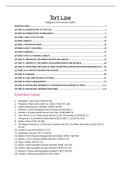
Tort Law
Negligence and Vicarious Liability
ESSENTIAL CASES.......................................................................................................................................... 1
LECTURE 1A: INTRODUCTION TO TORT LAW.................................................................................................. 2
LECTURE 1B: INTRODUCTION TO NEGLIGENCE............................................................................................... 6
LECTURES 2 AND 3: DUTY OF CARE.............................................................................................................. 12
LECTURE 4: BREACH.................................................................................................................................... 18
LECTURE 5: PSYCHIATRIC HARM.................................................................................................................. 26
LECTURES 6 AND 7: CAUSATION.................................................................................................................. 34
LECTURE 8: DEFENCES................................................................................................................................. 45
LECTURES 9 AND 10: VICARIOUS LIABILITY................................................................................................... 51
LECTURE 11: TRESPASS TO THE PERSON: BATTERY AND ASSAULT................................................................61
LECTURE 12: TRESPASS TO THE PERSON: FALSE IMPRISONMENT AND DEFENCES.........................................64
LECTURE 13: INTENTIONAL INFLICTION OF HARM OR DISTRESS & PROTECTION FROM HARASSMENT ACT. . .66
LECTURES 14-16: PRIVATE NUISANCE AND RYLANDS...................................................................................70
LECTURE 15: NUISANCE............................................................................................................................... 80
LECTURE 12: LAND TORTS RYLAND V FLETCHER........................................................................................... 87
LECTURE 13: WHAT IS DEFAMATION?.......................................................................................................... 91
LECTURE 14: DEFAMATION, REFERENCE TO THE PUBLICATION & DEFENCE OF TRUTH................................111
LECTURE 15: DEFAMATION, DEFENCES CONCLUDED..................................................................................115
Essential Cases
1. Donoghue v Stevenson [1932] AC 562
2. Meadows v Khan [2021] UKSC 21, [2021] 3 WLR 147, [28]
3. Caparo Industries plc v Dickman [1990] 2 AC 605
4. Robinson v Chief Constable of West Yorkshire [2018] UKSC 4
5. Darnley V Croydon Health Services NHS Trust [2018] UKSC 50
6. Marc Rich & Co AG v Bishop Rock Marine Co Ltd, The Nicholas H [1996] AC 211
7. Montgomery v Lanarkshire Health Board [2015] UKSC 11, [2015] AC 1430
8. Bolton v Stone [1951] AC 850
9. The Wagon Mound (no. 2) (Overseas Tankship (UK) Ltd v The Miller Steamship Co Pty) [1967] 1
AC 617
10. Orchard v Lee [2009] EWCA Civ 295
11. Nettleship v Weston [1971] 2 QB 691
12. Bolam v Friern Hospital Management Committee [1957] 1 WLR 582
13. Bolitho v City & Hackney Health Authority [1998] AC 232
14. Page v Smith [1996] AC 155
15. Alcock v Chief Constable of South Yorkshire [1992] 1 AC 310
16. White v Chief Constable of South Yorkshire [1999] 2 AC 455
17. Barnett v Chelsea and Kensington Hospital [1969] 1 QB 428
18. McGhee v National Coal Board [1973] 1 WLR 1
,19. Fairchild v Glenhaven Funeral Services Ltd [2002] UKHL 22; [2003] 1 AC 32
20. Barker v Corus plc [2006] UKHL 20; [206] 2 AC 572
21. Compensation Act 2006, s 3
22. Sienkiewicz v Greif (UK) Ltd [2011] UKSC 10; 2 WLR 523
23. Hotson v East Berkshire Area Health Authority [1987] AC 50
24. Gregg v Scott [2005] UKHL 2; [2005] 2 AC 176
25. The Wagon Mound (no. 1) (Overseas Tankship (UK) Ltd v Morts Dock & Engineering Co Ltd)
[1961] AC 388
26. Hughes v Lord Advocate [1963] AC 837
27. Jolley v Sutton London BC [2000] 3 All ER 409
28. Smith v Leech Brain & Co Ltd [1962] 2 QB 405
29. McKew v Holland & Hannan & Cubitts (Scotland) Ltd [1969] 3 All ER 1621
30. Jones v Livox Quarries [1952] 2 QB 608
31. Froom v Butcher [1976] QB 286
32. Morris v Murray [1991] 2 QB 6
33. Gray v Thames Trains Ltd [2009] 1 AC 1339
34. Patel v Mirza [2016] UKSC 42
35. Cox v Ministry of Justice [2016] UK SC 10, [2016] AC 660
36. Barclays Bank v Various Claimants [2020] UKSC 13, [2020] AC 973, [24]
37. Maga v Birmingham Roman Catholic Archdiocese Trustees [2010] EWCA Civ 256
38. Various Claimants v Catholic Child Welfare Society [2012] UKSC 56
39. Mohamud v Wm Morrison Supermarkets Plc [2016] UKSC 11
40. Morrisons v Various Claimants [2020] UKSC 12; [2020] AC 989
Lecture 1A: Introduction to Tort Law
What is Tort Law?
‘Tort is that branch of the civil law relating to obligations impose by the operation of law on
all natural and artificial persons. It concerns the basic duties one person owes to another
whether he likes it or not’ (Street on Torts).
‘A system of precepts about how people may, ought and ought not to behave in their
dealings with others’ (Cane, Atiyah’s Accidents, Compensation and the Law, p 13).
The law of civil wrongs
Tort law is concerned with behaviour legally classified as wrong or tortious. The law provides a
remedy to a civil wrong.
The law of obligations
Obligations are the requirements that one acts (or refrain from acting) in a certain way. Much of the
law is concerned with directing conduct in this way - notably criminal law - cf public and private law.
Tort law is concerned with obligations between individuals (PRIVATE not public law which concerns a
relationship with the state).
When does the law impose obligations on us?
, 1. We owe obligations when going about our daily lives to respect other’s interests
2. Where we breach these obligations, the law imposes duties on us to reverse the
consequences of the breach
Examples
Defamation – reputation
Nuisance – enjoyment of land
Assault concerns physical body
Physical injury
Primary obligations
Primary obligations when going about daily lives to protect others – body itegreity, mental health,
property. Breach = tort law and criinal law. Law imposes on us duties to reverse the consequences of
the breach – through compensation (loss) and restittuon (giving up the gains made).
Secondary obligations
There are many torts – 70/80 ish
What interests does tort law protect?
INTEREST TORT
Personal (both physical and mental) integrity Negligence
including the right to self- determination Occupiers’ liability
Employers’ liability
Product liability
Trespass to the person (assault, battery, false
imprisonment)
The rule in Wilkinson v Downton
An action under the Protection from Harassment Act
1997
Nuisance (public)
Damage to Property Negligence
Occupiers’ liability
Product liability
Employers’ liability
Trespass to land
Nuisance (public and private) The rule in Rylands v
Fletcher
Financial loss (pure and consequential) Negligence
Product liability
Defamation (libel and slander) Nuisance (public and
private)
Possession, use and Enjoyment of Land Trespass to land
Nuisance (public and private) The rule in Rylands v
Fletcher Negligence
Claims under the Protection from Harassment Act
1997
Reputation Defamation (libel and slander)
, Breach of Confidence
Privacy Negligence
Trespass to land
Nuisance (public and private) Breach of Confidence
‘Tort’ of Invasion of Privacy Claims under the
Protection from Harassment Act 1997
There are three difficulties with this:
1. Appearance of non-existent neatness (eg negligence)
a. While some torts protect specific types of interests, others are much more general
and, as such, protect a number of interests.
b. Protected interests can be defined in very broad terms. Jenny Steele uses the
example of ‘property interests’:
‘Property interests of different sorts are protected against invasion of different types by
various torts. So negligence protects against damage to property; private nuisance overlaps
with negligence but more broadly protects against interference with use and enjoyment of
land [and]; trespass to land protects against interference with possession of land and need
not involve any diminution in value at all’ p.
2. Not all interferences with an individual’s interests are recognised(e.g. where a tortious
ability is thought to be unreliable) see,
eg, McFarlane v Tayside Health Board [2000])
3. No general principle as to when particular conduct will or will not give rise to liability in tort
– not in itself enough to provide a remedy (compensation)
The disparate aims of tort law
Tort law has both backward- and forward- looking elements. It looks backward at what happened
the ‘wrong’ and addresses the harm done, while also looking to the future and at ways of regulating
behaviour and developing a response to the risk of harm. It seeks to protect an individual’s interests
both prospectively, that is to prevent or deter harm and retrospectively through the provision of
compensation and the distribution of losses. Thus, tort law has a number of disparate functions or
purposes typically identified under the following headings:
(corrective)justice
Compensation
Deterrence
Inquiry and/or publicity.
(Corrective) Justice
Tort law here is about establishing and applying appropriate principles of justice as to whether
someone should be required to correct for their wrongs: ‘to define cases in which the law may justly
hold one party liable to compensate another’ Lord
Bingham, Fairchild v Glenhaven Funeral Services
[2002] UKHL 22).
Negligence and Vicarious Liability
ESSENTIAL CASES.......................................................................................................................................... 1
LECTURE 1A: INTRODUCTION TO TORT LAW.................................................................................................. 2
LECTURE 1B: INTRODUCTION TO NEGLIGENCE............................................................................................... 6
LECTURES 2 AND 3: DUTY OF CARE.............................................................................................................. 12
LECTURE 4: BREACH.................................................................................................................................... 18
LECTURE 5: PSYCHIATRIC HARM.................................................................................................................. 26
LECTURES 6 AND 7: CAUSATION.................................................................................................................. 34
LECTURE 8: DEFENCES................................................................................................................................. 45
LECTURES 9 AND 10: VICARIOUS LIABILITY................................................................................................... 51
LECTURE 11: TRESPASS TO THE PERSON: BATTERY AND ASSAULT................................................................61
LECTURE 12: TRESPASS TO THE PERSON: FALSE IMPRISONMENT AND DEFENCES.........................................64
LECTURE 13: INTENTIONAL INFLICTION OF HARM OR DISTRESS & PROTECTION FROM HARASSMENT ACT. . .66
LECTURES 14-16: PRIVATE NUISANCE AND RYLANDS...................................................................................70
LECTURE 15: NUISANCE............................................................................................................................... 80
LECTURE 12: LAND TORTS RYLAND V FLETCHER........................................................................................... 87
LECTURE 13: WHAT IS DEFAMATION?.......................................................................................................... 91
LECTURE 14: DEFAMATION, REFERENCE TO THE PUBLICATION & DEFENCE OF TRUTH................................111
LECTURE 15: DEFAMATION, DEFENCES CONCLUDED..................................................................................115
Essential Cases
1. Donoghue v Stevenson [1932] AC 562
2. Meadows v Khan [2021] UKSC 21, [2021] 3 WLR 147, [28]
3. Caparo Industries plc v Dickman [1990] 2 AC 605
4. Robinson v Chief Constable of West Yorkshire [2018] UKSC 4
5. Darnley V Croydon Health Services NHS Trust [2018] UKSC 50
6. Marc Rich & Co AG v Bishop Rock Marine Co Ltd, The Nicholas H [1996] AC 211
7. Montgomery v Lanarkshire Health Board [2015] UKSC 11, [2015] AC 1430
8. Bolton v Stone [1951] AC 850
9. The Wagon Mound (no. 2) (Overseas Tankship (UK) Ltd v The Miller Steamship Co Pty) [1967] 1
AC 617
10. Orchard v Lee [2009] EWCA Civ 295
11. Nettleship v Weston [1971] 2 QB 691
12. Bolam v Friern Hospital Management Committee [1957] 1 WLR 582
13. Bolitho v City & Hackney Health Authority [1998] AC 232
14. Page v Smith [1996] AC 155
15. Alcock v Chief Constable of South Yorkshire [1992] 1 AC 310
16. White v Chief Constable of South Yorkshire [1999] 2 AC 455
17. Barnett v Chelsea and Kensington Hospital [1969] 1 QB 428
18. McGhee v National Coal Board [1973] 1 WLR 1
,19. Fairchild v Glenhaven Funeral Services Ltd [2002] UKHL 22; [2003] 1 AC 32
20. Barker v Corus plc [2006] UKHL 20; [206] 2 AC 572
21. Compensation Act 2006, s 3
22. Sienkiewicz v Greif (UK) Ltd [2011] UKSC 10; 2 WLR 523
23. Hotson v East Berkshire Area Health Authority [1987] AC 50
24. Gregg v Scott [2005] UKHL 2; [2005] 2 AC 176
25. The Wagon Mound (no. 1) (Overseas Tankship (UK) Ltd v Morts Dock & Engineering Co Ltd)
[1961] AC 388
26. Hughes v Lord Advocate [1963] AC 837
27. Jolley v Sutton London BC [2000] 3 All ER 409
28. Smith v Leech Brain & Co Ltd [1962] 2 QB 405
29. McKew v Holland & Hannan & Cubitts (Scotland) Ltd [1969] 3 All ER 1621
30. Jones v Livox Quarries [1952] 2 QB 608
31. Froom v Butcher [1976] QB 286
32. Morris v Murray [1991] 2 QB 6
33. Gray v Thames Trains Ltd [2009] 1 AC 1339
34. Patel v Mirza [2016] UKSC 42
35. Cox v Ministry of Justice [2016] UK SC 10, [2016] AC 660
36. Barclays Bank v Various Claimants [2020] UKSC 13, [2020] AC 973, [24]
37. Maga v Birmingham Roman Catholic Archdiocese Trustees [2010] EWCA Civ 256
38. Various Claimants v Catholic Child Welfare Society [2012] UKSC 56
39. Mohamud v Wm Morrison Supermarkets Plc [2016] UKSC 11
40. Morrisons v Various Claimants [2020] UKSC 12; [2020] AC 989
Lecture 1A: Introduction to Tort Law
What is Tort Law?
‘Tort is that branch of the civil law relating to obligations impose by the operation of law on
all natural and artificial persons. It concerns the basic duties one person owes to another
whether he likes it or not’ (Street on Torts).
‘A system of precepts about how people may, ought and ought not to behave in their
dealings with others’ (Cane, Atiyah’s Accidents, Compensation and the Law, p 13).
The law of civil wrongs
Tort law is concerned with behaviour legally classified as wrong or tortious. The law provides a
remedy to a civil wrong.
The law of obligations
Obligations are the requirements that one acts (or refrain from acting) in a certain way. Much of the
law is concerned with directing conduct in this way - notably criminal law - cf public and private law.
Tort law is concerned with obligations between individuals (PRIVATE not public law which concerns a
relationship with the state).
When does the law impose obligations on us?
, 1. We owe obligations when going about our daily lives to respect other’s interests
2. Where we breach these obligations, the law imposes duties on us to reverse the
consequences of the breach
Examples
Defamation – reputation
Nuisance – enjoyment of land
Assault concerns physical body
Physical injury
Primary obligations
Primary obligations when going about daily lives to protect others – body itegreity, mental health,
property. Breach = tort law and criinal law. Law imposes on us duties to reverse the consequences of
the breach – through compensation (loss) and restittuon (giving up the gains made).
Secondary obligations
There are many torts – 70/80 ish
What interests does tort law protect?
INTEREST TORT
Personal (both physical and mental) integrity Negligence
including the right to self- determination Occupiers’ liability
Employers’ liability
Product liability
Trespass to the person (assault, battery, false
imprisonment)
The rule in Wilkinson v Downton
An action under the Protection from Harassment Act
1997
Nuisance (public)
Damage to Property Negligence
Occupiers’ liability
Product liability
Employers’ liability
Trespass to land
Nuisance (public and private) The rule in Rylands v
Fletcher
Financial loss (pure and consequential) Negligence
Product liability
Defamation (libel and slander) Nuisance (public and
private)
Possession, use and Enjoyment of Land Trespass to land
Nuisance (public and private) The rule in Rylands v
Fletcher Negligence
Claims under the Protection from Harassment Act
1997
Reputation Defamation (libel and slander)
, Breach of Confidence
Privacy Negligence
Trespass to land
Nuisance (public and private) Breach of Confidence
‘Tort’ of Invasion of Privacy Claims under the
Protection from Harassment Act 1997
There are three difficulties with this:
1. Appearance of non-existent neatness (eg negligence)
a. While some torts protect specific types of interests, others are much more general
and, as such, protect a number of interests.
b. Protected interests can be defined in very broad terms. Jenny Steele uses the
example of ‘property interests’:
‘Property interests of different sorts are protected against invasion of different types by
various torts. So negligence protects against damage to property; private nuisance overlaps
with negligence but more broadly protects against interference with use and enjoyment of
land [and]; trespass to land protects against interference with possession of land and need
not involve any diminution in value at all’ p.
2. Not all interferences with an individual’s interests are recognised(e.g. where a tortious
ability is thought to be unreliable) see,
eg, McFarlane v Tayside Health Board [2000])
3. No general principle as to when particular conduct will or will not give rise to liability in tort
– not in itself enough to provide a remedy (compensation)
The disparate aims of tort law
Tort law has both backward- and forward- looking elements. It looks backward at what happened
the ‘wrong’ and addresses the harm done, while also looking to the future and at ways of regulating
behaviour and developing a response to the risk of harm. It seeks to protect an individual’s interests
both prospectively, that is to prevent or deter harm and retrospectively through the provision of
compensation and the distribution of losses. Thus, tort law has a number of disparate functions or
purposes typically identified under the following headings:
(corrective)justice
Compensation
Deterrence
Inquiry and/or publicity.
(Corrective) Justice
Tort law here is about establishing and applying appropriate principles of justice as to whether
someone should be required to correct for their wrongs: ‘to define cases in which the law may justly
hold one party liable to compensate another’ Lord
Bingham, Fairchild v Glenhaven Funeral Services
[2002] UKHL 22).