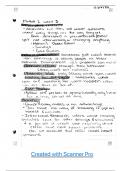
Double positive feedback catalyzes entry into mitosis: Inhibitors Wee1 Kinase and Myt1 Kinase inhibit
CycB1-Cdk1 (keeps it inactive, with 2 phosphates). Activators Cdc25 Phosphatases activate CycB1-
Cdk1. When it’s active, it blocks Wee1 Kinase. So the inhibition is inhibited → a lot of active CycB1-
Cdk1. Double positive feedback loop. Chain reaction. This will push the cell into mitosis.
Without cyclin B1 you can’t start mitosis. Also, cyclin B1 needs to be removed to continue.
This is done by Poly-Ubiquitination by Ubiquitin carriers/Ligases E1, E2 and E3 (APC/C). E1 and E2 are
Ubiquitin carriers and E3 is a Ubiquitin Ligase. 4x Ub = throw this protein away → degradation. The
protein is going into the proteasome where it is degraded. Blocking protein degradation stops cells in
mitosis.
Lecture 5 Cell Cycle Checkpoints and Regulation
APC/C = Anaphase Promoting Complex = big ubiquitin ligase. It becomes active after the metaphase
is completed (every chromosome is bound to the spindle and aligned in the middle).
The Spindle Assembly Checkpoint inhibits APC/C-Cdc20 to protect cyclin B1 and securin until ALL the
chromosomes are attached to the spindle. Cdc20 (cell division cycle protein 20) then binds to the
APC/C → anaphase starts.
When securing is bound to separase, separase can’t separate the chromosomes in the anaphase.
Securin needs to be degraded (exactly at the same time that Cyclin B1 is being degraded).
Cytokinesis = the formation/release of 2 new daughter cells. Tissue / muscle / brain cells etc are in
cell cycle arrest (G0 = differentiated).
Different cyclins drive transitions of the cell cycle.
G1 Cyclin D entering G0 (differentiation) or stay in G1
S Cyclin E (transition S phase – G2 phase)
G2 Cyclin A (transition S phase – G2 phase)
M Cyclin B mitosis
Cyclin Cyclin Dependant Kinase When produced?
Cyclin B CDK1 In S and G2 phase
Cyclin D CDK4 / CDK6 In response to growth stimuli
Cyclin E CDK2 During G1
Cyclin A CDK2 End of G1
CycB1-Cdk1 (keeps it inactive, with 2 phosphates). Activators Cdc25 Phosphatases activate CycB1-
Cdk1. When it’s active, it blocks Wee1 Kinase. So the inhibition is inhibited → a lot of active CycB1-
Cdk1. Double positive feedback loop. Chain reaction. This will push the cell into mitosis.
Without cyclin B1 you can’t start mitosis. Also, cyclin B1 needs to be removed to continue.
This is done by Poly-Ubiquitination by Ubiquitin carriers/Ligases E1, E2 and E3 (APC/C). E1 and E2 are
Ubiquitin carriers and E3 is a Ubiquitin Ligase. 4x Ub = throw this protein away → degradation. The
protein is going into the proteasome where it is degraded. Blocking protein degradation stops cells in
mitosis.
Lecture 5 Cell Cycle Checkpoints and Regulation
APC/C = Anaphase Promoting Complex = big ubiquitin ligase. It becomes active after the metaphase
is completed (every chromosome is bound to the spindle and aligned in the middle).
The Spindle Assembly Checkpoint inhibits APC/C-Cdc20 to protect cyclin B1 and securin until ALL the
chromosomes are attached to the spindle. Cdc20 (cell division cycle protein 20) then binds to the
APC/C → anaphase starts.
When securing is bound to separase, separase can’t separate the chromosomes in the anaphase.
Securin needs to be degraded (exactly at the same time that Cyclin B1 is being degraded).
Cytokinesis = the formation/release of 2 new daughter cells. Tissue / muscle / brain cells etc are in
cell cycle arrest (G0 = differentiated).
Different cyclins drive transitions of the cell cycle.
G1 Cyclin D entering G0 (differentiation) or stay in G1
S Cyclin E (transition S phase – G2 phase)
G2 Cyclin A (transition S phase – G2 phase)
M Cyclin B mitosis
Cyclin Cyclin Dependant Kinase When produced?
Cyclin B CDK1 In S and G2 phase
Cyclin D CDK4 / CDK6 In response to growth stimuli
Cyclin E CDK2 During G1
Cyclin A CDK2 End of G1