

Translational genomics
Genome architecture
DNA is present in two places in the cell±
1. DNA in the nucleus
2. DNA in the mitochondria
Functional DNA
- Protein coding
- Non coding
- Regulatory element
genes can be spliced different
- This can lead to different isoforms in different tissue
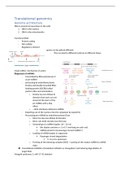
Small ncRNA: mechanism of action
Biogenesis of miRNAs
- transcribed by RNA polymerase II
as pri-miRNA
- processing by endoribonuclease
Drosha and double-stranded RNA-
binding protein DGCR8 (called
pasha in flies and nematodes).
o Drosha has two RNase III
domains that each cut one
strand of the stem of the
pri-miRNA with a 2bp
offset
o ~ 60nt stemloop called pre-miRNA
- Exporting out of the nucleus into the cytoplasm by exportin5
- Processing pre-miRNA by endoribonuclease Dicer
o Dicer has also two RNase III domains.
o Dicer cuts both strands near the loop
o Generating of a miRNA duplex (of ~ 22 nt)
this duplex contains a ~2 nt 3’ overhang on each end.
miRNA paired to its passenger strand (miRNA*)
o Loading of miRNA duplex in argonaute
Passenger strand degradation
5’ U or A is preferred
o Forming of the silencing complex (RISC) -> pairing of the mature miRNA to mRNA
sides
Translational inhibition (translation initiation or elongation) and inducing degradation of
target RNA
Feingold syndrome 2: miR-17~92 deletion
,Long ncRNA
NAT: natural antisense transcript
- Can work cis and trans
o Cis: from the same
template
o Trans: other gene
Mechanism
a. Inhibition of transcription
b. Blocking of splicing by binding a specific exon
c. Recruitment of RNAi inhibition of gene
expression
Regulatory elements
- Core promotor elements: surrounding the
transcriptional start site
(-40 - +40bp)
- Promotor proximal elements: upstream of the core promotor
(-200 - -40bp)
- Enhancer/silencer: further than 200bp upstream/downstream or even far away
Different regulatory DNA elements in eukaryotes are differentiated by distance from start
site
Core promotor elements: minimal sequence required for transcription initiation
- TATA box
- Initiator element
- Downstream promotor Element (DPE)
Promotor-proximal elements: modulation of transcription
- Often gene- or cell type-specific
Enhancers/silencers: modulation of transcription
- Often gene- or cell type-specific
- Can work from a distance
- Orientation-independent
Regulatory regions are diverse in eukaryotes
TATA-box: classical (core promotor)
o Fulfils similar function as enhancers and promoter-proximal elements
The core promotor
Core promotor: consists of the combination of distinct sequence motifs
- TATA:
Conserved sequence called the TATA box found 26-31bp upstream the transcription start
site. Positions RNA pol II for transcription initiation
- Inr
, Initiator sequence; instead of TATA box some eukaryotic genes contain an alternative
promotor element called the initiator.
- BRE
- DPE
‘junk’ DNA
Transposable elements (TEs): ‘jumping’ genes
o 45% of human genome
o <0.05% active
o The most abundant: Alu elements (10% genome)
Two classes
1. Class I: retrotransposons
a. LINEs
b. SINEs
c. LTR
2. Class II: DNA transposons
Example: family with dilated cardiomyopathy
They found that there was an exon spliced in
that normally isn’t there Alu repeat
They found differential expression of DMD
isoforms
They didn’t have the normal exon in
the cardiac muscle: possible
explaining the cardiac problems
Also, differential protein (dystrophin)
expression
Really clearly in heart, no expression
Genomic imprinting
What is the most extreme example of the effect of epigenetic modification on gene expression?
- DNA methylation
DNA methylation imprinting inactivation
Paternal and maternal genomes contain the same set of genes embryo from two paternal or two
maternal embryos cannot develop.
- Paternal and maternal genomes must be epigenetically modified
Imprinting turns on or off certain genes in either sperm or egg implying a memory of the
genes being in sperm or egg
o At least 80 imprinted genes identified in mammals
- Maternal and paternal genomes make different contributions to embryonic development
o Two maternal genomes: relatively well developed embryos; extra-embryonic tissue
poorly developed
o Two paternal genomes: well-developed extra-embryonic tissue; embryo itself is
abnormal
, Epigenetics:
- DNA methylation gene repression
o Always metalation of the C in a CG methylation of Cytosine by methyltransferase
to 5-Mehylcytosine
- Histone modifications gene repression and/or activation
- Non-coding regulatory RNAs
o Attracting of polycomb group proteins transcriptional repressors via chemical
modifications of histone proteins
Genomic imprinting = essential for normal development
Deregulation results in complex genetic diseases
Example: Chr15q11-q13: same deletion causes to very different
syndromes
1. Angelman syndrome: maternal deletion loss of maternal
gene expression = paternal uniparental disomy
a. ID, laugh a lot unexpectedly, ataxia, no speech,
epilepsy, typical face, friendly
2. Prader-Willi syndrome: Paternal deletion loss of paternal
gene expression = maternal uniparental disomy
a. Neonatally: hypotonia, feeding probles
b. First decade of life: obesitas, small, mild ID, hypogonadism, behavioural problems
Genome architecture
DNA is present in two places in the cell±
1. DNA in the nucleus
2. DNA in the mitochondria
Functional DNA
- Protein coding
- Non coding
- Regulatory element
genes can be spliced different
- This can lead to different isoforms in different tissue
Small ncRNA: mechanism of action
Biogenesis of miRNAs
- transcribed by RNA polymerase II
as pri-miRNA
- processing by endoribonuclease
Drosha and double-stranded RNA-
binding protein DGCR8 (called
pasha in flies and nematodes).
o Drosha has two RNase III
domains that each cut one
strand of the stem of the
pri-miRNA with a 2bp
offset
o ~ 60nt stemloop called pre-miRNA
- Exporting out of the nucleus into the cytoplasm by exportin5
- Processing pre-miRNA by endoribonuclease Dicer
o Dicer has also two RNase III domains.
o Dicer cuts both strands near the loop
o Generating of a miRNA duplex (of ~ 22 nt)
this duplex contains a ~2 nt 3’ overhang on each end.
miRNA paired to its passenger strand (miRNA*)
o Loading of miRNA duplex in argonaute
Passenger strand degradation
5’ U or A is preferred
o Forming of the silencing complex (RISC) -> pairing of the mature miRNA to mRNA
sides
Translational inhibition (translation initiation or elongation) and inducing degradation of
target RNA
Feingold syndrome 2: miR-17~92 deletion
,Long ncRNA
NAT: natural antisense transcript
- Can work cis and trans
o Cis: from the same
template
o Trans: other gene
Mechanism
a. Inhibition of transcription
b. Blocking of splicing by binding a specific exon
c. Recruitment of RNAi inhibition of gene
expression
Regulatory elements
- Core promotor elements: surrounding the
transcriptional start site
(-40 - +40bp)
- Promotor proximal elements: upstream of the core promotor
(-200 - -40bp)
- Enhancer/silencer: further than 200bp upstream/downstream or even far away
Different regulatory DNA elements in eukaryotes are differentiated by distance from start
site
Core promotor elements: minimal sequence required for transcription initiation
- TATA box
- Initiator element
- Downstream promotor Element (DPE)
Promotor-proximal elements: modulation of transcription
- Often gene- or cell type-specific
Enhancers/silencers: modulation of transcription
- Often gene- or cell type-specific
- Can work from a distance
- Orientation-independent
Regulatory regions are diverse in eukaryotes
TATA-box: classical (core promotor)
o Fulfils similar function as enhancers and promoter-proximal elements
The core promotor
Core promotor: consists of the combination of distinct sequence motifs
- TATA:
Conserved sequence called the TATA box found 26-31bp upstream the transcription start
site. Positions RNA pol II for transcription initiation
- Inr
, Initiator sequence; instead of TATA box some eukaryotic genes contain an alternative
promotor element called the initiator.
- BRE
- DPE
‘junk’ DNA
Transposable elements (TEs): ‘jumping’ genes
o 45% of human genome
o <0.05% active
o The most abundant: Alu elements (10% genome)
Two classes
1. Class I: retrotransposons
a. LINEs
b. SINEs
c. LTR
2. Class II: DNA transposons
Example: family with dilated cardiomyopathy
They found that there was an exon spliced in
that normally isn’t there Alu repeat
They found differential expression of DMD
isoforms
They didn’t have the normal exon in
the cardiac muscle: possible
explaining the cardiac problems
Also, differential protein (dystrophin)
expression
Really clearly in heart, no expression
Genomic imprinting
What is the most extreme example of the effect of epigenetic modification on gene expression?
- DNA methylation
DNA methylation imprinting inactivation
Paternal and maternal genomes contain the same set of genes embryo from two paternal or two
maternal embryos cannot develop.
- Paternal and maternal genomes must be epigenetically modified
Imprinting turns on or off certain genes in either sperm or egg implying a memory of the
genes being in sperm or egg
o At least 80 imprinted genes identified in mammals
- Maternal and paternal genomes make different contributions to embryonic development
o Two maternal genomes: relatively well developed embryos; extra-embryonic tissue
poorly developed
o Two paternal genomes: well-developed extra-embryonic tissue; embryo itself is
abnormal
, Epigenetics:
- DNA methylation gene repression
o Always metalation of the C in a CG methylation of Cytosine by methyltransferase
to 5-Mehylcytosine
- Histone modifications gene repression and/or activation
- Non-coding regulatory RNAs
o Attracting of polycomb group proteins transcriptional repressors via chemical
modifications of histone proteins
Genomic imprinting = essential for normal development
Deregulation results in complex genetic diseases
Example: Chr15q11-q13: same deletion causes to very different
syndromes
1. Angelman syndrome: maternal deletion loss of maternal
gene expression = paternal uniparental disomy
a. ID, laugh a lot unexpectedly, ataxia, no speech,
epilepsy, typical face, friendly
2. Prader-Willi syndrome: Paternal deletion loss of paternal
gene expression = maternal uniparental disomy
a. Neonatally: hypotonia, feeding probles
b. First decade of life: obesitas, small, mild ID, hypogonadism, behavioural problems

