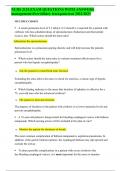
ESSENTIALS OF UNDERSTANDING PSYCHOLOGY 10TH EDITION BY ROBERT FELDMAN TEST BANK
Description INSTANT DOWNLOAD COMPLETE TEST BANK WITH ANSWERS Essentials of Understanding Psychology 10th Edition by Robert Feldman- Test Bank Sample Questions ch05 Student: ___________________________________________________________________________ 1. Psychologists use the term _____ to refer to a relatively permanent change in behavior resulting from experience. A. growth B. maturation C. cognition D. learning 2. Learning reflects _____. Maturation reflects _____. A. nurture; nature ESSENTIALS OF UNDERSTANDING PSYCHOLOGY 10TH EDITION BY ROBERT FELDMAN TEST BANK B. nature; nurture C. nature; nature as well D. nurture; nurture as well 3. _____ is the decrease in response to a stimulus that occurs after repeated presentations of the same stimulus. A. Sensation B. Disinhibition C. Habituation D. Conservation 4. You toss a newly purchased felt mouse across the floor; your cat chases it excitedly, clutches it in her paws and rolls around with it. Several tosses later, your cat yawns pointedly and settles herself for a nap. The change in your cat’s behavior illustrates: A. adaptation. B. habituation. C. conditioning. D. maturation. 5. _____ refers to a decrease in the response to a stimulus when it is presented repeatedly, whereas _____ refers to the eventual disappearance of a conditioned response when an unconditioned stimulus is no longer presented. A. Extinction; habituation B. Habituation; extinction C. Habituation; adaptation D. Adaptation; habituation 6. _____ is credited with laying the foundation for the study of classical conditioning in psychology. A. Thorndike B. Skinner C. Pavlov D. Watson 7. _____ is a type of learning in which a neutral stimulus comes to bring about a response after it is paired with a stimulus that naturally brings about that response. A. Classical conditioning B. Operant conditioning C. Observational learning D. Instrumental conditioning 8. _____ stimulus is a stimulus that does not naturally bring about the response of interest. A. Reflexive B. Unconditioned C. Neutral D. Normative 9. _____ stimulus is a stimulus that naturally brings about a particular response without having been learned. A. Conditioned B. Unconditioned C. Neutral D. Normative 10. In Pavlov’s study, the UCS was _____; the neutral stimulus was _____; and, finally, the CS was _____. A. meat; the bell; meat B. meat; the bell; the bell C. the bell; meat; meat D. meat; meat; the bell 11. Tim loves dill pickles. Now, the sight of a jar on the supermarket shelf makes his mouth water. In the terminology of classical conditioning, the sight of the jar is a(n) _____. A. conditioned stimulus B. unconditioned stimulus C. neutral stimulus D. conditioned response 12. Alexis uses cocaine, which activates her sympathetic nervous system. Expecting her dealer, her hands shake and her heart pounds when she hears a knock on the door. Which alternative below CORRECTLY identifies the neutral stimulus, the CS, and the UCS? A. Neutral stimulus—knock on the door; CS—cocaine; UCS—cocaine B. Neutral stimulus—knock on the door; CS—knock on the door; UCS—pounding heart C. Neutral stimulus—knock on the door; CS—knock on the door; UCS—cocaine D. Neutral stimulus—cocaine; CS—knock on the door; UCS—cocaine 13. In classical conditioning, how are the neutral stimulus and the conditioned response related? A. They are not related; they are completely different stimuli. B. They are the same thing; the terms are interchangeable. C. The neutral stimulus becomes the conditioned stimulus. D. The conditioned stimulus becomes the neutral stimulus. 14. Nature is to nurture what _____ is to _____. A. conditioned stimulus; unconditioned stimulus B. conditioned response; unconditioned response C. neutral stimulus; conditioned stimulus D. unconditioned response; conditioned response 15. Classical conditioning is most successful when the neutral stimulus begins: A. just before the unconditioned stimulus begins. B. at exactly the same time that the unconditioned stimulus begins. C. long before the unconditioned stimulus begins. D. immediately after the unconditioned stimulus begins. 16. Which pair below CORRECTLY identifies a stimulus or response in Watson and Rayner’s “Little Albert” study? A. Unconditioned stimulus—noise B. Conditioned stimulus— fear C. Unconditioned response—rat D. Neutral stimulus—fear 17. Jonas is a veteran of the war in Iraq. He suffers from PTSD. Now, back home in a quiet California neighborhood, he jumps when he hears a firecracker or a car backfire. In the terminology of classical conditioning, these sounds are best thought of as _____ stimuli. A. neutral B. unconditioned C. conditioned D. normative 18. _____ occurs when a previously conditioned response decreases in frequency and eventually disappears. A. Extinction B. Habituation C. Adaptation D. Deconditioning 19. Which of the following scenarios exemplifies extinction? A. Alexis is a former cocaine user. Now that she no longer uses cocaine, her hands no longer shake and her heart no longer pounds when she hears a car pull into her drive, like her dealer used to do in his car. B. Alexis uses cocaine. She no longer feels quite the same rush as she did when she first started using. C. Alexis is a former cocaine user in recovery. After a relapse, though, her hands shake and her heart pounds when she hears a car pull into her drive, like her dealer used to do in his car. D. Alexis uses cocaine. She finds that she is slowly losing her sense of smell. 20. Which of the following sequences CORRECTLY arranges the phases of the classical conditioning process, from first to last? A. Acquisition → spontaneous recovery → extinction B. Acquisition → extinction → spontaneous recovery C. Spontaneous recovery → acquisition → extinction D. Extinction → acquisition → spontaneous recovery 21. The reemergence of an extinguished conditioned response after a period of rest and with no further conditioning is known as _
Escuela, estudio y materia
- Institución
- PSYCHOLOGY10
- Grado
- PSYCHOLOGY10
Información del documento
- Subido en
- 19 de septiembre de 2022
- Número de páginas
- 74
- Escrito en
- 2022/2023
- Tipo
- Examen
- Contiene
- Preguntas y respuestas
Temas
-
essentials of understanding psychology 10th edition by robert feldman test bank
-
description instant download complete test bank with answers essentials of understanding psychology 10th edition by robe