NR222 Exam 1.CHAPTER 1-22
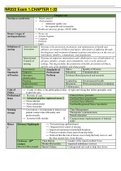
Chapter one Nursing as a profession ⟶ Patient centered ⟶ Professionalism o Administer quality care o Be responsible and accountable ⟶ Health care advocacy groups : FWJF / IOM Benner’s stages of nursing proficiency ⟶ Novice (us) ⟶ Advance beginner ⟶ Competent ⟶ Proficient ⟶ Expert Definitions of nursing American nurse Association Nursing is the protection, promotion, and optimization of health and abilities; prevention of illness and injury; alleviation of suffering through the diagnosis and treatment of human response and advocacy in the care of individuals, families, communities, and populations. International Council of nursing Nursing encompasses autonomous and collaborative care of individuals of all ages, families, groups, and communities, sick or well, and in all settings. Nursing includes the promotion of health; prevention of illness; and the care of ill, disabled, and dying people Six Standards of Practice Assessments Standards of Professional Perform Ethics Quality of Practice Diagnosis Education Communication Outcomes identification Evidence-Based practiced and research Planning Leadership Environmental health Implementation Resources Professional practice evaluation Evaluation Collaboration Code of Ethics ⟶ A code of ethics is the philosophical ideas of right and wrong that define principles used to provide care. Professional Roles ⟶ Provider of care ⟶ Advanced practice registered nurse ⟶ Nurse educator ⟶ Nurse administrator ⟶ Nurse researcher Clinical Nurse specialist Certified Nurse practitioner Certified Nurse Midwife Certified Registered Nurse Anesthetist Nursing storage ⟶ Less nurses = its important to learn to use patient contact time efficiently and professionally. ⟶ Essential skills include Time Management Therapeutic communication Patient education Compassionate implementation of bedside skills Histor y Florence Nightingale ⟶ First practicing epidemiologist ⟶ Organized first school of nursing ⟶ Improved sanitation in battlefield hospitals ⟶ Practices remain a basic part of nursing today ⟶ believed that the role of nurses was to help the body recover, and the then remain free, from disease. Civil war – 20th century The Civil War, fought from 1860 to 1865, stimulated the growth of nursing in the United States Clara Barton founder of the American Red Cross Mother Bickerdyke organized ambulance services Harriet Tubma Underground rail road to help free slaves Mary Mahoney as a noted nursing leader she brought forth an awareness of cultural diversity and respect for the individual, regardless of background, race, color, or religion. Lilian wald opened the Henry Street Settlement, which focused on the health needs of poor people who lived in tenements in New York City. Twenty Century ⟶ Movement toward scientific, research-based practice and defined body of knowledge ⟶ Nurses assumed expanded and advanced practice roles ⟶ Changes in curriculum ⟶ Advances in tech and informatics ⟶ New programs and leardership roles. Contemporary influences Importance of nurses’ self-care Changes in society lead to changes in nursing: Affordable Care Act (ACA) Rising health care costs Demographic changes Medically underserved Chapter 2 Health Care ⟶ Uninsured patients ⟶ Reducing health care costs while maintaining high quality-care for patients. Challenges ⟶ Improving access and coverage for more people ⟶ Encouraging healthy behaviors ⟶ Earlier healthy behaviors Earlier hospital discharges result in more patients needing nursing homes or home care National priorities partnerships ⟶ Promote best practices ⟶ Promote prevention, treatment, and intervention. ⟶ Ensure person- and family -centered care ⟶ Make care safer ⟶ Promote communication and care coordination ⟶ Make quality care affordable. Institute of medicine (IOM) Nursing need to be transformed by: ⟶ Practicing to the full extent of their training ⟶ Achieving higher levels of education through an education system that provides seamless progress ⟶ Becoming full partners with physical and other health care providers in redesigning the health care system. Improving data collection and the information infrastructure for effective workforce planning and policy making. Health care regulation and Reform Regulators and competitive approaches ⟶ Professional standards review organizations (PSROs) o Create to review the quality, quantity and cost of hospital care provide through Medicare and Medicaid. ⟶ Utilization Review (UR) committees o Review admissions, diagnostic testing, and treatments ordered by physicians who cared for patients receiving Medicare. Health care Regulation and Reform Patient protection and Affordable care act ⟶ Access to health care for all ⟶ Reducing costs ⟶ Improving quality ⟶ Provisions include o Insurance industry reforms o Increased funding for public programs o Improved coverage for children. Emphasis on population wellness Health services pyramid ⟶ Managing health instead of illness ⟶ Emphasis on wellness ⟶ Injury-prevention programs. Preventive Reduces and controls risk factors Primary ⟶ Focuses on improved health outcomes ⟶ Requires collaboration Secondary Focus: diagnosis and treatment of diseases. ⟶ Disease management is the most common expensive service of the health care delivery system ⟶ Postponement of care by uninsured contributes to high costs. ⟶ Hospital ED, urgent care, etc. o Work redesign, discharge planning. ⟶ Intensive care, psychiatric faculties, rural hospitals. Tertiary Restorative ⟶ Services patients recovering from an acute or chronic illness/ disability. ⟶ Helps individuals regain maximal function and enhance quality of life.
Escuela, estudio y materia
- Institución
- Chamberlain College Of Nursing
- Grado
- NR222
Información del documento
- Subido en
- 14 de septiembre de 2022
- Número de páginas
- 28
- Escrito en
- 2022/2023
- Tipo
- Examen
- Contiene
- Preguntas y respuestas
Temas
-
nr222 exam
-
nr222
-
nr222 exam 1chapter 1 22
-
nr222 exam 1
-
nr222 exam 1chapter 1 22 graded a

Documento también disponible en un lote