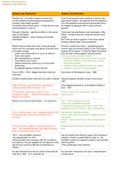
Comparing the revolutions
1905
CAUSES AND AIMS
- Workers - 8 hour working day, general strike, better health care and insurance
- Peasants - redemption payments and land hunger (poor agricultural methods, periodic reallocation of land)
- Middle class and intelligentsia - against autocracy
- Socialists like SDs and SRs - aimed for reformed economy as well as political system
- Russo - Japanese War - short term war that emphasised economic problems and in capabilities of the Tsar =
middle class discontent
- Bloody Sunday - short term trigger of revolution - significant because was more prominent to the people as on
the home front (compared to the failures of war which were distant.
FEATURES
- General Strike led by workers
- Creation of St Petersburg Soviet
- Role of Trotsky in influencing St Petersburg Soviet
- Moscow uprising by armed workers
- Peasant disorder in ‘Black Earth’ region
- Mutineers from battleship Potemkin
- Use of army to suppress uprisings - 2000 died when Potemkin joined workers movements
- Repression - St Petersburg forced to disband
OUTCOMES
- Tsar’s reactionary policies of August Manifesto and October Manifesto
- Restoration of autocracy - Octobrists agreed with Tsar
- Split in revolutionary parries - Tsar reduced opposition by dividing them
- Some change - creation of Dumas that are to be elected by the majority of people
- Continuation of repression and violence - evidenced by crushing of Moscow Uprising
SOCIAL
- Unrest among peasants
- Redemption payments and high taxes
- Land hunger
- Unrest among workers
- Strikes - 300 times in 1901 and 500 times in 1902.
- Pay was low, hour long (60 hours a week), no health and safety precautions
- Main aim of Bloody Sunday was to improve social conditions
- Parallel revolutions of widespread discontent
- Potemkin battleship mutiny
, - General strike started by workers and rise of the St Petersburg Soviet in October 1905.
POLITICAL
- Repression and the Okhrana - 1900 1500 members and agents
- Autocracy (Tsar had complete power and was no answerable to the people)
- Orthodoxy and Nationalism - repression of Jews in Pale of Settlement, nationalities unable to establish
independent churches.
- Development of revolutionary groups - mainly the middle class forming League of Liberation and ‘intelligentsia’
- League of Liberation - end autocracy, not socialist economy, non violent methods
- Zemstvo had more power - opposed the Tsar
- SRs - peasant support, violent, Combat Organisation.
- SDs - Marxist, Mensheviks and Bolsheviks, small group
- Socialist parties not as involved - mainly middle class liberals or individual workers involved.
- Political groups were illegal, people exiled, restriction on press etc
- Divisions between revolutionary groups - SDs split in Mensheviks and Bolsheviks, socialists and liberals split
over economic changes (capitalism or communism).
- Bloody Sunday = trigger/catalyst
- 150,000 unarmed demonstrates gathered = army suppressed them = 200 killed.
- More social aims = 8 hour working day etc
- Less political aims = did not call for abolition of autocracy or removal of capitalism
ECONOMIC
- Agriculture was not well developed
- Periodic reallocation of land which did not give people incentive to improve soil quality
- Crop rotations - only 2/3 of land was under cultivation at one time.
- Russo- Japanese War 1905
- Unemployment and inflation
- Cause for social discontent and political mobilisation
1905
CAUSES AND AIMS
- Workers - 8 hour working day, general strike, better health care and insurance
- Peasants - redemption payments and land hunger (poor agricultural methods, periodic reallocation of land)
- Middle class and intelligentsia - against autocracy
- Socialists like SDs and SRs - aimed for reformed economy as well as political system
- Russo - Japanese War - short term war that emphasised economic problems and in capabilities of the Tsar =
middle class discontent
- Bloody Sunday - short term trigger of revolution - significant because was more prominent to the people as on
the home front (compared to the failures of war which were distant.
FEATURES
- General Strike led by workers
- Creation of St Petersburg Soviet
- Role of Trotsky in influencing St Petersburg Soviet
- Moscow uprising by armed workers
- Peasant disorder in ‘Black Earth’ region
- Mutineers from battleship Potemkin
- Use of army to suppress uprisings - 2000 died when Potemkin joined workers movements
- Repression - St Petersburg forced to disband
OUTCOMES
- Tsar’s reactionary policies of August Manifesto and October Manifesto
- Restoration of autocracy - Octobrists agreed with Tsar
- Split in revolutionary parries - Tsar reduced opposition by dividing them
- Some change - creation of Dumas that are to be elected by the majority of people
- Continuation of repression and violence - evidenced by crushing of Moscow Uprising
SOCIAL
- Unrest among peasants
- Redemption payments and high taxes
- Land hunger
- Unrest among workers
- Strikes - 300 times in 1901 and 500 times in 1902.
- Pay was low, hour long (60 hours a week), no health and safety precautions
- Main aim of Bloody Sunday was to improve social conditions
- Parallel revolutions of widespread discontent
- Potemkin battleship mutiny
, - General strike started by workers and rise of the St Petersburg Soviet in October 1905.
POLITICAL
- Repression and the Okhrana - 1900 1500 members and agents
- Autocracy (Tsar had complete power and was no answerable to the people)
- Orthodoxy and Nationalism - repression of Jews in Pale of Settlement, nationalities unable to establish
independent churches.
- Development of revolutionary groups - mainly the middle class forming League of Liberation and ‘intelligentsia’
- League of Liberation - end autocracy, not socialist economy, non violent methods
- Zemstvo had more power - opposed the Tsar
- SRs - peasant support, violent, Combat Organisation.
- SDs - Marxist, Mensheviks and Bolsheviks, small group
- Socialist parties not as involved - mainly middle class liberals or individual workers involved.
- Political groups were illegal, people exiled, restriction on press etc
- Divisions between revolutionary groups - SDs split in Mensheviks and Bolsheviks, socialists and liberals split
over economic changes (capitalism or communism).
- Bloody Sunday = trigger/catalyst
- 150,000 unarmed demonstrates gathered = army suppressed them = 200 killed.
- More social aims = 8 hour working day etc
- Less political aims = did not call for abolition of autocracy or removal of capitalism
ECONOMIC
- Agriculture was not well developed
- Periodic reallocation of land which did not give people incentive to improve soil quality
- Crop rotations - only 2/3 of land was under cultivation at one time.
- Russo- Japanese War 1905
- Unemployment and inflation
- Cause for social discontent and political mobilisation