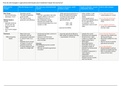
How far did changes in agricultural techniques and investment impact the economy?
What was the Why did change occur? Was there any continuity/limited Impact on Economy - profit, Impact on Society - poverty, Links to other changes
change? impact? produce, surplus urbanisation, literacy
New Crops - Population growth Society - 1640s agricultural production in - better variation in diet Link to National Markets
- such as artichokes, - The need to guarantee - The rise in population had other Britain exceeded all European (revolutionised eating - market gardens in London
asparagus, clover good harvests negative effects on the poor = countries (except Holland) habits)
- The need to boost increased poverty etc - average days worked per - Growing agricultural Link to Farming Techniques
Market Garden’s production and efficiency - Not widespread change - agricultural family: productivity released labour - experimentation of new
created because poor people diet for non-agricultural crops
- specialist producer remained bread based (not much 1700 = 405 occupations = link to
of fruits and veg variation in diet) 1450 = 266 urbanisation and the cloth Link to Capital Investment
- large and served trade. - money for experimentation
1000s - improved soil fertility and new crops
- Fed London (largest
city)
Enclosure - Meant that crops - enclosures had been common in - improved agricultural efficiency - protests from small Link to Farming Techniques
production was not medieval times - Split arable and pastoral farming landowners and peasants - Improved crop rotation and
1660 proceeding unnecessarily duplicated - Closure of common land = specialisation of farming - Small farmers in debt farming techniques
rapidly - To reduce rivalry in an - Not changed much because - Unable to compete with - More field available for crop
area same concept larger enclose farms rotations
- Peasants had to accept - Sherrington - Abel to commit to specific
to break it of cycle of Economy (Buckinghamshire) - agricultural techniques
subsistence farming Not widespread across counties freeholders driven out
- To ensure efficiency and - Oxfordshire - Increased number of Link to Specialisation
variety for a staple diet - Still very successful agricultural labourers by forcing small - allowed people to split up
innovation farmers out pastoral and arable farming
- Increased employment in - Able to specialise without
cloth industry - using common land.
urbanisation
- Agreements struck
between the land owners
and local farmers
, What was the Why did change occur? Was there any continuity/limited Impact on Economy - profit, Impact on Society - poverty, Links to other changes
change? impact? produce, surplus urbanisation, literacy
Farming Techniques - Increased level literacy Economy - previous ineffective system (1 of - Migration - Dutch workers Link to New Crops
after 1600 - use of potatoes was not 3 field left to fallow to restore improved irrigation - experimentation and new
- reducing number of - Yeomen and widespread nutrients to soil) this led to - Cornelius Vermuyden crops
fields left fallow husbandmen able to - Farming had existed for decreased yield (Ducth) was knighted by - Low Countries brought new
- Crops selected read books centuries- continuity because - New crops could be introduced Charles I for draining water crops
based on suitability - Walter Blith - wrote techniques already being used and experimentation meadows
to soil books on using manure and in place. - Frost resistant turnips (from Low - Samuel Hartlib (German) - Link to Enclosure
- Manuring - as fertiliser Countries) = more economical promoted Dutch methods - Enclosure allowed new
encouraged fertility - subsistence farming no - Aided industry: flax used for - Literacy and techniques to be used
of the soil longer an option linen, hemp for ropes, hops for encouragement of - Enclosure changed system
- Husbandry - form of - Awareness that efficient beer education for farmers etc of crop rotation
rotation - land was farming meant using as - Increased yield - Less likely to have famine -
restored and greater much land as possible - Less concern about a poor variety fo crops so always Link to Water Meadows
yields of crops and harvest have form of food. - Walter Blith believed in
more land without drainage of water meadows
crops for pastoral as a new method
farming. - Cornelius Vermuyden
- Irrigation
1420 - 1700= 7 million
to 9 million acres for
arable farming
1400 - 1700 = 3 million
to 1.8 million for fallow
Water Meadows - the need to provide food - water meadows had been used - improvement in agricultural - Dutch engineers expertise Link to Enclosure
for animals during winter for years practice in draining land - enclosure meant individual
- diverting water from - Had been used - Only was accelerated use in the - Making sure land is not breeds of animals could be
a river to a field previously so a known 1600s waterlogged would create more kept separated
- Regulated by gates technique water for pasture - Allowed single breeds of
and dams - - Encouraged grass to grow earlier animals to be selected
- Ensured the soil was - Sheep and cattle could feed on - Sheep breed with greatest
always damp = grass - source of food in the wool blend selected for wool
reduces chance of winter industry
frost - Hay was harvested = more
produce
- Maintain working and non-
working animals
1700 = 630,000 horses
1600 = 300,000
- Sheep breed with greatest wool
blend selected for wool industry
What was the Why did change occur? Was there any continuity/limited Impact on Economy - profit, Impact on Society - poverty, Links to other changes
change? impact? produce, surplus urbanisation, literacy
New Crops - Population growth Society - 1640s agricultural production in - better variation in diet Link to National Markets
- such as artichokes, - The need to guarantee - The rise in population had other Britain exceeded all European (revolutionised eating - market gardens in London
asparagus, clover good harvests negative effects on the poor = countries (except Holland) habits)
- The need to boost increased poverty etc - average days worked per - Growing agricultural Link to Farming Techniques
Market Garden’s production and efficiency - Not widespread change - agricultural family: productivity released labour - experimentation of new
created because poor people diet for non-agricultural crops
- specialist producer remained bread based (not much 1700 = 405 occupations = link to
of fruits and veg variation in diet) 1450 = 266 urbanisation and the cloth Link to Capital Investment
- large and served trade. - money for experimentation
1000s - improved soil fertility and new crops
- Fed London (largest
city)
Enclosure - Meant that crops - enclosures had been common in - improved agricultural efficiency - protests from small Link to Farming Techniques
production was not medieval times - Split arable and pastoral farming landowners and peasants - Improved crop rotation and
1660 proceeding unnecessarily duplicated - Closure of common land = specialisation of farming - Small farmers in debt farming techniques
rapidly - To reduce rivalry in an - Not changed much because - Unable to compete with - More field available for crop
area same concept larger enclose farms rotations
- Peasants had to accept - Sherrington - Abel to commit to specific
to break it of cycle of Economy (Buckinghamshire) - agricultural techniques
subsistence farming Not widespread across counties freeholders driven out
- To ensure efficiency and - Oxfordshire - Increased number of Link to Specialisation
variety for a staple diet - Still very successful agricultural labourers by forcing small - allowed people to split up
innovation farmers out pastoral and arable farming
- Increased employment in - Able to specialise without
cloth industry - using common land.
urbanisation
- Agreements struck
between the land owners
and local farmers
, What was the Why did change occur? Was there any continuity/limited Impact on Economy - profit, Impact on Society - poverty, Links to other changes
change? impact? produce, surplus urbanisation, literacy
Farming Techniques - Increased level literacy Economy - previous ineffective system (1 of - Migration - Dutch workers Link to New Crops
after 1600 - use of potatoes was not 3 field left to fallow to restore improved irrigation - experimentation and new
- reducing number of - Yeomen and widespread nutrients to soil) this led to - Cornelius Vermuyden crops
fields left fallow husbandmen able to - Farming had existed for decreased yield (Ducth) was knighted by - Low Countries brought new
- Crops selected read books centuries- continuity because - New crops could be introduced Charles I for draining water crops
based on suitability - Walter Blith - wrote techniques already being used and experimentation meadows
to soil books on using manure and in place. - Frost resistant turnips (from Low - Samuel Hartlib (German) - Link to Enclosure
- Manuring - as fertiliser Countries) = more economical promoted Dutch methods - Enclosure allowed new
encouraged fertility - subsistence farming no - Aided industry: flax used for - Literacy and techniques to be used
of the soil longer an option linen, hemp for ropes, hops for encouragement of - Enclosure changed system
- Husbandry - form of - Awareness that efficient beer education for farmers etc of crop rotation
rotation - land was farming meant using as - Increased yield - Less likely to have famine -
restored and greater much land as possible - Less concern about a poor variety fo crops so always Link to Water Meadows
yields of crops and harvest have form of food. - Walter Blith believed in
more land without drainage of water meadows
crops for pastoral as a new method
farming. - Cornelius Vermuyden
- Irrigation
1420 - 1700= 7 million
to 9 million acres for
arable farming
1400 - 1700 = 3 million
to 1.8 million for fallow
Water Meadows - the need to provide food - water meadows had been used - improvement in agricultural - Dutch engineers expertise Link to Enclosure
for animals during winter for years practice in draining land - enclosure meant individual
- diverting water from - Had been used - Only was accelerated use in the - Making sure land is not breeds of animals could be
a river to a field previously so a known 1600s waterlogged would create more kept separated
- Regulated by gates technique water for pasture - Allowed single breeds of
and dams - - Encouraged grass to grow earlier animals to be selected
- Ensured the soil was - Sheep and cattle could feed on - Sheep breed with greatest
always damp = grass - source of food in the wool blend selected for wool
reduces chance of winter industry
frost - Hay was harvested = more
produce
- Maintain working and non-
working animals
1700 = 630,000 horses
1600 = 300,000
- Sheep breed with greatest wool
blend selected for wool industry