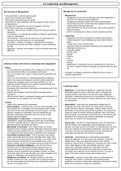
2.3 Leadership and Management
Key functions of Management: Management vs Leadership:
• direct activities to achieve specific goals • Management
• supervising, directing and advising • management is the work of directing a business organisation’s
• planning and reaching long-term goals resources to achieve business objectives.
• responsible for daily operations and ensuring the smooth work of • managers are generally tasked with these responsibilities:
all departments • ensure that everyone is performing their assigned duties and co-
• the larger the organisation, the more managers it will have ordinate efforts among employees
• Henri Fayol’s functions of management: • make decisions that impact a business’ day-to-day operations
• planning - sets out how to achieve short and long-term goals or • resolve problems
objectives • work to coordinate and achieve smooth operational activity
• co-ordinating - co-ordinate the activities of different departments
within an organisation • Leadership
• commanding - involves giving instructions to employees and • leadership is the use of strategic and creative thinking that
ensuring work performance is of a high standard inspires people to meet challenges and accomplish defined
• controlling - requires a manager to understand the business’ goals
processes and policies and make changes to ensure objectives • a leader has a more visionary goal
are met. • required to keep the company operating at the cutting edge
• organising - requires the manager to use the available resources • challenge the status quo
efficiently • successful leader:
• guiding vision
• passion
• integrity
• trust
• curiosity
• daring
Influence of ethics and culture on leadership and management: • leadership isn’t something you are necessarily born with but is
the result of people rising to challenges and reinventing who they
• Ethics are
• to what extenet should leaders and managers do what is right
• how important are ethics in a business environment • managers and leaders still perform different functions within a
• how do we judge what is right in certain business practises and business organisation
situations
• How may culture impact our understanding that something is
right in one country and wrong in another (cultural relativism)
• leaders and managers need to set clear guidelines or rule s
• guidlines need to dictate how to conduct oneself ethically and
give a clear idea of what to strive for Leadership styles:
• businesses that value ethics must seek out employees who think
the way they do • Situational - a style that one adopts for a particular situation.
• leaders and managers must build ethics into performance Demands leaders to think on their feet, react to changes and
evaluations implore people to have faith in the decision made. Employee
• ethical conduct leads to increased company performance and to motivation, morale and productivity can be affected if they don’t
employees who are happier and more helpful feel secure about the decision making. Situational can also lead to
an overreaction
• Culture
• needs to be understood by businesses • paternalistic - looks after the organisations interest and its
• power distance - measures how a country views inequality. The employees as if they were family. Promotes sense of security,
more tolerant it is of inequality, the more society tends to defer loyalty and bond. Sense of belonging - esteem needs. Can be
authority and the more hierarchical its social structure. The less beneficial for productivity because the business is not solely profit
tolerant a society is of inequality, the more questioning its driven but cares for familial working conditions. Due to this bond,
attitude to leadership that doesn’t take into account other both the leader and employees sometimes fail to see that the best
people’s ideas and efforts interests of the company are not being addressed, for example
• individualism vs collectivism - if a society tends to value when there is a need to let employees go.
individualism, people are expected to take care of themselves
and their immediate family. If collectivist, people value a more • laissez-faire - ‘hands off’, characterised by a lack of interference
extended role for themselves and family. from the leader of an organisation. Gives employees minimal
• Masculinity vs femininity - this measure looks at cultures direction and large amounts of freedom to make decisions and find
through the lens of tough vs tender. Masculine cultures are about their own methods of accomplishing objectives. Can help build
material success, achievement and competition. Feminine refers motivation and drive among employees. Some inexperienced
to an approach that values caring, cooperation and consensus employees may feel lost with the lack of guidance.
• Uncertainty avoidance index - tries to ascertain how people
within society feel about the future. Societies with a high index • autocratic - characterised by a domineering and possibly
score want control and tend to be more rigid. A low index score tyrannical approach. It is strong and rule orientated. Autocratic
would indicate a society that is more relaxed favour what is leaders rely on their own ideas and instincts when making
going to happen and is not necessarily trying to shape the future decisions. Good style for entrepreneurs of people who have a fixed
• Long term orientation indulgence - tries to find out how vision. High degree of clear and detailed instruction, close
societies view the relationship between past and future. A supervision. Eliminates guesswork. Employees may feel
society that scores low tends to choose tradition and ritual, demotivated that their opinions and ideas are not welcomed.
change would be questioned and probably avoided. A society Innovation and creativity may be reduced as their is no pool of
that scores high tend to see education as a way to prepare one’s ideas. Can lead to a high turnover rate in labour force.
culture for challenges in the present and future.
• Indulgence vs restraint - an indulgent society is more free • democratic - opposite of autocratic, values inclusiveness and
spirited, carefree and open. A society that is restrained tends to employee input. listen to employees and understand their
be more conservative and less free and would feel the need to questions or concerns. Democratic leadership and decision making
conform to societal norms. takes time as everyone’s ideas are considered.
Key functions of Management: Management vs Leadership:
• direct activities to achieve specific goals • Management
• supervising, directing and advising • management is the work of directing a business organisation’s
• planning and reaching long-term goals resources to achieve business objectives.
• responsible for daily operations and ensuring the smooth work of • managers are generally tasked with these responsibilities:
all departments • ensure that everyone is performing their assigned duties and co-
• the larger the organisation, the more managers it will have ordinate efforts among employees
• Henri Fayol’s functions of management: • make decisions that impact a business’ day-to-day operations
• planning - sets out how to achieve short and long-term goals or • resolve problems
objectives • work to coordinate and achieve smooth operational activity
• co-ordinating - co-ordinate the activities of different departments
within an organisation • Leadership
• commanding - involves giving instructions to employees and • leadership is the use of strategic and creative thinking that
ensuring work performance is of a high standard inspires people to meet challenges and accomplish defined
• controlling - requires a manager to understand the business’ goals
processes and policies and make changes to ensure objectives • a leader has a more visionary goal
are met. • required to keep the company operating at the cutting edge
• organising - requires the manager to use the available resources • challenge the status quo
efficiently • successful leader:
• guiding vision
• passion
• integrity
• trust
• curiosity
• daring
Influence of ethics and culture on leadership and management: • leadership isn’t something you are necessarily born with but is
the result of people rising to challenges and reinventing who they
• Ethics are
• to what extenet should leaders and managers do what is right
• how important are ethics in a business environment • managers and leaders still perform different functions within a
• how do we judge what is right in certain business practises and business organisation
situations
• How may culture impact our understanding that something is
right in one country and wrong in another (cultural relativism)
• leaders and managers need to set clear guidelines or rule s
• guidlines need to dictate how to conduct oneself ethically and
give a clear idea of what to strive for Leadership styles:
• businesses that value ethics must seek out employees who think
the way they do • Situational - a style that one adopts for a particular situation.
• leaders and managers must build ethics into performance Demands leaders to think on their feet, react to changes and
evaluations implore people to have faith in the decision made. Employee
• ethical conduct leads to increased company performance and to motivation, morale and productivity can be affected if they don’t
employees who are happier and more helpful feel secure about the decision making. Situational can also lead to
an overreaction
• Culture
• needs to be understood by businesses • paternalistic - looks after the organisations interest and its
• power distance - measures how a country views inequality. The employees as if they were family. Promotes sense of security,
more tolerant it is of inequality, the more society tends to defer loyalty and bond. Sense of belonging - esteem needs. Can be
authority and the more hierarchical its social structure. The less beneficial for productivity because the business is not solely profit
tolerant a society is of inequality, the more questioning its driven but cares for familial working conditions. Due to this bond,
attitude to leadership that doesn’t take into account other both the leader and employees sometimes fail to see that the best
people’s ideas and efforts interests of the company are not being addressed, for example
• individualism vs collectivism - if a society tends to value when there is a need to let employees go.
individualism, people are expected to take care of themselves
and their immediate family. If collectivist, people value a more • laissez-faire - ‘hands off’, characterised by a lack of interference
extended role for themselves and family. from the leader of an organisation. Gives employees minimal
• Masculinity vs femininity - this measure looks at cultures direction and large amounts of freedom to make decisions and find
through the lens of tough vs tender. Masculine cultures are about their own methods of accomplishing objectives. Can help build
material success, achievement and competition. Feminine refers motivation and drive among employees. Some inexperienced
to an approach that values caring, cooperation and consensus employees may feel lost with the lack of guidance.
• Uncertainty avoidance index - tries to ascertain how people
within society feel about the future. Societies with a high index • autocratic - characterised by a domineering and possibly
score want control and tend to be more rigid. A low index score tyrannical approach. It is strong and rule orientated. Autocratic
would indicate a society that is more relaxed favour what is leaders rely on their own ideas and instincts when making
going to happen and is not necessarily trying to shape the future decisions. Good style for entrepreneurs of people who have a fixed
• Long term orientation indulgence - tries to find out how vision. High degree of clear and detailed instruction, close
societies view the relationship between past and future. A supervision. Eliminates guesswork. Employees may feel
society that scores low tends to choose tradition and ritual, demotivated that their opinions and ideas are not welcomed.
change would be questioned and probably avoided. A society Innovation and creativity may be reduced as their is no pool of
that scores high tend to see education as a way to prepare one’s ideas. Can lead to a high turnover rate in labour force.
culture for challenges in the present and future.
• Indulgence vs restraint - an indulgent society is more free • democratic - opposite of autocratic, values inclusiveness and
spirited, carefree and open. A society that is restrained tends to employee input. listen to employees and understand their
be more conservative and less free and would feel the need to questions or concerns. Democratic leadership and decision making
conform to societal norms. takes time as everyone’s ideas are considered.