FL02 2/10/15 Prof. Michael Shillig
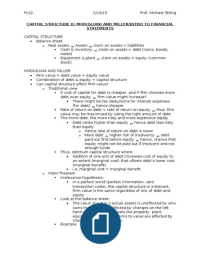
CAPITAL STRUCTURE II: MODIGLIANI AND MILLER/INTRO TO FINANCIAL
STATEMENTS
CAPITAL STRUCTURE
Balance sheet
o Real assets Assets claim on assets = liabilities
Cash & Inventory claim on assets = debt (loans, bonds,
notes)
Equipment & plant claim on assets = equity (common
stock)
MODIGLIANI AND MILLER
Firm value = debt value + equity value
Combination of debt & equity = capital structure
Can capital structure affect firm value?
o Traditional view
If cost of capital for debt is cheaper, and if firm chooses more
debt over equity firm value might increase?
There might be tax deductions for interest expenses
(for debt) hence cheaper
Rate of return on debt < rate of return on equity thus, firm
value may be maximised by using the right amount of debt
The more debt, the more risky and more expensive equity
Debt ranks higher than equity hence debt less risky
than equity
o Hence rate of return on debt is lower
o More debt higher risk of insolvency debt
paid out first before equity hence, chance that
equity might not be paid out if insolvent and not
enough funds
Thus, optimum capital structure where
Addition of one unit of debt increases cost of equity to
an extent (marginal cost) that offsets debt’s lower cost
(marginal benefit)
i.e. marginal cost = marginal benefit
o M&M Theorem
Irrelevance hypothesis:
In a perfect world (perfect information, zero
transaction costs), the capital structure is irrelevant.
Firm value is the same regardless of mix of debt and
equity
Look at the balance sheet:
The value of a firm’s actual assets is unaffected by who
owns them. Value is affected by changes on the left
hand side (debit, e.g. assets like property, plant,
equipment, etc.). Only claims to value are affected by
changes to right hand side.
Example
CAPITAL STRUCTURE II: MODIGLIANI AND MILLER/INTRO TO FINANCIAL
STATEMENTS
CAPITAL STRUCTURE
Balance sheet
o Real assets Assets claim on assets = liabilities
Cash & Inventory claim on assets = debt (loans, bonds,
notes)
Equipment & plant claim on assets = equity (common
stock)
MODIGLIANI AND MILLER
Firm value = debt value + equity value
Combination of debt & equity = capital structure
Can capital structure affect firm value?
o Traditional view
If cost of capital for debt is cheaper, and if firm chooses more
debt over equity firm value might increase?
There might be tax deductions for interest expenses
(for debt) hence cheaper
Rate of return on debt < rate of return on equity thus, firm
value may be maximised by using the right amount of debt
The more debt, the more risky and more expensive equity
Debt ranks higher than equity hence debt less risky
than equity
o Hence rate of return on debt is lower
o More debt higher risk of insolvency debt
paid out first before equity hence, chance that
equity might not be paid out if insolvent and not
enough funds
Thus, optimum capital structure where
Addition of one unit of debt increases cost of equity to
an extent (marginal cost) that offsets debt’s lower cost
(marginal benefit)
i.e. marginal cost = marginal benefit
o M&M Theorem
Irrelevance hypothesis:
In a perfect world (perfect information, zero
transaction costs), the capital structure is irrelevant.
Firm value is the same regardless of mix of debt and
equity
Look at the balance sheet:
The value of a firm’s actual assets is unaffected by who
owns them. Value is affected by changes on the left
hand side (debit, e.g. assets like property, plant,
equipment, etc.). Only claims to value are affected by
changes to right hand side.
Example