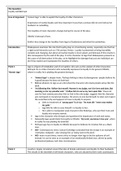
The Question:
Loyalty and Betrayal
Line of Argument ‘Honest Iago’ is able to exploit the loyalty of other characters.
Importance of marital loyalty and how important it was that a woman did not ever betray her
husband- ie cuckolding
The loyalties of most characters change during the course of the play.
Othello’s betrayal of love.
Emilia’s key change in her loyalties from Iago to Desdemona and what this symbolises.
Introduction Shakespeare examines the role that loyalty plays in a functioning society, especially one that has
a rigid social hierarchy such as 17th century Venice. Loyalty is presented as being incredibly
complex and changing, but above all marital loyalty is most valued, and betrayal of this results in
dire consequence by the end of the play. It is the character of Iago that Shakespeare presents as
the cause of all destruction in the play, as he highlights the damage that just one individual can
do if they exploit and manipulate the loyalties of others.
Point 1 Iago is a figure of temptation and of corruption, who acts as the catalyst of other characters
betrayal. He is a false character who outwardly expresses his loyalty to his general Othello,
‘Honest Iago’ where in reality he is plotting the greatest betrayal.
‘Honest Iago’ is deeply ironic. Perhaps linking to idea of physiognomy- people believe he
is good because he does not look bad.
Biblical allusions to Iago as an untrustworthy character who leads people astray like the
devil.
‘In following him I follow but myself. Heaven is my judge, not I for love and duty, But
seeming so for my peculiar end.’ ‘I follow him to serve my turn upon him.’ Does not
care for how anyone perceives him as God is the only judge- suggests that his character
acts not based on morals but impulse. He serves no one but himself, he does not respect
the social hierarchy and appears to have no loyalty to anyone:
o Links to treatment of ‘young quat’ Roderigo- ‘he must die’ ‘every way makes
my gain.’
o Iago kills his wife to save himself- no loyalty to her.
o He is able to manipulate weak characters like Roderigo, who put their trust and
loyalty into anyone naively.
Iago is the character who disrupts and questions the importance of rank and status.
Outwardly Iago would claim his loyalty to Othello: ‘My Lord, you know I love you’, when
in reality he was plotting his downfall.
Perhaps Iago has no loyalty to Othello because he believes he is below him as a black
man.
A05- Contemporary views: Samuel Coleridge concluded that the ensign is an example of
‘motiveless malignity’, also viewing him as ‘being next to the devil.’
A05- more recent times, many critics no longer view Iago to be the epitome of evil.
Instead, he can be seen as an example of an emotionally limited man, driven by petty
professional jealousy and class consciousness.
Point 2 Loyalty is largely circulated around the idea of female submission and loyalty to their husbands.
This results in the downfall of all female characters, who are abused by their male counterparts.
Loyalty and Betrayal
Line of Argument ‘Honest Iago’ is able to exploit the loyalty of other characters.
Importance of marital loyalty and how important it was that a woman did not ever betray her
husband- ie cuckolding
The loyalties of most characters change during the course of the play.
Othello’s betrayal of love.
Emilia’s key change in her loyalties from Iago to Desdemona and what this symbolises.
Introduction Shakespeare examines the role that loyalty plays in a functioning society, especially one that has
a rigid social hierarchy such as 17th century Venice. Loyalty is presented as being incredibly
complex and changing, but above all marital loyalty is most valued, and betrayal of this results in
dire consequence by the end of the play. It is the character of Iago that Shakespeare presents as
the cause of all destruction in the play, as he highlights the damage that just one individual can
do if they exploit and manipulate the loyalties of others.
Point 1 Iago is a figure of temptation and of corruption, who acts as the catalyst of other characters
betrayal. He is a false character who outwardly expresses his loyalty to his general Othello,
‘Honest Iago’ where in reality he is plotting the greatest betrayal.
‘Honest Iago’ is deeply ironic. Perhaps linking to idea of physiognomy- people believe he
is good because he does not look bad.
Biblical allusions to Iago as an untrustworthy character who leads people astray like the
devil.
‘In following him I follow but myself. Heaven is my judge, not I for love and duty, But
seeming so for my peculiar end.’ ‘I follow him to serve my turn upon him.’ Does not
care for how anyone perceives him as God is the only judge- suggests that his character
acts not based on morals but impulse. He serves no one but himself, he does not respect
the social hierarchy and appears to have no loyalty to anyone:
o Links to treatment of ‘young quat’ Roderigo- ‘he must die’ ‘every way makes
my gain.’
o Iago kills his wife to save himself- no loyalty to her.
o He is able to manipulate weak characters like Roderigo, who put their trust and
loyalty into anyone naively.
Iago is the character who disrupts and questions the importance of rank and status.
Outwardly Iago would claim his loyalty to Othello: ‘My Lord, you know I love you’, when
in reality he was plotting his downfall.
Perhaps Iago has no loyalty to Othello because he believes he is below him as a black
man.
A05- Contemporary views: Samuel Coleridge concluded that the ensign is an example of
‘motiveless malignity’, also viewing him as ‘being next to the devil.’
A05- more recent times, many critics no longer view Iago to be the epitome of evil.
Instead, he can be seen as an example of an emotionally limited man, driven by petty
professional jealousy and class consciousness.
Point 2 Loyalty is largely circulated around the idea of female submission and loyalty to their husbands.
This results in the downfall of all female characters, who are abused by their male counterparts.