— Attachment
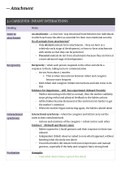
3.1 CAREGIVER-INFANT INTERACTIONS
Heading Notes
Intro to An attachment = a close two-way emotional bond between two individuals
attachment in which each sees the other as essential for their own emotional security
Do all animals form attachments?
- Only altricial animals form attachments - they are born at a
relatively early stage of development, so have to form attachments
with adults so that they can be protected
- Precocial animals do not form attachments because they are born at
a more advanced stage of developments
Reciprocity Reciprocity = when each person responds to the other and elicits a
response to them, taking turns in communication
- Occurs from about 3 months
→ This is when interactions between infant and caregiver
become more frequent
- Both infant and caregiver initiate interactions and take turns to do
this
Evidence for importance - still-face experiment (Edward Tronick)
- Mother interacting with child as normal, then the mother suddenly
stops giving verbal and physical feedback to the babies actions
- All the babies became distressed at this and tried a lot harder to get
the mother’s attention
- When the mother began interacting again, the babies calmed down
Interactional Interactional synchrony = when the caregiver and infant carry out the
synchrony same actions simultaneously
- Actions and emotions of the caregiver + infant mirror each other
Evidence - Meltzoff and Moore (1997)
- Babies exposed to 3 facial gestures and their response to these was
videoed
- Independent (blind) observer asked to note what happened, without
knowing what the study was about
- Found that babies did imitate both facial expressions and manual
gestures, especially if the baby and caregiver had a strong bond
Evaluation Strengths
+ Controlled observations capture fine detail
, → Observations done of mother and infant are well controlled,
often filmed from various angles so they can capture fine
details
→ Babies won’t really know or care that they’re being observed
so there will be no demand characteristics - can still have
different behaviour but not due to ^ - therefore the research
has good validity
Weaknesses
- It is hard to know what is happening when observing infants
→ All we observe are hand movements or changes in
expressions - making assumptions about why this is
happening
→ Can’t know what is happening from the infants’ perspective
and any special meanings → subjective conclusions
3.2 SCHAFFER’S STAGES OF ATTACHMENT
Heading Notes
The study Schaffer and Emerson, 1964
- Longitudinal study → followed the same participants for a long time
- 60 newborn babies and their mothers - most from working class
families in Glasgow
- Visited once a month for 2 ½ years, and the mothers were also
interviewed (and kept a diary to log their children’s behaviour)
- Separation anxiety was measured by asking the mother how her
child responded to situations such as an adult leaving the room
- Stranger anxiety was measured by asking mothers about the child’s
anxiety response to unfamiliar adults
Findings - 50% of babies showed separation anxiety towards a particular adult
between 6 & 8 months old (usually the mother)
- After 18 months, 87% of the babies had at least two attachments
- Babies tended to attach to the caregiver who was most interactive
and sensitive to their signals and facial expressions - where there
was reciprocity
→ This wasn't necessarily the person they spent the most time
with
Stages of
STAGE AGE KEY FEATURES
attachment
Pre-attachment First few Babies' behaviour towards non-humans
phase/asocial weeks objects and humans is similar. Babies
show small preferences to familiar
, adults. Babies are also happier when in
the presence of other humans.
Indiscriminate 2-7 Babies display more social behaviour.
attachment months Show preference for people rather than
phase objects. Some preference for familiar
adults. Indiscriminate because it is not
different towards any one person.
Discriminate 7 months Display anxiety towards strangers and
attachment are anxious when separated from one
phase/specific particular adult (65% cases it’s the
mother). Formed specific attachment
(primary) to person who offers most
interaction
Multiple 7 months Babies show attachment towards other
attachment onwards adults who they spend time with. Called
phase secondary attachments. By the end of
one year most had developed multiple
attachments.
Evaluation Strengths
+ Good external validity
→ Most observations were made by parents during ordinary
activity and then told to researchers
→ Therefore behaviour of babies is unlikely to have been
different due to the presence of observers → more natural
behaviour
+ Study carried out longitudinally
→ Same children followed up and observed regularly
→ Eliminates any possibilities of participant variables → better
internal validity
→ The alternative would have been to observe multiple children
at different ages but this would have a big problem
Weaknesses
- However, the mothers may not have been objective
→ May have been biased in what they noticed/reported, even if
this was unintentional (demand characteristics from the
mother)
→ Also could have missed key behaviours (e.g. when the mother
is out of the room)
→ Although the babies’ behaviour might have been natural, it
may not have been accurately reported
- Issues with how they assessed multiple attachment
→ Just because a baby gets upset when an individual leaves the
room it doesn’t mean they’ve formed a true attachment to
them (that’s how they measured it)
3.1 CAREGIVER-INFANT INTERACTIONS
Heading Notes
Intro to An attachment = a close two-way emotional bond between two individuals
attachment in which each sees the other as essential for their own emotional security
Do all animals form attachments?
- Only altricial animals form attachments - they are born at a
relatively early stage of development, so have to form attachments
with adults so that they can be protected
- Precocial animals do not form attachments because they are born at
a more advanced stage of developments
Reciprocity Reciprocity = when each person responds to the other and elicits a
response to them, taking turns in communication
- Occurs from about 3 months
→ This is when interactions between infant and caregiver
become more frequent
- Both infant and caregiver initiate interactions and take turns to do
this
Evidence for importance - still-face experiment (Edward Tronick)
- Mother interacting with child as normal, then the mother suddenly
stops giving verbal and physical feedback to the babies actions
- All the babies became distressed at this and tried a lot harder to get
the mother’s attention
- When the mother began interacting again, the babies calmed down
Interactional Interactional synchrony = when the caregiver and infant carry out the
synchrony same actions simultaneously
- Actions and emotions of the caregiver + infant mirror each other
Evidence - Meltzoff and Moore (1997)
- Babies exposed to 3 facial gestures and their response to these was
videoed
- Independent (blind) observer asked to note what happened, without
knowing what the study was about
- Found that babies did imitate both facial expressions and manual
gestures, especially if the baby and caregiver had a strong bond
Evaluation Strengths
+ Controlled observations capture fine detail
, → Observations done of mother and infant are well controlled,
often filmed from various angles so they can capture fine
details
→ Babies won’t really know or care that they’re being observed
so there will be no demand characteristics - can still have
different behaviour but not due to ^ - therefore the research
has good validity
Weaknesses
- It is hard to know what is happening when observing infants
→ All we observe are hand movements or changes in
expressions - making assumptions about why this is
happening
→ Can’t know what is happening from the infants’ perspective
and any special meanings → subjective conclusions
3.2 SCHAFFER’S STAGES OF ATTACHMENT
Heading Notes
The study Schaffer and Emerson, 1964
- Longitudinal study → followed the same participants for a long time
- 60 newborn babies and their mothers - most from working class
families in Glasgow
- Visited once a month for 2 ½ years, and the mothers were also
interviewed (and kept a diary to log their children’s behaviour)
- Separation anxiety was measured by asking the mother how her
child responded to situations such as an adult leaving the room
- Stranger anxiety was measured by asking mothers about the child’s
anxiety response to unfamiliar adults
Findings - 50% of babies showed separation anxiety towards a particular adult
between 6 & 8 months old (usually the mother)
- After 18 months, 87% of the babies had at least two attachments
- Babies tended to attach to the caregiver who was most interactive
and sensitive to their signals and facial expressions - where there
was reciprocity
→ This wasn't necessarily the person they spent the most time
with
Stages of
STAGE AGE KEY FEATURES
attachment
Pre-attachment First few Babies' behaviour towards non-humans
phase/asocial weeks objects and humans is similar. Babies
show small preferences to familiar
, adults. Babies are also happier when in
the presence of other humans.
Indiscriminate 2-7 Babies display more social behaviour.
attachment months Show preference for people rather than
phase objects. Some preference for familiar
adults. Indiscriminate because it is not
different towards any one person.
Discriminate 7 months Display anxiety towards strangers and
attachment are anxious when separated from one
phase/specific particular adult (65% cases it’s the
mother). Formed specific attachment
(primary) to person who offers most
interaction
Multiple 7 months Babies show attachment towards other
attachment onwards adults who they spend time with. Called
phase secondary attachments. By the end of
one year most had developed multiple
attachments.
Evaluation Strengths
+ Good external validity
→ Most observations were made by parents during ordinary
activity and then told to researchers
→ Therefore behaviour of babies is unlikely to have been
different due to the presence of observers → more natural
behaviour
+ Study carried out longitudinally
→ Same children followed up and observed regularly
→ Eliminates any possibilities of participant variables → better
internal validity
→ The alternative would have been to observe multiple children
at different ages but this would have a big problem
Weaknesses
- However, the mothers may not have been objective
→ May have been biased in what they noticed/reported, even if
this was unintentional (demand characteristics from the
mother)
→ Also could have missed key behaviours (e.g. when the mother
is out of the room)
→ Although the babies’ behaviour might have been natural, it
may not have been accurately reported
- Issues with how they assessed multiple attachment
→ Just because a baby gets upset when an individual leaves the
room it doesn’t mean they’ve formed a true attachment to
them (that’s how they measured it)