Cross cultural marketing aantekeningen & samenvatting
Lecture 2:
Perception:
Schwartz human values 10:
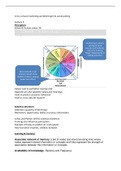
SCHWARTZ HUMAN VALUES (SCHWARTZ 1992, 2001)
Conforming to others,
valuing personal
security and traditions,
not prone to doing
things independently or
seeking adventure
Conservation
Resultant
More inclined to self
interest instead of the
welfare of others, seeking
power over others
Resultant
Self
Enhancement
Values next to eachother overlap a bit
Opposite are also opposite values and meanings
Used to predict consumer behaviour
Used in cross cultural research
Selective attention:
Attention caused by three things:
Motivation, opportunity, ability to process information.
Loftus and Palmer (1974): selective distortion
Framing also influences perception:
Example of frases to predict car crash speed:
How fast when smashes, collided, bumped.
Learning & memory:
Associate network of memory: a set of nodes and interconnecting links where
nodes represent stored information or concepts and links represent the strength of
association between this information or concepts
Availability of knowledge: Recency and Frequency
, Evaluative conditioning: changes in the liking of a stimulus that are due to the fact
that the stimulus has been paired with other, positive or negative, stimuli (de Houwer
et al., 2001)
Priming: exposure to one stimulus influences the response to another
MEMORY: EBBINGHAUS
Social FORGETTING
learning: Observations CURVE
of behavior of others can also lead to learning
http://psychclassics.yorku.ca/Ebbinghaus/index.htm
Ebbinghaus forgetting curve:
LEARNING & MEMORY
Dual process theory
Kahneman, 2003: system 1 and system 2
10
Petty & Cacioppo, 1986: Elaboration likelihood model
System 1 System 2
Hot Cold
Intuition Reasoning
Impulsive Reflexive
Unconscious Conscious
Emotional Rational
Automatic Controlled
Fast Slow
Low effort High effort
13
System 1 low level not thoughtfull oppervlakkig
System 2 high level doordacht
, ELABORATION LIKELIHOOD MODEL PETTY& CACIOPPO:
Motivation:
14
Maslow , 1954
Physiological needs:
• Food, shelter and transportation
• Cheaper affordable things
Safety needs:
MOTIVATION
• Retirement funds, self-defense classes and self-defense videos and books
• Nanny cameras, guns and alarm systems
Maslow, 1954
Love and belonging needs:
No strict hierarchy
Self
actualization
• Magazines and things to keep them updated
Different cultures en/discourage Esteem needs
• Name brand items to help them fit
the pursuit of different needs:
• Perfumes, make-up and clothes to attract and
e.g., Hindu self-actualization Social needs
gain love e.g., conspicuous consumption
• Self-improvement books to avoid criticism and
Safety needs
be accepted
Physiological needs
Esteem needs:
20
• Work-out equipment; healthy foods
• Books to gain power and control
• Online financial investments to have control over money
• Anti-ageing cosmetics to look younger
• Expensive clothes, cars, etc. to feel superior
, Self-actualization:
• Art, flowers and beautiful things
• Travel for enjoyment
• Reading books for intellectual stimulation
• Charity items and spontaneous gifts to feel joy when other people are happy
MOTIVATIONS: WHY DO WE WANT BRANDS
Branding literature, Park, 2013 Manage problems in daily life,
simplify daily activities
Functional
needs
Communicate to
others who you are or
want to be
Symbolic Hedonic
needs needs Provide pleasure,
enjoyment
Park, C. W., Eisingerich, A. B., & Park, J. W. (2013). Attachment–aversion (AA) model of customer–brand
22 relationships. Journal of Consumer Psychology, 23(2), 229-248.
Consumer behavior:
Consumption experiences:
CONSUMPTION EXPERIENCES
Cultural variations in eating
1. Ways of shopping
2. Quality aspects
3. Cooking methods
4. Consumption situations
5. Purchase motives
26
Lecture 2:
Perception:
Schwartz human values 10:
SCHWARTZ HUMAN VALUES (SCHWARTZ 1992, 2001)
Conforming to others,
valuing personal
security and traditions,
not prone to doing
things independently or
seeking adventure
Conservation
Resultant
More inclined to self
interest instead of the
welfare of others, seeking
power over others
Resultant
Self
Enhancement
Values next to eachother overlap a bit
Opposite are also opposite values and meanings
Used to predict consumer behaviour
Used in cross cultural research
Selective attention:
Attention caused by three things:
Motivation, opportunity, ability to process information.
Loftus and Palmer (1974): selective distortion
Framing also influences perception:
Example of frases to predict car crash speed:
How fast when smashes, collided, bumped.
Learning & memory:
Associate network of memory: a set of nodes and interconnecting links where
nodes represent stored information or concepts and links represent the strength of
association between this information or concepts
Availability of knowledge: Recency and Frequency
, Evaluative conditioning: changes in the liking of a stimulus that are due to the fact
that the stimulus has been paired with other, positive or negative, stimuli (de Houwer
et al., 2001)
Priming: exposure to one stimulus influences the response to another
MEMORY: EBBINGHAUS
Social FORGETTING
learning: Observations CURVE
of behavior of others can also lead to learning
http://psychclassics.yorku.ca/Ebbinghaus/index.htm
Ebbinghaus forgetting curve:
LEARNING & MEMORY
Dual process theory
Kahneman, 2003: system 1 and system 2
10
Petty & Cacioppo, 1986: Elaboration likelihood model
System 1 System 2
Hot Cold
Intuition Reasoning
Impulsive Reflexive
Unconscious Conscious
Emotional Rational
Automatic Controlled
Fast Slow
Low effort High effort
13
System 1 low level not thoughtfull oppervlakkig
System 2 high level doordacht
, ELABORATION LIKELIHOOD MODEL PETTY& CACIOPPO:
Motivation:
14
Maslow , 1954
Physiological needs:
• Food, shelter and transportation
• Cheaper affordable things
Safety needs:
MOTIVATION
• Retirement funds, self-defense classes and self-defense videos and books
• Nanny cameras, guns and alarm systems
Maslow, 1954
Love and belonging needs:
No strict hierarchy
Self
actualization
• Magazines and things to keep them updated
Different cultures en/discourage Esteem needs
• Name brand items to help them fit
the pursuit of different needs:
• Perfumes, make-up and clothes to attract and
e.g., Hindu self-actualization Social needs
gain love e.g., conspicuous consumption
• Self-improvement books to avoid criticism and
Safety needs
be accepted
Physiological needs
Esteem needs:
20
• Work-out equipment; healthy foods
• Books to gain power and control
• Online financial investments to have control over money
• Anti-ageing cosmetics to look younger
• Expensive clothes, cars, etc. to feel superior
, Self-actualization:
• Art, flowers and beautiful things
• Travel for enjoyment
• Reading books for intellectual stimulation
• Charity items and spontaneous gifts to feel joy when other people are happy
MOTIVATIONS: WHY DO WE WANT BRANDS
Branding literature, Park, 2013 Manage problems in daily life,
simplify daily activities
Functional
needs
Communicate to
others who you are or
want to be
Symbolic Hedonic
needs needs Provide pleasure,
enjoyment
Park, C. W., Eisingerich, A. B., & Park, J. W. (2013). Attachment–aversion (AA) model of customer–brand
22 relationships. Journal of Consumer Psychology, 23(2), 229-248.
Consumer behavior:
Consumption experiences:
CONSUMPTION EXPERIENCES
Cultural variations in eating
1. Ways of shopping
2. Quality aspects
3. Cooking methods
4. Consumption situations
5. Purchase motives
26