P1 Matter Definitions:
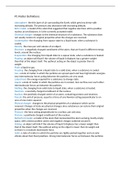
Atmosphere- the thin layer of air surrounding the Earth, which gets less dense with
increasing altitude. The pressure also decreases with increasing altitude.
Bohr model- a model of the atom that suggested that negative electrons orbit a positive
nucleus at set distances. It is the currently accepted model.
Chemical changes- changes to the chemical structure of a substance. The substance does
not usually restore its original properties when the changes are reversed.
Condensation- the changing from vapour state to a liquid state, when a substance is
cooled.
Density- the mass per unit volume of an object.
Electrons- a negatively charged constituent of the atom, that are found in different energy
levels, around the nucleus.
Evaporation- the changing from liquid state to a vapour state, when a substance is heated.
Floating- an object will float if the volume of liquid it displaces has a greater weight
than that of the object itself. The upthrust acting on the object is greater than its
weight.
Fluid- a liquid or gas.
Freezing- the changing from a liquid state to a solid state, when a substance is cooled.
Gas- a state of matter in which the particles are spread apart and have high kinetic energies.
Any intermolecular forces acting between the particles are very weak.
Latent heat- the energy required for a substance to change state.
Liquid- a state of matter in which the particles are in contact, but can flow over each other.
Intermolecular forces act between the particles.
Melting- the changing from solid state to liquid state, when a substance is heated.
Neutrons- a neutrally charged constituent of the nucleus.
Nucleus- the positively charged centre of an atom, containing protons and neutrons.
Pascals- the unit of pressure, equal to a force of one Newton acting perpendicular to an
area of one metre squared.
Physical changes- changes to the physical properties of a substance which can be
reversed. Changes of state are physical changes since substances can restore their original
properties when the changes are reversed.
Pressure- the force acting perpendicular to a surface, per unit area.
Protons- a positively charged constituent of the nucleus.
Rutherford model- a model of the atom that represented the atom as being mostly empty
space, with a dense positive centre and negative charges scattered around it.
Sinking- an object will sink if the volume of liquid it displaces has a lower weight than
that of the object itself. The upthrust acting on the object is lower than its weight and
so there is a resultant downwards force.
Solid- a state of matter in which the particles are tightly packed together and can only
vibrate about their fixed positions. Strong intermolecular forces act between the particles
https://bit.ly/pmt-cc
https
Atmosphere- the thin layer of air surrounding the Earth, which gets less dense with
increasing altitude. The pressure also decreases with increasing altitude.
Bohr model- a model of the atom that suggested that negative electrons orbit a positive
nucleus at set distances. It is the currently accepted model.
Chemical changes- changes to the chemical structure of a substance. The substance does
not usually restore its original properties when the changes are reversed.
Condensation- the changing from vapour state to a liquid state, when a substance is
cooled.
Density- the mass per unit volume of an object.
Electrons- a negatively charged constituent of the atom, that are found in different energy
levels, around the nucleus.
Evaporation- the changing from liquid state to a vapour state, when a substance is heated.
Floating- an object will float if the volume of liquid it displaces has a greater weight
than that of the object itself. The upthrust acting on the object is greater than its
weight.
Fluid- a liquid or gas.
Freezing- the changing from a liquid state to a solid state, when a substance is cooled.
Gas- a state of matter in which the particles are spread apart and have high kinetic energies.
Any intermolecular forces acting between the particles are very weak.
Latent heat- the energy required for a substance to change state.
Liquid- a state of matter in which the particles are in contact, but can flow over each other.
Intermolecular forces act between the particles.
Melting- the changing from solid state to liquid state, when a substance is heated.
Neutrons- a neutrally charged constituent of the nucleus.
Nucleus- the positively charged centre of an atom, containing protons and neutrons.
Pascals- the unit of pressure, equal to a force of one Newton acting perpendicular to an
area of one metre squared.
Physical changes- changes to the physical properties of a substance which can be
reversed. Changes of state are physical changes since substances can restore their original
properties when the changes are reversed.
Pressure- the force acting perpendicular to a surface, per unit area.
Protons- a positively charged constituent of the nucleus.
Rutherford model- a model of the atom that represented the atom as being mostly empty
space, with a dense positive centre and negative charges scattered around it.
Sinking- an object will sink if the volume of liquid it displaces has a lower weight than
that of the object itself. The upthrust acting on the object is lower than its weight and
so there is a resultant downwards force.
Solid- a state of matter in which the particles are tightly packed together and can only
vibrate about their fixed positions. Strong intermolecular forces act between the particles
https://bit.ly/pmt-cc
https