A101 Introduction to Aerodynamics Section 1-5
__________________________________________________________________________
Outline
• We have previously considered a control volume when considering the conservation of
mass.
• We have also introduced/reviewed partial differentiation.
• Today we will use both these ideas to form the basic equation governing hydrostatics
• Whilst you may be familiar with the results from your previous studies try and follow the
form of the formulation since we will re-use these ideas in deriving the governing
equations of conservation of mass and momentum.
Hydrostatics
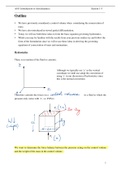
There is no motion of the fluid to consider.
Z
Although we typically use ‘y’ as the vertical
coordinate we shall use adopt the convention of
using ‘z’ in our discussion of hydrostatics since
this is the normal convention
yl
I
Therefore consider the forces on a control volume in a fluid in which the
pressure only varies with ‘z’, i.e. P=P(z).
P2 Ga)
' 1111
-
baby
wt b-
! Eddy
(
weight) f ← son
G)
P1
We want to determine the force balance between the pressure acting on the control volume
and the weight of the mass in the control volume.
1
, A101 Introduction to Aerodynamics Section 1-5
__________________________________________________________________________
Vertical force acting on control volume due to pressure.
= Area Lover Area
Upper pressure x -
pressure x
= - P2 ΔxΔy + P1 ΔxΔy
= -
( Pa + Pi ) Doody
=
D
Doody
-
p
This force must be balanced by the weight of the fluid in the control volume, i.e. W = mg
where, g, is the acceleration due to gravity. Therefore the force due to gravity (which acts
downwards)
pbxbybzg
-W= -mg = -
Net force = 0 = Force on CV due to pressure + Force on CV due to weight
Dp doc by Doody bag
=
p
-
-
O =
Dada
-
pg
-
Taking the limit as Δz →0 we obtain
dp
= − ρg (1)
dz
If we know how ρ varies with ‘z’ and g is a constant then we can integrate this equation.
Z constant
pg
For example if ρ = constant then P = -
t
Or
P constant
pg
z
-
t -
Pg 6)
z
Pat
h -
p a
pgh =
P
Pa
pgh
- -
-
0 P=Pa
If P = Pa at z = 0 then at z = h we have
2
__________________________________________________________________________
Outline
• We have previously considered a control volume when considering the conservation of
mass.
• We have also introduced/reviewed partial differentiation.
• Today we will use both these ideas to form the basic equation governing hydrostatics
• Whilst you may be familiar with the results from your previous studies try and follow the
form of the formulation since we will re-use these ideas in deriving the governing
equations of conservation of mass and momentum.
Hydrostatics
There is no motion of the fluid to consider.
Z
Although we typically use ‘y’ as the vertical
coordinate we shall use adopt the convention of
using ‘z’ in our discussion of hydrostatics since
this is the normal convention
yl
I
Therefore consider the forces on a control volume in a fluid in which the
pressure only varies with ‘z’, i.e. P=P(z).
P2 Ga)
' 1111
-
baby
wt b-
! Eddy
(
weight) f ← son
G)
P1
We want to determine the force balance between the pressure acting on the control volume
and the weight of the mass in the control volume.
1
, A101 Introduction to Aerodynamics Section 1-5
__________________________________________________________________________
Vertical force acting on control volume due to pressure.
= Area Lover Area
Upper pressure x -
pressure x
= - P2 ΔxΔy + P1 ΔxΔy
= -
( Pa + Pi ) Doody
=
D
Doody
-
p
This force must be balanced by the weight of the fluid in the control volume, i.e. W = mg
where, g, is the acceleration due to gravity. Therefore the force due to gravity (which acts
downwards)
pbxbybzg
-W= -mg = -
Net force = 0 = Force on CV due to pressure + Force on CV due to weight
Dp doc by Doody bag
=
p
-
-
O =
Dada
-
pg
-
Taking the limit as Δz →0 we obtain
dp
= − ρg (1)
dz
If we know how ρ varies with ‘z’ and g is a constant then we can integrate this equation.
Z constant
pg
For example if ρ = constant then P = -
t
Or
P constant
pg
z
-
t -
Pg 6)
z
Pat
h -
p a
pgh =
P
Pa
pgh
- -
-
0 P=Pa
If P = Pa at z = 0 then at z = h we have
2