AERO40001 Aerodynamics I Section 1-6
__________________________________________________________________________
Outline
• We have introduced the basic idea of flow over an aerofoil where we saw that forces are
usually expressed in terms of non-dimensional form.
• Today we shall discuss the concept of dimensional analysis which is
an important tool in analysis of fluid mechanics.
• We will use this analysis to define non-dimensional force coefficients.
• Will also allow us to introduce the concept of total, dynamic and static pressure.
• Finally we will also discuss a very important non-dimensional number for
number
incompressible flow known as the
Reynolds
Dimensional Analysis
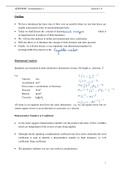
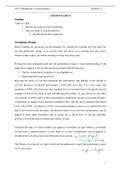
Quantities are measured in units which have dimensions of mass, M, length, L, and time, T.
4T
e.g. I
LT
-
=
Velocity m/s
4 T2 =L T 2
-
Acceleration m/s2
ML
IT ? MLT Z
-
Force (mass x acceleration in Newtons)
-
/ L2
t -
N/m2 MLT 2
ML
-
Pressure T
-
=
Density kg/m3 '
Viscosity C )
kg/m/s
M
lL = MLS
I
' -
T
-
MIC Lt ) = ML
All terms in an equation must have the same dimensions. e.g. we can equate forces but we
cannot equate a force to an acceleration or a pressure or a velocity.
Dimensionless Numbers or Coefficient
• As the name suggests dimensionless numbers are the product and ratios of flow variables
which are independent of the system of units being applied.
• Although strictly speaking a mathematical coefficient may have units commonly the word
coefficient is used to identify a dimensionless number in fluid dynamics, i.e. Lift
coefficient, Drag coefficient.
• The quantities outlined over are very useful in aerodynamics.
1
, AERO40001 Aerodynamics I Section 1-6
__________________________________________________________________________
Examples: (i) Pressure Coefficient. Cp
We measure the pressure difference p - P
N
Later in the course we shall show that the pressure is proportional to both density and the square
of velocity. i.e. p ← x Uts
pas
has units of
E. ⇐HE which is the same as pressure.
Therefore the ratio is dimensionless a number.
However it is conventional to divide by - this is called the dynamic pressure
of a stream.
previously we
just caused this pressure
-
The addition of the static pressure and the dynamic pressure is called the total pressure, Po
Total
pressure = Static Pressure
a
+
Dynamic Pressure
← -
The total pressure can be measured by using a Pitot tube - a tube pointing into the flow.
connected to a manometer the air flow is
brought to rest at the face of the tube.
We have already considered a static presssure tapping and so from this equation, which is also
known as Bernoulli 's equation we could calculate the velocity. We will return to
this equation later in the course.
2
__________________________________________________________________________
Outline
• We have introduced the basic idea of flow over an aerofoil where we saw that forces are
usually expressed in terms of non-dimensional form.
• Today we shall discuss the concept of dimensional analysis which is
an important tool in analysis of fluid mechanics.
• We will use this analysis to define non-dimensional force coefficients.
• Will also allow us to introduce the concept of total, dynamic and static pressure.
• Finally we will also discuss a very important non-dimensional number for
number
incompressible flow known as the
Reynolds
Dimensional Analysis
Quantities are measured in units which have dimensions of mass, M, length, L, and time, T.
4T
e.g. I
LT
-
=
Velocity m/s
4 T2 =L T 2
-
Acceleration m/s2
ML
IT ? MLT Z
-
Force (mass x acceleration in Newtons)
-
/ L2
t -
N/m2 MLT 2
ML
-
Pressure T
-
=
Density kg/m3 '
Viscosity C )
kg/m/s
M
lL = MLS
I
' -
T
-
MIC Lt ) = ML
All terms in an equation must have the same dimensions. e.g. we can equate forces but we
cannot equate a force to an acceleration or a pressure or a velocity.
Dimensionless Numbers or Coefficient
• As the name suggests dimensionless numbers are the product and ratios of flow variables
which are independent of the system of units being applied.
• Although strictly speaking a mathematical coefficient may have units commonly the word
coefficient is used to identify a dimensionless number in fluid dynamics, i.e. Lift
coefficient, Drag coefficient.
• The quantities outlined over are very useful in aerodynamics.
1
, AERO40001 Aerodynamics I Section 1-6
__________________________________________________________________________
Examples: (i) Pressure Coefficient. Cp
We measure the pressure difference p - P
N
Later in the course we shall show that the pressure is proportional to both density and the square
of velocity. i.e. p ← x Uts
pas
has units of
E. ⇐HE which is the same as pressure.
Therefore the ratio is dimensionless a number.
However it is conventional to divide by - this is called the dynamic pressure
of a stream.
previously we
just caused this pressure
-
The addition of the static pressure and the dynamic pressure is called the total pressure, Po
Total
pressure = Static Pressure
a
+
Dynamic Pressure
← -
The total pressure can be measured by using a Pitot tube - a tube pointing into the flow.
connected to a manometer the air flow is
brought to rest at the face of the tube.
We have already considered a static presssure tapping and so from this equation, which is also
known as Bernoulli 's equation we could calculate the velocity. We will return to
this equation later in the course.
2