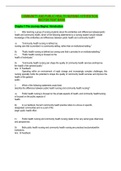
COMMUNITY AND PUBLIC HEALTH NURSING 10TH EDITION RECTOR TEST BANK
Chapter 1 The Journey Begins: Introduction 1. After teaching a group of nursing students about the similarities and differences between public health and community health, which of the following statements by a nursing student would indicate knowledge of the similarities and differences between public health and community health? A) “Community health nursing is defined as nursing care that is provided in a community setting, rather than an institutional setting.” B) “Public health nursing is defined as nursing care that is provided in an institutional setting.” C) “Public health nursing is focused on the health of individuals.” D) “Community health nursing can shape the quality of community health services and improve the health of the general public.” Ans: D Feedback: Operating within an environment of rapid change and increasingly complex challenges, this nursing specialty holds the potential to shape the quality of community health services and improve the health of the general public. 2. Which of the following statements would best describe the difference between public health nursing and community health nursing? A) Public health nursing is focused on the private aspects of health, and community health nursing is focused on the public aspects of health. B) In our textbook, the term community health practice refers to a focus on specific, designated communities and is a part of the larger public health effort. C) Public health nursing and community health nursing relate to the very same types of services and perspectives. D) Both public health nursing and community health nursing are practiced exclusively within institutions. Ans: B Feedback: In this textbook, community health practice refers to a focus on specific, designated communities. It is a part of the larger public health effort and recognizes the fundamental concepts and principles of public health as its birthright and foundation for practice. Public health nursing is focused on the public aspects of health. Public health nursing and community health nursing have distinctive types of services and perspectives. Neither public health nursing nor community health nursing is practiced exclusively within institutions. 3. Which of the following is most accurate about the concept of community? A) A community is a collection of people who share some important features of their lives. B) Community members live in the same geographic location. C) Community members are biologically related. D) A community is made up of people who do not necessarily interact with one another and do not necessarily share a sense of belonging to that group. Ans: A Feedback: The broad definition of a community is a collection of people who share some important features of their lives. Community members may not live in the same geographic location as in a common-interest community or a community of solution. A population is made up of people who do not necessarily interact with one another and do not necessarily share a sense of belonging to that group. 4. A group of students are reviewing material for a test on populations, communities, and aggregates. Which of the following indicates that the students understand these concepts? A) Members of a population share a sense of belonging. B) Communities and populations are types of aggregates. C) Individuals of a community are loosely connected. D) Members of an aggregate share a strong bond. Ans: B Feedback: An aggregate refers to a mass of grouping of distinct individuals who are considered as a whole and who are loosely associated with one another. Communities and populations are types of aggregates. A population is made up of people who do not necessarily interact with one another and do not necessarily share a sense of belonging to the group. A community is a collection of people who chose to interact with one another because of common interests, characteristics, or goals, which form the basis for a sense of unity or belonging. 5. Which of the following would a community health nurse identify as a community of common interest? A) The global community B) Small rural town in a northern state C) National professional organization D) Counties addressing water pollution Ans: C Feedback: A common-interest community shares a common interest or goal that binds the members together. Membership in a national professional organization is one example. The global community and a small rural town in a northern state would be examples of a geographic community. Counties addressing a water pollution problem would be an example of a community of solution. 6. The nurse is working with a community of solution. Which of the following would the nurse expect to find? A) A health problem affecting the group B) Common goal binding members together C) Sharing of a similar goal D) Locational boundaries Ans: A Feedback: A community of solution involves a group of people coming together to solve a problem that affects them. A common-interest community involves a collection of people widely scattered geographically who have an interest or goal that binds the members together. A geographical community is one defined by its geographical or locational boundaries. 7. Which one of the following statements made by a student would the nurse educator recognize as evidence that a student understands the health continuum? A) The distinction between health and illness is well demarcated. B) Illness refers to a state of being relatively unhealthy. C) The term health is limited to reflect an individual's state. D) Treatment of acute conditions reflects the current focus of health care. Ans: B Feedback: Although society typically depicts an absolute line of difference between being either well or ill, health is considered a relative term. Thus, illness is viewed as a state of being relatively unhealthy. Health is typically described as a continuum that involves a range of degrees from optimal health at one end to total disability or death at the other. The line of demarcation is not clear. Health applies to individuals, families, and communities. Traditionally, most health care has focused on the treatment of acute and chronic conditions at the illness end of the continuum, but this emphasis is shifting to focus on the wellness end. 8. When discussing the concept of the health continuum with a class, the nurse educator would be certain to include which statement in the description? A) Wellness is a relative concept, not an absolute, and illness is a state of being relatively unhealthy. B) A client's placement on the health continuum is static throughout time. C) Health is best described as cyclic. D) The health continuum can only be applied to individuals. Ans: A Feedback: Wellness is a relative concept, not an absolute, and illness is a state of being relatively unhealthy. The continuum can change. Because health involves a range of degrees from optimal health at one end to total disability or death at the other, it is often described as a continuum. The health continuum applies not only to individuals but also to families and communities. 9. After discussing the leading health indicators with a class, which condition if stated by the class as one of these indicators suggests that the class has understood the information? A) Cardiac disease B) Mental health C) Sedentary lifestyle D) Maternal health care Ans: B Feedback: Mental health is a leading health indicator. Other leading health indicators include physical activity, overweight and obesity, tobacco use, substance use, responsible sexual behavior, injury and violence, environmental quality, immunization, and access to health care. 10. Which of the following statements about health promotion and disease prevention is the most accurate? A) Health promotion and disease prevention include all efforts that seek to move people closer to optimal well-being or higher levels of wellness. B) Disease prevention differs from health promotion in that disease prevention is targeted toward a specific disease or diseases. C) Health promotion can be described in terms of primary, secondary, and tertiary prevention. D) The goal of disease prevention is to raise levels of wellness for individuals, families, populations, and communities. Ans: B Feedback: Health promotion includes all efforts that seek to move people closer to optimal well- being or higher levels of wellness. The goal of health promotion is to raise levels of wellness for individuals, families, populations, and communities. Disease prevention is targeted toward a specific disease or diseases and consists of primary, secondary, and tertiary prevention. 11. A group of community health nursing students design a health education program for a group of pregnant teens that includes teaching nutrition during pregnancy, demonstrating helpful exercises, and discussing their concerns. This is an example of which of the following? A) Health promotion B) Treatment of disorders C) Rehabilitation D) Evaluation Ans: A Feedback: The student nurses are engaging in health promotion activities. Health promotion incorporates all efforts that seek to move people closer to optimal well-being or to higher levels of wellness. Treatment of disorders would include direct car
Escuela, estudio y materia
- Institución
- Chamberlain College Of Nursng
- Grado
- COMMUNITY AND PUBLIC HEALTH NURSING 10TH EDITION
Información del documento
- Subido en
- 22 de agosto de 2022
- Número de páginas
- 330
- Escrito en
- 2022/2023
- Tipo
- Examen
- Contiene
- Preguntas y respuestas
Temas
-
community and public health nursing 10th edition rector test bank
-
community and public health
-
community and public health 10th edition rector test bank
-
community and public health nursing 10th editio

Documento también disponible en un lote