Practice Exam for ST260 Midterm
Multiple Choice Questions:
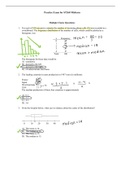
1. For each of 100 successive minutes the number of incoming phone calls (X) was recorded in a
switchboard. The frequency distribution of the number of calls, which could be plotted as a
histogram, was
20
\
= =
^ x Frequency mean
Lili
0 33
1 38
2 18 → median
-
-
18
3 8
4 3
-
mean > median
Total 100
O l 23 4
The histogram for these data would be
A) symmetric.
B) skewed to the left.
✓ -
C) skewed to the right.
D) of indeterminate skewness.
2. The leading countries in auto production in 1987 were (in millions):
France 0
3.0
% 4.31-27.2 11.24g
Japan 7.9 =
=
West Germany 4.3
USA 7.1
The median production of these four countries is approximately
A) 6.1
÷
B) 5.7
C) 4.3
D) 5.6
3. From the boxplot below, what can we deduce about the centre of the distribution?
__________
-------|___|______|----------------------
---|---------|----------|----------|----------|------ 14
median
-_
0 10 20 30 40
:
A) The mean is 14.
I
B) The median is 14.
C) The mean is 15.
D) The median is 15.
, 4. An appliance store recorded its monthly sales of microwave ovens for 20 months and ordered
them as follows:
median
ish
-
-
;,yy'##
123, 126, 140, 141, 152 152, 152, 160, 164, 165
172, 179, 183, 183,O192 198, 210, 231, 233, 274
I,inwdfediganQy*
*
' 168.5
The third quartile for the monthly sales over the 20 months is:
A) 231
-192+2-198
€
B) 195 Third Quarter
C) 152 -
D) 140 = 195
5. There are three children in a room, ages three, four and five. If a four-year-old child enters the
room the
=
A)
B)
mean age will stay the same but the variance will increase.
mean age will stay the same but the variance will decrease.
:÷÷÷÷÷÷
=itqt
C) mean age and variance will stay the same.
D) mean age and variance will increase.
5. is; =
=3
6. The distribution of values taken by a statistic in all possible samples of the same size from the
same population is
X -p
A) the probability that the statistic is obtained.
B) the population parameter.
C) the variance of the values.
-
D) the sampling distribution of the statistic.
7. One of the great virtues of random sampling is that
g -
A) it prohibits the sampler from selecting observations that tend to support his prejudices.
B) it gives 95% confidence intervals that always include the true parameter value.
C) it makes items such as population proportions accurate estimates of their associated sample
proportions despite some small bias.
D) it is easier to do than any other type of sampling.
8. You collect a random sample of size n from a population and, from the data collected, you
compute a 95% confidence interval for µ the mean of the population. Which of the following
would produce a new confidence interval with larger width (i.e. larger margin of error) based on
the same data?
critical value
# i.
lawrffftrhctarge
.
m -
's
#g A) Use a larger confidence level.
B) User a smaller confidence level.
C) Use the same confidence level, but compute the interval n times. Approximately 5% of these
intervals will be larger.
D) Nothing can guarantee absolutely that you will get a larger interval. One can only say the
chance of obtaining a larger interval is 0.05.
Multiple Choice Questions:
1. For each of 100 successive minutes the number of incoming phone calls (X) was recorded in a
switchboard. The frequency distribution of the number of calls, which could be plotted as a
histogram, was
20
\
= =
^ x Frequency mean
Lili
0 33
1 38
2 18 → median
-
-
18
3 8
4 3
-
mean > median
Total 100
O l 23 4
The histogram for these data would be
A) symmetric.
B) skewed to the left.
✓ -
C) skewed to the right.
D) of indeterminate skewness.
2. The leading countries in auto production in 1987 were (in millions):
France 0
3.0
% 4.31-27.2 11.24g
Japan 7.9 =
=
West Germany 4.3
USA 7.1
The median production of these four countries is approximately
A) 6.1
÷
B) 5.7
C) 4.3
D) 5.6
3. From the boxplot below, what can we deduce about the centre of the distribution?
__________
-------|___|______|----------------------
---|---------|----------|----------|----------|------ 14
median
-_
0 10 20 30 40
:
A) The mean is 14.
I
B) The median is 14.
C) The mean is 15.
D) The median is 15.
, 4. An appliance store recorded its monthly sales of microwave ovens for 20 months and ordered
them as follows:
median
ish
-
-
;,yy'##
123, 126, 140, 141, 152 152, 152, 160, 164, 165
172, 179, 183, 183,O192 198, 210, 231, 233, 274
I,inwdfediganQy*
*
' 168.5
The third quartile for the monthly sales over the 20 months is:
A) 231
-192+2-198
€
B) 195 Third Quarter
C) 152 -
D) 140 = 195
5. There are three children in a room, ages three, four and five. If a four-year-old child enters the
room the
=
A)
B)
mean age will stay the same but the variance will increase.
mean age will stay the same but the variance will decrease.
:÷÷÷÷÷÷
=itqt
C) mean age and variance will stay the same.
D) mean age and variance will increase.
5. is; =
=3
6. The distribution of values taken by a statistic in all possible samples of the same size from the
same population is
X -p
A) the probability that the statistic is obtained.
B) the population parameter.
C) the variance of the values.
-
D) the sampling distribution of the statistic.
7. One of the great virtues of random sampling is that
g -
A) it prohibits the sampler from selecting observations that tend to support his prejudices.
B) it gives 95% confidence intervals that always include the true parameter value.
C) it makes items such as population proportions accurate estimates of their associated sample
proportions despite some small bias.
D) it is easier to do than any other type of sampling.
8. You collect a random sample of size n from a population and, from the data collected, you
compute a 95% confidence interval for µ the mean of the population. Which of the following
would produce a new confidence interval with larger width (i.e. larger margin of error) based on
the same data?
critical value
# i.
lawrffftrhctarge
.
m -
's
#g A) Use a larger confidence level.
B) User a smaller confidence level.
C) Use the same confidence level, but compute the interval n times. Approximately 5% of these
intervals will be larger.
D) Nothing can guarantee absolutely that you will get a larger interval. One can only say the
chance of obtaining a larger interval is 0.05.