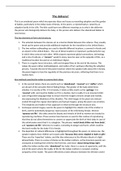
‘The deliverer’
This is an emotional poem which incorporates ideas and issues surrounding adoption and the gender
of babies, particularly in the Indian state of Kerala. In the poem, a rejected baby is raised by an
adoptive family in the USA. The title could have two different meanings as to who is the deliverer:
the person who biologically delivers the baby, or the person who delivers the abandoned babies to
new homes.
The key elements of form and structure:
1. The asterisks between the stanzas act as a barrier/divide between the cultures. They visually
break up the poem and provide additional emphasis for the transition to the United States.
2. The two written subheadings are used to identify different locations, a convent in Kerala and
an airport in the United States. The use of these locations is important, particularly the way
in which they contrast each other. While airports represent global connections, technology
and a mix of cultures, a “convent” would in many cases be seen as the opposite of this, as a
traditional location focused on an individual religion.
3. There is a regular tercet structure, with end-stopped lines at the end of the stanzas. This
makes the poem rather methodological, and matter of fact, perhaps reflecting the adoption
process. Towards the end of the poem however where the speaker talks about life in Kerala,
the poem begins to lose the regularity of the previous structure, reflecting that there is no
routine here.
Key methods used by the writer to convey their ideas:
1. In the second stanza, there are words such as ‘abandoned’, ‘covered’ and ‘stuffed’ which
are all part of the semantic field of hiding things. The gender of the baby determines
whether it is worthy of life- if it is female, it holds as little worth as the ‘garbage’ it is
‘covered’ with, and must be hidden as if it is a burden, but in reality it is an innocent child.
2. Lack of figurative language helps to ensure that the imagery remains simple and realistic,
also expressing the bleakness of the situation. The vivid images in the poem are instead
evoked through the regular descriptions and factual imagery, giving the poem raw emotion.
This simplicity and matter of fact approach is enforced through the structure also.
3. Grotesque animal imagery used in the poem to highlight the robotic role of the mother in
birth, and the potentially dangerous repercussions of the child being female. Women
‘squeeze out life’- this takes away the beauty and miracle of birth as women are treated as
reproducing machines. These women have become so used to this routine of reproducing
that they do not allow themselves to connect or appreciate the birth of their baby in case of
the unfortunate event that it is a daughter. The phrases ‘watch body slither out from body’,
and ‘squeeze out life’ reference to snakes, connoting to danger and harm, which could be
the harsh reality for the baby if it is female.
4. The depiction of cultural differences is highlighted throughout the poem. In stanza one, the
speaker explains how children are tossed aside ‘because they were crippled or dark or girls’.
These are the ‘imperfect’ babies, and this idea references to the Western ideals of a light
skinned baby. There is a sense of shame on the Indian mothers, as the American parents are
overjoyed at meeting their child for the first time, and know ‘about doing things right’,
unlike the Indian mother who ‘abandoned’ her baby- there is a sense of superiority, until the
end of the poem where the reality of life for the Indian mothers is revealed, evoking
sympathy of the reader. The poem effectively creates distance between the Western world
This is an emotional poem which incorporates ideas and issues surrounding adoption and the gender
of babies, particularly in the Indian state of Kerala. In the poem, a rejected baby is raised by an
adoptive family in the USA. The title could have two different meanings as to who is the deliverer:
the person who biologically delivers the baby, or the person who delivers the abandoned babies to
new homes.
The key elements of form and structure:
1. The asterisks between the stanzas act as a barrier/divide between the cultures. They visually
break up the poem and provide additional emphasis for the transition to the United States.
2. The two written subheadings are used to identify different locations, a convent in Kerala and
an airport in the United States. The use of these locations is important, particularly the way
in which they contrast each other. While airports represent global connections, technology
and a mix of cultures, a “convent” would in many cases be seen as the opposite of this, as a
traditional location focused on an individual religion.
3. There is a regular tercet structure, with end-stopped lines at the end of the stanzas. This
makes the poem rather methodological, and matter of fact, perhaps reflecting the adoption
process. Towards the end of the poem however where the speaker talks about life in Kerala,
the poem begins to lose the regularity of the previous structure, reflecting that there is no
routine here.
Key methods used by the writer to convey their ideas:
1. In the second stanza, there are words such as ‘abandoned’, ‘covered’ and ‘stuffed’ which
are all part of the semantic field of hiding things. The gender of the baby determines
whether it is worthy of life- if it is female, it holds as little worth as the ‘garbage’ it is
‘covered’ with, and must be hidden as if it is a burden, but in reality it is an innocent child.
2. Lack of figurative language helps to ensure that the imagery remains simple and realistic,
also expressing the bleakness of the situation. The vivid images in the poem are instead
evoked through the regular descriptions and factual imagery, giving the poem raw emotion.
This simplicity and matter of fact approach is enforced through the structure also.
3. Grotesque animal imagery used in the poem to highlight the robotic role of the mother in
birth, and the potentially dangerous repercussions of the child being female. Women
‘squeeze out life’- this takes away the beauty and miracle of birth as women are treated as
reproducing machines. These women have become so used to this routine of reproducing
that they do not allow themselves to connect or appreciate the birth of their baby in case of
the unfortunate event that it is a daughter. The phrases ‘watch body slither out from body’,
and ‘squeeze out life’ reference to snakes, connoting to danger and harm, which could be
the harsh reality for the baby if it is female.
4. The depiction of cultural differences is highlighted throughout the poem. In stanza one, the
speaker explains how children are tossed aside ‘because they were crippled or dark or girls’.
These are the ‘imperfect’ babies, and this idea references to the Western ideals of a light
skinned baby. There is a sense of shame on the Indian mothers, as the American parents are
overjoyed at meeting their child for the first time, and know ‘about doing things right’,
unlike the Indian mother who ‘abandoned’ her baby- there is a sense of superiority, until the
end of the poem where the reality of life for the Indian mothers is revealed, evoking
sympathy of the reader. The poem effectively creates distance between the Western world