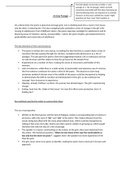
The title alludes to the idea of either a ‘safe’
passage or a ‘rite of passage’ which are both
commonly associated with the idea of growing up
and transitioning from one experience to another.
An Easy Passage However as the poem unfolds the reader might
question just how ‘easy’ this transition is.
On a literal level, the poem is about two teenage girls: one is climbing back into a room in her house,
and the other is watching her. This also metaphorically symbolizes a time of change in the girl’s life:
moving to adolescence from childhood. Hence, the poem expresses nostalgia for adolescence and its
blooming sense of freedom, daring, and possibility—which, the poem implies, get dampened by the
predictability and constriction of adulthood.
The key elements of form and structure:
This poem is written all in one stanza, recreating the idea that this is a poem about a time of
transition (literally passing through the window, metaphorically adolescence as a rite of
passage). This also gives the poem a flow feel suggesting freedom. Life is continuous and has
no said structure and this relates to how the girl sees her life ahead of her.
Enjambment on a number of lines- evoking the sense of movement and fluidity of this
moment.
Lack of sentences- while there is a wide variety of punctuation and extensive use of commas,
the first sentence continues for nearly a third of the poem. The decision to have long
sentences sandwich shorter ones in the middle of the poem could be interpreted as helping
to demonstrate the shift in narrative and development of the girl, as she continues her
‘passage’ from innocence to experience.
Opening- already ‘halfway’ up there- the journey has already begun. The girl is experiencing
change.
Ending- back into the ‘shade of the house’- for now this offers some protection, but is it
limiting her?
Key methods used by the writer to convey their ideas
The use of perspective:
Written in the third person and the lack of dialogue creates a corresponding lack of variety in
pronouns, with only uses of “her” and “she” in the poem. This creates distance from the
events being described with the more observational tone, which could be interpreted as
making it feel more story-like. Stories are often used in relation to growing up, which would
therefore link with the idea of a rite of passage.
The speaker is a voyeur commenting on the actions of the girls; they seem detached from
the action. The rhetorical question, ‘What can she know of the way the world admits us
less and less the more we grow?’, suggests that’s the speaker has more experience of life
than the girls.
The girls never seem to be given an identity, making the poem more universal in its tone and
approach.
passage or a ‘rite of passage’ which are both
commonly associated with the idea of growing up
and transitioning from one experience to another.
An Easy Passage However as the poem unfolds the reader might
question just how ‘easy’ this transition is.
On a literal level, the poem is about two teenage girls: one is climbing back into a room in her house,
and the other is watching her. This also metaphorically symbolizes a time of change in the girl’s life:
moving to adolescence from childhood. Hence, the poem expresses nostalgia for adolescence and its
blooming sense of freedom, daring, and possibility—which, the poem implies, get dampened by the
predictability and constriction of adulthood.
The key elements of form and structure:
This poem is written all in one stanza, recreating the idea that this is a poem about a time of
transition (literally passing through the window, metaphorically adolescence as a rite of
passage). This also gives the poem a flow feel suggesting freedom. Life is continuous and has
no said structure and this relates to how the girl sees her life ahead of her.
Enjambment on a number of lines- evoking the sense of movement and fluidity of this
moment.
Lack of sentences- while there is a wide variety of punctuation and extensive use of commas,
the first sentence continues for nearly a third of the poem. The decision to have long
sentences sandwich shorter ones in the middle of the poem could be interpreted as helping
to demonstrate the shift in narrative and development of the girl, as she continues her
‘passage’ from innocence to experience.
Opening- already ‘halfway’ up there- the journey has already begun. The girl is experiencing
change.
Ending- back into the ‘shade of the house’- for now this offers some protection, but is it
limiting her?
Key methods used by the writer to convey their ideas
The use of perspective:
Written in the third person and the lack of dialogue creates a corresponding lack of variety in
pronouns, with only uses of “her” and “she” in the poem. This creates distance from the
events being described with the more observational tone, which could be interpreted as
making it feel more story-like. Stories are often used in relation to growing up, which would
therefore link with the idea of a rite of passage.
The speaker is a voyeur commenting on the actions of the girls; they seem detached from
the action. The rhetorical question, ‘What can she know of the way the world admits us
less and less the more we grow?’, suggests that’s the speaker has more experience of life
than the girls.
The girls never seem to be given an identity, making the poem more universal in its tone and
approach.