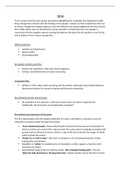
‘Spring’
This is a poem that discusses spring, opening by highlighting the tranquility and happiness it might
bring, though this contrasts with the feelings of the speaker. Instead, he feels isolated from the rest
of society, though this isolation appears to be self-inflicted as he passes judgement on those around
him. Unlike others who are distracted by spring and hold a romanticized view, the speaker is
concerned with the negative aspects of spring but believes this gives him the position to see it truly
and to define it from a voyeur perspective.
Different themes:
Isolation and detachment
Natural world
Social expectation
Key poems to link to and why:
Reasons for attendance- false ideas about happiness
Coming- romanticized view of nature and spring
Contextual links:
Written in 1950, when Larkin was living with his mother and finally let go of Ruth Bowman-
dissonance between the season of spring and the poets melancholy.
Key elements of form and structure:
No resolution in the structure- Larkin uses sonnet form, but doesn’t separate this
traditionally. Mirroring the unconventionality of speaker?
Key methods and argument of the poem:
The first stanza begins with the speakers depiction of a park in springtime, conveying a sense of
tranquility as people wander through the location:
‘Green shadowed people’- those embracing the environment have become immersed in it,
almost as if they are a part of this natural world. The colour green is typically associated with
growth and the vibrancy of nature, which is a sign of life that contrasts the images of winter
which precede the season.
‘People sit, or walk in rings’- they have no purpose or are not being productive, simply
enjoying the environment.
Repetition of ‘calmly’ to establish sense of tranquility, as there appears a harmony with
humanity and nature.
Romanticised image of the sun with the simile- ‘like a dangled looking glass’. This sun
‘lights the balls that bounce, the dogs that bark’- plosive sounds used on this line to mirror
This is a poem that discusses spring, opening by highlighting the tranquility and happiness it might
bring, though this contrasts with the feelings of the speaker. Instead, he feels isolated from the rest
of society, though this isolation appears to be self-inflicted as he passes judgement on those around
him. Unlike others who are distracted by spring and hold a romanticized view, the speaker is
concerned with the negative aspects of spring but believes this gives him the position to see it truly
and to define it from a voyeur perspective.
Different themes:
Isolation and detachment
Natural world
Social expectation
Key poems to link to and why:
Reasons for attendance- false ideas about happiness
Coming- romanticized view of nature and spring
Contextual links:
Written in 1950, when Larkin was living with his mother and finally let go of Ruth Bowman-
dissonance between the season of spring and the poets melancholy.
Key elements of form and structure:
No resolution in the structure- Larkin uses sonnet form, but doesn’t separate this
traditionally. Mirroring the unconventionality of speaker?
Key methods and argument of the poem:
The first stanza begins with the speakers depiction of a park in springtime, conveying a sense of
tranquility as people wander through the location:
‘Green shadowed people’- those embracing the environment have become immersed in it,
almost as if they are a part of this natural world. The colour green is typically associated with
growth and the vibrancy of nature, which is a sign of life that contrasts the images of winter
which precede the season.
‘People sit, or walk in rings’- they have no purpose or are not being productive, simply
enjoying the environment.
Repetition of ‘calmly’ to establish sense of tranquility, as there appears a harmony with
humanity and nature.
Romanticised image of the sun with the simile- ‘like a dangled looking glass’. This sun
‘lights the balls that bounce, the dogs that bark’- plosive sounds used on this line to mirror