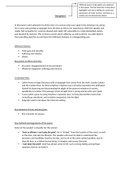
Different layers of deception are explored
in this poem. The fact that this is also plural
highlights how this is telling of a universal
experience of many women, and how as a
‘Deceptions’ society we are deceived by desire.
In this poem Larkin attempts to tell the story of a woman who was raped in the Victorian era, giving
her a voice and quoting an epigraph from the time to link to her experiences. Both the speaker and
reader feel sympathy for a woman abused and raped, left vulnerable in a male dominated society
and haunted by memory. This is hence a poem about suffering, as well as desire, as Larkin depicts
the controlling need for sex and how this fulfilment however is a disappointing one.
Different themes:
Male gaze and sexuality
Suffering and violence
Desire
Key poems to link to and why:
Dry point- disappointment of sex and desire
Whatever happened- suffering and memory
Contextual links:
Larkin chose to begin the piece with an epigraph that comes from the work, London Labour
and the London Poor, by Henry Mayhew. Mayhew was a Victorian journalist who dedicated
himself to observing and documenting the plight of the poorest members of society,
specifically in London. This passage comes straight from a young woman who was raped.
It was Larkin’s goal, by using Mayhew’s reported story, to bring the terrible events that
normally go unnoticed, and certainly unreported, into the light.
Epigraph used to introduce the Victorian setting.
Key elements of form and structure:
Key moments of caesura.
Key methods and arguments of the poem:
Sense of the speaker’s empathy for the woman
‘Even so distant, I can taste the grief’- He is “distant” from the location of the event, as well
as the time, and also the lifestyle. The speaker will never be able to understand the
pressures and hardships faced by women, and is not of the same societal position, but he
does his best, as a fellow human being, to imagine and convey that pain.
‘I can taste the grief’- Grief has almost come to life- such a strong feeling and perhaps
repulsion that he can taste it.
in this poem. The fact that this is also plural
highlights how this is telling of a universal
experience of many women, and how as a
‘Deceptions’ society we are deceived by desire.
In this poem Larkin attempts to tell the story of a woman who was raped in the Victorian era, giving
her a voice and quoting an epigraph from the time to link to her experiences. Both the speaker and
reader feel sympathy for a woman abused and raped, left vulnerable in a male dominated society
and haunted by memory. This is hence a poem about suffering, as well as desire, as Larkin depicts
the controlling need for sex and how this fulfilment however is a disappointing one.
Different themes:
Male gaze and sexuality
Suffering and violence
Desire
Key poems to link to and why:
Dry point- disappointment of sex and desire
Whatever happened- suffering and memory
Contextual links:
Larkin chose to begin the piece with an epigraph that comes from the work, London Labour
and the London Poor, by Henry Mayhew. Mayhew was a Victorian journalist who dedicated
himself to observing and documenting the plight of the poorest members of society,
specifically in London. This passage comes straight from a young woman who was raped.
It was Larkin’s goal, by using Mayhew’s reported story, to bring the terrible events that
normally go unnoticed, and certainly unreported, into the light.
Epigraph used to introduce the Victorian setting.
Key elements of form and structure:
Key moments of caesura.
Key methods and arguments of the poem:
Sense of the speaker’s empathy for the woman
‘Even so distant, I can taste the grief’- He is “distant” from the location of the event, as well
as the time, and also the lifestyle. The speaker will never be able to understand the
pressures and hardships faced by women, and is not of the same societal position, but he
does his best, as a fellow human being, to imagine and convey that pain.
‘I can taste the grief’- Grief has almost come to life- such a strong feeling and perhaps
repulsion that he can taste it.