Law of Succession Content Notes: Semester 1
Frances du Toit
Study Unit 1
General Introduction to the Law of Succession and the Administration of Deceased Estates
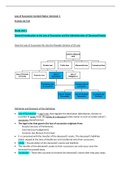
How the Law of Succession fits into the Broader Scheme of SA Law
Definition and Elements of the Definition
• Law of Succession = Legal rules that regulate the devolution (distribution, division or
transfer) of assets from the estate of a deceased estate owner to such an estate owner’s
successors (beneficiaries).
• The legal rules that govern the law of succession originate from:
- Statute law (acts of Parliament).
- Case law (court judgments).
- Common law (Roman-Dutch law).
• It is concerned with the transfer of the deceased’s assets. The deceased’s liabilities
(debts unpaid at the time of death) are not transferred onto their successors.
• Estate = Accumulation of the deceased’s assets and liabilities.
• The transfer of the deceased’s assets to their successors can only occur once the
deceased has passed away.
• Successors = Those who succeed to (receive) the deceased’s assets after they pass away.
,• The SA law of succession comprises a dual system:
- The common law of succession, with its origins in Roman-Dutch law and English law
(our focus).
- The customary law of succession, of SA’s various black population groups.
• The common law of succession is subdivided into 3 branches:
- Law of testate succession (applies when the deceased has made a will).
- Law of intestate succession (applies in the absence of a will).
- Succession by contract (the deceased has, prior to death, entered into a pactum
successorium = contract regarding the division of their assets upon death. It is invalid
with the exception of 2 instances – the antenuptial contract and the donatio mortis
causa = a contract of donation made in contemplation of the death of the donor).
The Administration/Winding Up of Deceased Estates
• Administration is a statutory process – it is regulated by the Administration of Estates
Act 66 of 1965.
• The Master of the HC and the executor of the deceased estate are 2 important
functionaries involved in the administration process.
• The Master of the HC:
- Each HC in SA has a Master’s office.
- The Master and their staff attend to legal and administrative functions regarding
deceased estates, trusts, insolvent estates, curatorship, etc.
• The executor:
- Actively administers a deceased estate.
- Usually nominated in the deceased’s will (executor testamentary).
- This is not sufficient – they must also be officially appointed by the Master through
the issuing of letters of executorship before commencing with their functions.
- If the deceased left no will or the will contains no nomination, the Master nominates
an executor (executor dative).
• The executor’s principal functions:
- Complete the relevant estate documents (death notice, inventory of estimated asset
values, etc.).
- Lodge all estate documents and the deceased’s original will (if any) with the Master.
- Advertise to the deceased’s creditors to submit their claims against the estate,
usually within 30 days of publication of the advert (appear in local newspapers).
- Pay all the claims against the estate (hospital, death-bed, funeral expenses, etc.),
taxes still owed (income tax, capital gains tax, etc.) and claims of creditors, utilising
cash available in the estate. If insufficient, the executor will sell some or all
(insolvent) of the estate assets to raise the funds to meet claims against the estate.
- Distribute the remaining estate assets among the deceased’s successors, if assets
remain in the estate after all claims have been paid.
- Prepare the estate’s liquidation and distribution (l&d) account reflecting the
foregoing information. This lies open for inspection for 21 days at the Master’s office
, and Magistrate’s office in the district where the deceased was a resident before
death. If no one objects, the executor finalises the administration of the estate.
• The law of succession is relevant towards the end of the administration process, when
the executor transfers the net assets in the estate to the successors of the deceased.
• The rules of the law of succession fulfil a dual purpose:
- Identify the successors of the deceased (who they are).
- Determine the extent of each successor’s benefit (which assets and how much).
Terminology
• Testate succession = Legal rules that apply to the making and implementation of wills;
legal rules that identify a deceased’s successors and the extent of each successor’s
benefit in terms of the deceased’s will.
• Intestate succession = Legal rules that apply in the absence of wills; legal rules that
identify a deceased’s successors and the extent of each successor’s benefit when the
deceased did not do so in terms of a will.
• Succession by contract = Regulation of succession through a contract concluded
between the deceased and someone else.
• Legatee = Beneficiary in terms of a will who received a particular asset, group of assets
or sum of money in terms of a will.
• Legacy = Particular asset, group of assets or sum of money that a legatee receives in
terms of a will.
• Heir = Beneficiary who receives the residue of the deceased’s estate after all the legacies
have been distributed in the law of testate succession. Equivalent to the terms
“successor” or “beneficiary” in the law of intestate succession.
• Inheritance = Benefit that goes to the heir in the law of testate succession or intestate
successor in the law of intestate succession.
• Testator = Person who makes a will.
• Freedom of testation = In SA law, a testator has the freedom to leave their assets to
whomever they want, impose whatever terms and conditions they want on these
bequests, and disinherit whomever they wish (e.g. close family members cannot
challenge a testator leaving all their assets to their secretary on the basis that it is
unreasonable or unfair, since the testator is exercising freedom of testation). Freedom
of testation is not absolute – it is subject to some limitations (recent CC judgments have
pointed to a more restricted judicial view on the freedom of testation).
Is Succession a Mode of Acquisition of Ownership
• No. When a testator bequeaths property to a legatee, the legatee does not acquire
ownership (dominium) in that property on the death of the testator. What they acquire
is a vested personal right (in personam) to claim from the testator’s executors after
confirmation of the l&d account (Greenberg v Estate Greenberg).
, • This personal right operates ex lege = by operation of law.
• Moment of dies cedit = Moment upon which a legatee’s right against a deceased’s
estate becomes vested (i.e. upon death of the testator).
• Moment of dies venit = Moment upon which the legatee’s right to claim transfer of the
property from the executor of the deceased’s estate becomes enforceable (i.e. upon
confirmation of the l&d account).
Requirements for Succession to Occur in Favour of a Successor
• The estate owner must have died or a court must have issued an order of the
presumption of death, in regard to the estate owner.
• The successor must have been born at the moment of dies cedit or must have been
conceived at that time and later, be born alive (nasciturus fiction).
• The successor must have survived (out-lived) the deceased estate owner:
- If the beneficiary predeceased (died before) the deceased, succession in favour of
that beneficiary cannot occur.
- If the beneficiary and the deceased died simultaneously (commorientes), succession
in favour of that beneficiary cannot occur.
• The beneficiary must be competent to receive a benefit – they must not be disqualified
from succession for some reason.
MS Teams lecture: 22 February
• The executor deals with divisions for marriage in community of property and
preferential claims (e.g. maintenance for dependent children or indigent surviving
spouses, not parents) before the executor does the division in terms of the law of
succession.
• If a minor is left a sum of money, it is paid to the Master of the HC and they put it into a
guardianship fund, to be accessed at the age of maturity. In SA, this is not advised due to
challenges in the Master’s courts – it would be better to have the money put in a trust.
• One can exclude matrimonial property regimes in their will (e.g. a parent can leave an
asset to a child and stipulate that it not be subject to accrual, even if the child is married
in community of property).
• The executor can be a beneficiary in a will, but cannot also have signed as a witness. The
Master will supervise this and act on issues (if they pick up any issues in the l&d account
or are alerted of any issues by someone else).
• If a sole beneficiary dies before the testator, and the will is not amended, intestate
succession kicks in upon death of the testator.
• On the slow amendment of the Intestate Succession Act – it does not seem to be a
priority in Parliament.
Frances du Toit
Study Unit 1
General Introduction to the Law of Succession and the Administration of Deceased Estates
How the Law of Succession fits into the Broader Scheme of SA Law
Definition and Elements of the Definition
• Law of Succession = Legal rules that regulate the devolution (distribution, division or
transfer) of assets from the estate of a deceased estate owner to such an estate owner’s
successors (beneficiaries).
• The legal rules that govern the law of succession originate from:
- Statute law (acts of Parliament).
- Case law (court judgments).
- Common law (Roman-Dutch law).
• It is concerned with the transfer of the deceased’s assets. The deceased’s liabilities
(debts unpaid at the time of death) are not transferred onto their successors.
• Estate = Accumulation of the deceased’s assets and liabilities.
• The transfer of the deceased’s assets to their successors can only occur once the
deceased has passed away.
• Successors = Those who succeed to (receive) the deceased’s assets after they pass away.
,• The SA law of succession comprises a dual system:
- The common law of succession, with its origins in Roman-Dutch law and English law
(our focus).
- The customary law of succession, of SA’s various black population groups.
• The common law of succession is subdivided into 3 branches:
- Law of testate succession (applies when the deceased has made a will).
- Law of intestate succession (applies in the absence of a will).
- Succession by contract (the deceased has, prior to death, entered into a pactum
successorium = contract regarding the division of their assets upon death. It is invalid
with the exception of 2 instances – the antenuptial contract and the donatio mortis
causa = a contract of donation made in contemplation of the death of the donor).
The Administration/Winding Up of Deceased Estates
• Administration is a statutory process – it is regulated by the Administration of Estates
Act 66 of 1965.
• The Master of the HC and the executor of the deceased estate are 2 important
functionaries involved in the administration process.
• The Master of the HC:
- Each HC in SA has a Master’s office.
- The Master and their staff attend to legal and administrative functions regarding
deceased estates, trusts, insolvent estates, curatorship, etc.
• The executor:
- Actively administers a deceased estate.
- Usually nominated in the deceased’s will (executor testamentary).
- This is not sufficient – they must also be officially appointed by the Master through
the issuing of letters of executorship before commencing with their functions.
- If the deceased left no will or the will contains no nomination, the Master nominates
an executor (executor dative).
• The executor’s principal functions:
- Complete the relevant estate documents (death notice, inventory of estimated asset
values, etc.).
- Lodge all estate documents and the deceased’s original will (if any) with the Master.
- Advertise to the deceased’s creditors to submit their claims against the estate,
usually within 30 days of publication of the advert (appear in local newspapers).
- Pay all the claims against the estate (hospital, death-bed, funeral expenses, etc.),
taxes still owed (income tax, capital gains tax, etc.) and claims of creditors, utilising
cash available in the estate. If insufficient, the executor will sell some or all
(insolvent) of the estate assets to raise the funds to meet claims against the estate.
- Distribute the remaining estate assets among the deceased’s successors, if assets
remain in the estate after all claims have been paid.
- Prepare the estate’s liquidation and distribution (l&d) account reflecting the
foregoing information. This lies open for inspection for 21 days at the Master’s office
, and Magistrate’s office in the district where the deceased was a resident before
death. If no one objects, the executor finalises the administration of the estate.
• The law of succession is relevant towards the end of the administration process, when
the executor transfers the net assets in the estate to the successors of the deceased.
• The rules of the law of succession fulfil a dual purpose:
- Identify the successors of the deceased (who they are).
- Determine the extent of each successor’s benefit (which assets and how much).
Terminology
• Testate succession = Legal rules that apply to the making and implementation of wills;
legal rules that identify a deceased’s successors and the extent of each successor’s
benefit in terms of the deceased’s will.
• Intestate succession = Legal rules that apply in the absence of wills; legal rules that
identify a deceased’s successors and the extent of each successor’s benefit when the
deceased did not do so in terms of a will.
• Succession by contract = Regulation of succession through a contract concluded
between the deceased and someone else.
• Legatee = Beneficiary in terms of a will who received a particular asset, group of assets
or sum of money in terms of a will.
• Legacy = Particular asset, group of assets or sum of money that a legatee receives in
terms of a will.
• Heir = Beneficiary who receives the residue of the deceased’s estate after all the legacies
have been distributed in the law of testate succession. Equivalent to the terms
“successor” or “beneficiary” in the law of intestate succession.
• Inheritance = Benefit that goes to the heir in the law of testate succession or intestate
successor in the law of intestate succession.
• Testator = Person who makes a will.
• Freedom of testation = In SA law, a testator has the freedom to leave their assets to
whomever they want, impose whatever terms and conditions they want on these
bequests, and disinherit whomever they wish (e.g. close family members cannot
challenge a testator leaving all their assets to their secretary on the basis that it is
unreasonable or unfair, since the testator is exercising freedom of testation). Freedom
of testation is not absolute – it is subject to some limitations (recent CC judgments have
pointed to a more restricted judicial view on the freedom of testation).
Is Succession a Mode of Acquisition of Ownership
• No. When a testator bequeaths property to a legatee, the legatee does not acquire
ownership (dominium) in that property on the death of the testator. What they acquire
is a vested personal right (in personam) to claim from the testator’s executors after
confirmation of the l&d account (Greenberg v Estate Greenberg).
, • This personal right operates ex lege = by operation of law.
• Moment of dies cedit = Moment upon which a legatee’s right against a deceased’s
estate becomes vested (i.e. upon death of the testator).
• Moment of dies venit = Moment upon which the legatee’s right to claim transfer of the
property from the executor of the deceased’s estate becomes enforceable (i.e. upon
confirmation of the l&d account).
Requirements for Succession to Occur in Favour of a Successor
• The estate owner must have died or a court must have issued an order of the
presumption of death, in regard to the estate owner.
• The successor must have been born at the moment of dies cedit or must have been
conceived at that time and later, be born alive (nasciturus fiction).
• The successor must have survived (out-lived) the deceased estate owner:
- If the beneficiary predeceased (died before) the deceased, succession in favour of
that beneficiary cannot occur.
- If the beneficiary and the deceased died simultaneously (commorientes), succession
in favour of that beneficiary cannot occur.
• The beneficiary must be competent to receive a benefit – they must not be disqualified
from succession for some reason.
MS Teams lecture: 22 February
• The executor deals with divisions for marriage in community of property and
preferential claims (e.g. maintenance for dependent children or indigent surviving
spouses, not parents) before the executor does the division in terms of the law of
succession.
• If a minor is left a sum of money, it is paid to the Master of the HC and they put it into a
guardianship fund, to be accessed at the age of maturity. In SA, this is not advised due to
challenges in the Master’s courts – it would be better to have the money put in a trust.
• One can exclude matrimonial property regimes in their will (e.g. a parent can leave an
asset to a child and stipulate that it not be subject to accrual, even if the child is married
in community of property).
• The executor can be a beneficiary in a will, but cannot also have signed as a witness. The
Master will supervise this and act on issues (if they pick up any issues in the l&d account
or are alerted of any issues by someone else).
• If a sole beneficiary dies before the testator, and the will is not amended, intestate
succession kicks in upon death of the testator.
• On the slow amendment of the Intestate Succession Act – it does not seem to be a
priority in Parliament.