

Module 17
Product Costing:
Job and Process Operations
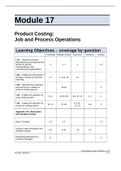
Learning Objectives – coverage by question
True/False Multiple Choice Exercises Problems Essays
LO1 – Describe inventory
requirements and measurement
issues for service, 2 1, 2 1 1, 2
merchandising, and
manufacturing organizations.
LO2 – Explain the framework of
inventory costing for financial 1-7 1, 3-12, 25 2-4
reporting.
LO3 – Describe the production
environment as it relates to 13-18 3
product costing systems.
LO4 – Explain the operation of
8, 9 19-24, 26 5-8, 12, 13 1, 2 3
a job costing system.
LO5 – Explain the operation of 5, 9-12,
10, 11 27-38 3-6 3
a process costing system. 14, 15
Appendix 17A: Absorption
and Variable Costing
Basic Concepts 1-5 1-5 1, 2
Income Under Absorption and
6-8 6-10 1-8 1-5
Variable Costing
Evaluating Alternatives to
9 3
Inventory Valuation
©Cambridge Business Publishers, 2015
Test Bank, Module 17 17-1
,Module 17: Product Costing: Job and Process Operations
True/False
Topic: Definition of Product Costing
LO: 2
1. The process of assigning cost to inventories as they are converted from raw material to finished
goods is called product costing.
Answer: True
Rationale: The textbook definition of the term “product costing” is: “all costs incurred in the
manufacturing of products.”
Topic: Manufacturing Inventories
LO: 1, 2
2. In a manufacturing organization, manufacturing supplies costs are recorded as expenses as they are
used.
Answer: False
Rationale: As manufacturing supplies are used in a manufacturing organization, their costs are
recorded as part of Work-in-Process Inventory.
Topic: Inventory Cost Flow
LO: 2
3. When goods are transferred from the factory to the finished goods warehouse, Work-In-Process is
reduced and Cost of Goods Sold Expense is recorded.
Answer: False
Rationale: When goods are transferred to the finished goods warehouse, Finished Goods Inventory is
increased and Work-in-Process Inventory is decreased. Cost of Goods Sold Expense is not recorded
until the finished inventory is sold.
Topic: Period versus Product Costs
LO: 2
4. In financial accounting, the term period costs refers to all expired costs not related to the
manufacturing function, and product costs refers to all costs incurred during the period related to the
manufacturing function.
Answer: True
Rationale: As manufacturing costs are incurred, they are added to the cost of manufactured
inventories, but as non-manufacturing costs expire, they are recorded as expenses of the period.
©Cambridge Business Publishers, 2015
17-2 Financial & Managerial Accounting for MBAs, 4th Edition
,Topic: Manufacturing Depreciation
LO: 2
5. All depreciation on factory assets is recorded as an expense of the period.
Answer: False
Rationale: Depreciation on factory assets is a product cost added to Work-in-Process Inventory. It is
expensed as part of Cost of Goods Sold expense when the product is completed and sold.
Topic: Predetermined Manufacturing Overhead Rate
LO: 2
6. One of the reasons for using a predetermined manufacturing overhead rate is that it smooths out
seasonal costs over the entire accounting period.
Answer: True
Rationale: By estimating total overhead costs for the accounting period (say, one year), the seasonal
costs that occur only in the winter months or only in the summer months are spread out over the
entire year.
Topic: Predetermined Manufacturing Overhead Rate
LO: 2
7. If costs are accurately estimated when establishing an annual predetermined overhead rate, there
should never be an overapplied or underapplied overhead balance.
Answer: False
Rationale: Even though costs are accurately estimated, total overhead costs can be over- or under-
applied if total estimated activity for the year is estimated inaccurately.
Topic: Job Costing
LO: 4
8. A job costing system is a cost system designed to accumulate the manufacturing costs of producing
unique jobs, such as building a house or a naval air craft carrier, but would not include producing a
batch of several identical units of product, such as 100 chairs in a furniture factory.
Answer: False
Rationale: A job costing system is often used for costing both unique products such as houses or
ships, but also for producing single batches of product that include several or many identical items of
product.
Topic: Job Costing
LO: 4
9. In a job costing system, costs are accumulated in a separate Work-in-Process account for each job.
Answer: True
Rationale: As each job is started, there will be a unique Work-in-Process account created for each
job, and that account will accumulate all costs for that job until it is completed.
©Cambridge Business Publishers, 2015
Test Bank, Module 17 17-3
, Topic: Process Costing
LO: 5
10. Process costing is best suited for production environments where identical units of product are
produced on a continuous basis.
Answer: True
Rationale: Process costing is designed to accumulate costs for continuous processes as opposed to
unique production jobs.
Topic: Process Costing
LO: 5
11. In process costing, each accounting period is actually equivalent to a unique job in a job costing
system.
Answer: True
Rationale: In process costing, all costs for a continuous process are accumulated for each period,
and the average cost of producing a unit of cost during the period is calculated. In a similar fashion, a
job cost system accumulates costs over the entire production period for a given unit or batch of units
of product.
©Cambridge Business Publishers, 2015
17-4 Financial & Managerial Accounting for MBAs, 4th Edition
Product Costing:
Job and Process Operations
Learning Objectives – coverage by question
True/False Multiple Choice Exercises Problems Essays
LO1 – Describe inventory
requirements and measurement
issues for service, 2 1, 2 1 1, 2
merchandising, and
manufacturing organizations.
LO2 – Explain the framework of
inventory costing for financial 1-7 1, 3-12, 25 2-4
reporting.
LO3 – Describe the production
environment as it relates to 13-18 3
product costing systems.
LO4 – Explain the operation of
8, 9 19-24, 26 5-8, 12, 13 1, 2 3
a job costing system.
LO5 – Explain the operation of 5, 9-12,
10, 11 27-38 3-6 3
a process costing system. 14, 15
Appendix 17A: Absorption
and Variable Costing
Basic Concepts 1-5 1-5 1, 2
Income Under Absorption and
6-8 6-10 1-8 1-5
Variable Costing
Evaluating Alternatives to
9 3
Inventory Valuation
©Cambridge Business Publishers, 2015
Test Bank, Module 17 17-1
,Module 17: Product Costing: Job and Process Operations
True/False
Topic: Definition of Product Costing
LO: 2
1. The process of assigning cost to inventories as they are converted from raw material to finished
goods is called product costing.
Answer: True
Rationale: The textbook definition of the term “product costing” is: “all costs incurred in the
manufacturing of products.”
Topic: Manufacturing Inventories
LO: 1, 2
2. In a manufacturing organization, manufacturing supplies costs are recorded as expenses as they are
used.
Answer: False
Rationale: As manufacturing supplies are used in a manufacturing organization, their costs are
recorded as part of Work-in-Process Inventory.
Topic: Inventory Cost Flow
LO: 2
3. When goods are transferred from the factory to the finished goods warehouse, Work-In-Process is
reduced and Cost of Goods Sold Expense is recorded.
Answer: False
Rationale: When goods are transferred to the finished goods warehouse, Finished Goods Inventory is
increased and Work-in-Process Inventory is decreased. Cost of Goods Sold Expense is not recorded
until the finished inventory is sold.
Topic: Period versus Product Costs
LO: 2
4. In financial accounting, the term period costs refers to all expired costs not related to the
manufacturing function, and product costs refers to all costs incurred during the period related to the
manufacturing function.
Answer: True
Rationale: As manufacturing costs are incurred, they are added to the cost of manufactured
inventories, but as non-manufacturing costs expire, they are recorded as expenses of the period.
©Cambridge Business Publishers, 2015
17-2 Financial & Managerial Accounting for MBAs, 4th Edition
,Topic: Manufacturing Depreciation
LO: 2
5. All depreciation on factory assets is recorded as an expense of the period.
Answer: False
Rationale: Depreciation on factory assets is a product cost added to Work-in-Process Inventory. It is
expensed as part of Cost of Goods Sold expense when the product is completed and sold.
Topic: Predetermined Manufacturing Overhead Rate
LO: 2
6. One of the reasons for using a predetermined manufacturing overhead rate is that it smooths out
seasonal costs over the entire accounting period.
Answer: True
Rationale: By estimating total overhead costs for the accounting period (say, one year), the seasonal
costs that occur only in the winter months or only in the summer months are spread out over the
entire year.
Topic: Predetermined Manufacturing Overhead Rate
LO: 2
7. If costs are accurately estimated when establishing an annual predetermined overhead rate, there
should never be an overapplied or underapplied overhead balance.
Answer: False
Rationale: Even though costs are accurately estimated, total overhead costs can be over- or under-
applied if total estimated activity for the year is estimated inaccurately.
Topic: Job Costing
LO: 4
8. A job costing system is a cost system designed to accumulate the manufacturing costs of producing
unique jobs, such as building a house or a naval air craft carrier, but would not include producing a
batch of several identical units of product, such as 100 chairs in a furniture factory.
Answer: False
Rationale: A job costing system is often used for costing both unique products such as houses or
ships, but also for producing single batches of product that include several or many identical items of
product.
Topic: Job Costing
LO: 4
9. In a job costing system, costs are accumulated in a separate Work-in-Process account for each job.
Answer: True
Rationale: As each job is started, there will be a unique Work-in-Process account created for each
job, and that account will accumulate all costs for that job until it is completed.
©Cambridge Business Publishers, 2015
Test Bank, Module 17 17-3
, Topic: Process Costing
LO: 5
10. Process costing is best suited for production environments where identical units of product are
produced on a continuous basis.
Answer: True
Rationale: Process costing is designed to accumulate costs for continuous processes as opposed to
unique production jobs.
Topic: Process Costing
LO: 5
11. In process costing, each accounting period is actually equivalent to a unique job in a job costing
system.
Answer: True
Rationale: In process costing, all costs for a continuous process are accumulated for each period,
and the average cost of producing a unit of cost during the period is calculated. In a similar fashion, a
job cost system accumulates costs over the entire production period for a given unit or batch of units
of product.
©Cambridge Business Publishers, 2015
17-4 Financial & Managerial Accounting for MBAs, 4th Edition

