

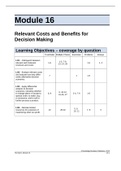
Module 16
Relevant Costs and Benefits for
Decision Making
Learning Objectives – coverage by question
True/False Multiple Choice Exercises Problems Essays
LO1 – Distinguish between
1-5, 7-9,
relevant and irrelevant 1-6 1-5 1, 2
13, 14, 26
revenues and costs.
LO2 – Analyze relevant costs
and indicate how they differ
7 1 1-5
under alternative decision
scenarios.
LO3 – Apply differential
analysis to decision
scenarios, including whether
6, 10-12,
to change plans; to accept a 8, 9 2-4, 7-9 1-6
15-25, 27
special order; to make, buy,
or outsource; and to sell or
further process a product.
LO4 – Allocate limited
5, 6,
resources for purposes of 10 28-32 7, 8 3
10, 11
maximizing short-run profit.
©Cambridge Business Publishers, 2015
Test Bank, Module 16 16-1
,Module 16: Relevant Costs and Benefits for Decision Making
True/False
Topic: Relevant Costs
LO: 1
1. Relevant costs are future costs that differ between competing decision alternatives.
Answer: True
Rationale: Definition
Topic: Outlay Costs
LO: 1
2. Outlay costs are costs that have been incurred in the past, such as the purchase of a new piece of
equipment for an outlay cost of $8,000.
Answer: False
Rationale: Within the context of “relevant costing,” outlay costs refer to future costs that will be
incurred.
Topic: Outlay Costs
LO: 1
3. All outlay costs are relevant.
Answer: False
Rationale: Outlay costs are relevant only if they differ between competing alternatives.
Topic: Sunk Costs
LO: 1
4. Sunk costs are the result of past decisions; therefore, they are always relevant to future decisions.
Answer: False
Rationale: Sunk costs are the result of past decisions, but such costs do not differ between competing
future alternatives; therefore, they are never relevant.
Topic: Opportunity Costs
LO: 1
5. An opportunity cost is any benefit foregone as a result of rejecting one opportunity in favor of another
opportunity.
Answer: True
Rationale: Textbook definition.
©Cambridge Business Publishers, 2015
16-2 Financial & Managerial Accounting for MBAs, 4th Edition
, Topic: Opportunity Costs
LO: 1
6. Opportunity costs are usually relevant in relevant cost analysis, but not always.
Answer: False
Rationale: Opportunity costs are always relevant in making decisions among alternatives.
Topic: Differential Analysis of Relevant Costs
LO: 2
7. Differential analysis is an approach to the analysis of relevant costs that focuses on the costs that
differ under alternative actions.
Answer: True
Rationale: This is the textbook definition of the term “differential analysis.”
Topic: Joint Costs
LO: 3
8. In deciding whether to sell a joint product or to process it further, any costs incurred prior to the split-
off point are sunk costs and are, therefore, irrelevant costs.
Answer: True
Rationale: Joint costs are sunk costs that are irrelevant because they are not affected by the decision
regarding possible further processing of a joint product.
Topic: Joint Costs
LO: 3
9. Joint Costs are costs associated with joint products that are incurred subsequent to the split-off point.
Answer: False
Rationale: Joint costs are incurred prior to the split-off point. Costs of further processing are incurred
subsequently to the split-off point.
Topic: Theory of Constraints
LO: 4
10. The theory of constraints states that every process has a bottleneck and production cannot take place
faster than it is processed through the bottleneck.
Answer: True
Rationale: This theory is based on the assumption that if bottlenecks are eliminated throughput will be
maximized.
©Cambridge Business Publishers, 2015
Test Bank, Module 16 16-3
Relevant Costs and Benefits for
Decision Making
Learning Objectives – coverage by question
True/False Multiple Choice Exercises Problems Essays
LO1 – Distinguish between
1-5, 7-9,
relevant and irrelevant 1-6 1-5 1, 2
13, 14, 26
revenues and costs.
LO2 – Analyze relevant costs
and indicate how they differ
7 1 1-5
under alternative decision
scenarios.
LO3 – Apply differential
analysis to decision
scenarios, including whether
6, 10-12,
to change plans; to accept a 8, 9 2-4, 7-9 1-6
15-25, 27
special order; to make, buy,
or outsource; and to sell or
further process a product.
LO4 – Allocate limited
5, 6,
resources for purposes of 10 28-32 7, 8 3
10, 11
maximizing short-run profit.
©Cambridge Business Publishers, 2015
Test Bank, Module 16 16-1
,Module 16: Relevant Costs and Benefits for Decision Making
True/False
Topic: Relevant Costs
LO: 1
1. Relevant costs are future costs that differ between competing decision alternatives.
Answer: True
Rationale: Definition
Topic: Outlay Costs
LO: 1
2. Outlay costs are costs that have been incurred in the past, such as the purchase of a new piece of
equipment for an outlay cost of $8,000.
Answer: False
Rationale: Within the context of “relevant costing,” outlay costs refer to future costs that will be
incurred.
Topic: Outlay Costs
LO: 1
3. All outlay costs are relevant.
Answer: False
Rationale: Outlay costs are relevant only if they differ between competing alternatives.
Topic: Sunk Costs
LO: 1
4. Sunk costs are the result of past decisions; therefore, they are always relevant to future decisions.
Answer: False
Rationale: Sunk costs are the result of past decisions, but such costs do not differ between competing
future alternatives; therefore, they are never relevant.
Topic: Opportunity Costs
LO: 1
5. An opportunity cost is any benefit foregone as a result of rejecting one opportunity in favor of another
opportunity.
Answer: True
Rationale: Textbook definition.
©Cambridge Business Publishers, 2015
16-2 Financial & Managerial Accounting for MBAs, 4th Edition
, Topic: Opportunity Costs
LO: 1
6. Opportunity costs are usually relevant in relevant cost analysis, but not always.
Answer: False
Rationale: Opportunity costs are always relevant in making decisions among alternatives.
Topic: Differential Analysis of Relevant Costs
LO: 2
7. Differential analysis is an approach to the analysis of relevant costs that focuses on the costs that
differ under alternative actions.
Answer: True
Rationale: This is the textbook definition of the term “differential analysis.”
Topic: Joint Costs
LO: 3
8. In deciding whether to sell a joint product or to process it further, any costs incurred prior to the split-
off point are sunk costs and are, therefore, irrelevant costs.
Answer: True
Rationale: Joint costs are sunk costs that are irrelevant because they are not affected by the decision
regarding possible further processing of a joint product.
Topic: Joint Costs
LO: 3
9. Joint Costs are costs associated with joint products that are incurred subsequent to the split-off point.
Answer: False
Rationale: Joint costs are incurred prior to the split-off point. Costs of further processing are incurred
subsequently to the split-off point.
Topic: Theory of Constraints
LO: 4
10. The theory of constraints states that every process has a bottleneck and production cannot take place
faster than it is processed through the bottleneck.
Answer: True
Rationale: This theory is based on the assumption that if bottlenecks are eliminated throughput will be
maximized.
©Cambridge Business Publishers, 2015
Test Bank, Module 16 16-3

