

Module 11
Forecasting Financial Statements
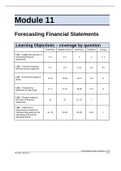
Learning Objectives – coverage by question
True/False Multiple Choice Exercises Problems Essays
LO1 – Explain the process of
forecasting financial 1-5 1-3 1 1 1, 2
statements.
LO2 – Forecast revenues
6-7 4-9 2-11 2-4 3-5
and the income statement.
LO3 – Forecast the balance
8-10 10-16 12-17 2-4 5
sheet.
LO4 – Forecast the
11, 2 17-21 18-20 5, 6 6
statement of cash flows.
LO5 – Prepare multiyear
forecasts of financial 13 22 21, 22 7 -
statements.
LO6 – Implement a
parsimonious method for
multiyear forecasting of net 14, 15 23-25 23-25 8-10 7
operating profit and net
operating assets.
©Cambridge Business Publishers, 2015
Test Bank, Module 11 11-1
,Module 11: Forecasting Financial Statements
True/False
Topic: Eliminating Transitory Activities
LO: 1
1. To forecast future performance, we should first create a set of financial statements that reflects items
we expect to persist.
Answer: True
Rationale: Persistent activities are those that will recur – that is the point of forecasting, to predict
what will recur.
Topic: Conservatism versus Optimism
LO: 1
2. When forecasting future events, it is better to take a more conservative view for items such as
revenue growth and profit margins.
Answer: False
Rationale: The best forecasts are the most realistic ones. Being overly conservative can lead to
missed opportunities.
Topic: Bias Resulting from Accruals
LO: 1
3. Accruals can be used to bias financial statements in order to achieve certain reporting objectives.
Answer: True
Rationale: Managers can use accruals to depress current period income by writing off an excessive
amount of assets and accruing an excessive amount of liabilities (big bath). Managers can also
increase current period income by accruing an insufficient allowance for uncollectible accounts, for
example.
Topic: Adjusting Process
LO: 1
4. The adjusting process is useful for historical analysis, but not for prospective analysis.
Answer: False
Rationale: The adjusting process parses the financial statements into operating/nonoperating and
core/transitory components. It is useful for both historical and prospective analysis.
Topic: Order of Projections
LO: 1
5. The usual financial statement projection process is completed in the following order: balance sheet,
income statement, statement of cash flows.
Answer: False
Rationale: The usual projection process begins with the income statement, followed by the balance
sheet, and finished with the statement of cash flows.
©Cambridge Business Publishers, 2015
11-2 Financial & Managerial Accounting for MBAs, 4th Edition
,Topic: Projecting Revenues
LO: 2
6. An unbiased approach to forecasting future revenues gives equal weight to historical organic revenue
growth and revenue growth from mergers and acquisitions.
Answer: False
Rationale: The most accurate forecast of future revenue is one that considers future organic versus
M&A revenue growth. Historic numbers are informative to the extent that we expect past trends to
continue.
Topic: Projecting Revenues
LO: 2
7. Revenue forecasts derived from unit sales and current prices are usually more accurate than those
derived from dollar sales.
Answer: True
Rationale: Using units and prices allows the forecaster to alter each separately which is a more
dynamic and usually more accurate way to forecast demand and revenue.
Topic: Projections Using Most Current Ratios
LO: 3
8. Projecting balance sheet items is most accurate if we use the most recent ratios.
Answer: False
Rationale: For accurate forecasts, we want to use the most stable and relevant ratios concerning the
company’s financial condition. Sometimes, the most recent ratios are not stable.
Topic: Projecting Property, Plant, and Equipment (PPE)
LO: 3
9. To forecast property, plant, and equipment (PPE) we first determine capital expenditures (CAPEX)
and add that to historical PPE.
Answer: True
Rationale: We do not forecast disposals unless the MD&A specifically mentions them.
Topic: Projection of Cash
LO: 3
10. The forecasting process assumes that the cash on the balance sheet reflects an economically
appropriate balance that we forecast similarly for the next fiscal year.
Answer: True
Rationale: Our forecasting process is to forecast a cash balance and adjust the level of investment
securities or short-term debt to balance the balance sheet.
Topic: Projected Cash Flow Statement
LO: 4
11. The forecasted statement of cash flows uses either the forecasted income statement or the balance
sheet.
Answer: False
Rationale: The statement of cash flow uses both to explain the change in cash on the balance sheet.
©Cambridge Business Publishers, 2015
Test Bank, Module 11 11-3
, Topic: Depreciation Expense on the Statement of Cash Flows
LO: 4
12. Depreciation expense, determined as a percentage of actual property, plant, and equipment, is added
back to net income in the operating cash flow section.
Answer: True
Rationale: Depreciation is a noncash expense that does not affect cash.
Topic: Multiyear Forecast
LO: 5
13. The drawback of a multiyear forecast is that the same revenue growth assumption must be used for
each year and this may not be the most accurate assessment of future revenue growth especially for
firms that have not yet reached maturity.
Answer: False
Rationale: Assumptions may vary for each year’s forecast.
Topic: Parsimonious Method of Projection
LO: 6
14. The parsimonious projection method relies on sales growth, net operating profit margin (NOPM), and
asset turnover (AT) to project net operating profit after tax and net operating assets.
Answer: False
Rationale: The parsimonious projection method relies on net operating asset turnover (NOAT) and not
total asset turnover (AT).
Topic: Projecting Property Plant and Equipment with Parsimonious Method
LO: 6
15. The parsimonious projection method is the more efficient method for projecting property, plant and
equipment.
Answer: False
Rationale: The parsimonious projection method does not project individual income statement and
balance sheet items; it is used to project net operating profit (NOPAT) and net operating assets
(NOA).
©Cambridge Business Publishers, 2015
11-4 Financial & Managerial Accounting for MBAs, 4th Edition
Forecasting Financial Statements
Learning Objectives – coverage by question
True/False Multiple Choice Exercises Problems Essays
LO1 – Explain the process of
forecasting financial 1-5 1-3 1 1 1, 2
statements.
LO2 – Forecast revenues
6-7 4-9 2-11 2-4 3-5
and the income statement.
LO3 – Forecast the balance
8-10 10-16 12-17 2-4 5
sheet.
LO4 – Forecast the
11, 2 17-21 18-20 5, 6 6
statement of cash flows.
LO5 – Prepare multiyear
forecasts of financial 13 22 21, 22 7 -
statements.
LO6 – Implement a
parsimonious method for
multiyear forecasting of net 14, 15 23-25 23-25 8-10 7
operating profit and net
operating assets.
©Cambridge Business Publishers, 2015
Test Bank, Module 11 11-1
,Module 11: Forecasting Financial Statements
True/False
Topic: Eliminating Transitory Activities
LO: 1
1. To forecast future performance, we should first create a set of financial statements that reflects items
we expect to persist.
Answer: True
Rationale: Persistent activities are those that will recur – that is the point of forecasting, to predict
what will recur.
Topic: Conservatism versus Optimism
LO: 1
2. When forecasting future events, it is better to take a more conservative view for items such as
revenue growth and profit margins.
Answer: False
Rationale: The best forecasts are the most realistic ones. Being overly conservative can lead to
missed opportunities.
Topic: Bias Resulting from Accruals
LO: 1
3. Accruals can be used to bias financial statements in order to achieve certain reporting objectives.
Answer: True
Rationale: Managers can use accruals to depress current period income by writing off an excessive
amount of assets and accruing an excessive amount of liabilities (big bath). Managers can also
increase current period income by accruing an insufficient allowance for uncollectible accounts, for
example.
Topic: Adjusting Process
LO: 1
4. The adjusting process is useful for historical analysis, but not for prospective analysis.
Answer: False
Rationale: The adjusting process parses the financial statements into operating/nonoperating and
core/transitory components. It is useful for both historical and prospective analysis.
Topic: Order of Projections
LO: 1
5. The usual financial statement projection process is completed in the following order: balance sheet,
income statement, statement of cash flows.
Answer: False
Rationale: The usual projection process begins with the income statement, followed by the balance
sheet, and finished with the statement of cash flows.
©Cambridge Business Publishers, 2015
11-2 Financial & Managerial Accounting for MBAs, 4th Edition
,Topic: Projecting Revenues
LO: 2
6. An unbiased approach to forecasting future revenues gives equal weight to historical organic revenue
growth and revenue growth from mergers and acquisitions.
Answer: False
Rationale: The most accurate forecast of future revenue is one that considers future organic versus
M&A revenue growth. Historic numbers are informative to the extent that we expect past trends to
continue.
Topic: Projecting Revenues
LO: 2
7. Revenue forecasts derived from unit sales and current prices are usually more accurate than those
derived from dollar sales.
Answer: True
Rationale: Using units and prices allows the forecaster to alter each separately which is a more
dynamic and usually more accurate way to forecast demand and revenue.
Topic: Projections Using Most Current Ratios
LO: 3
8. Projecting balance sheet items is most accurate if we use the most recent ratios.
Answer: False
Rationale: For accurate forecasts, we want to use the most stable and relevant ratios concerning the
company’s financial condition. Sometimes, the most recent ratios are not stable.
Topic: Projecting Property, Plant, and Equipment (PPE)
LO: 3
9. To forecast property, plant, and equipment (PPE) we first determine capital expenditures (CAPEX)
and add that to historical PPE.
Answer: True
Rationale: We do not forecast disposals unless the MD&A specifically mentions them.
Topic: Projection of Cash
LO: 3
10. The forecasting process assumes that the cash on the balance sheet reflects an economically
appropriate balance that we forecast similarly for the next fiscal year.
Answer: True
Rationale: Our forecasting process is to forecast a cash balance and adjust the level of investment
securities or short-term debt to balance the balance sheet.
Topic: Projected Cash Flow Statement
LO: 4
11. The forecasted statement of cash flows uses either the forecasted income statement or the balance
sheet.
Answer: False
Rationale: The statement of cash flow uses both to explain the change in cash on the balance sheet.
©Cambridge Business Publishers, 2015
Test Bank, Module 11 11-3
, Topic: Depreciation Expense on the Statement of Cash Flows
LO: 4
12. Depreciation expense, determined as a percentage of actual property, plant, and equipment, is added
back to net income in the operating cash flow section.
Answer: True
Rationale: Depreciation is a noncash expense that does not affect cash.
Topic: Multiyear Forecast
LO: 5
13. The drawback of a multiyear forecast is that the same revenue growth assumption must be used for
each year and this may not be the most accurate assessment of future revenue growth especially for
firms that have not yet reached maturity.
Answer: False
Rationale: Assumptions may vary for each year’s forecast.
Topic: Parsimonious Method of Projection
LO: 6
14. The parsimonious projection method relies on sales growth, net operating profit margin (NOPM), and
asset turnover (AT) to project net operating profit after tax and net operating assets.
Answer: False
Rationale: The parsimonious projection method relies on net operating asset turnover (NOAT) and not
total asset turnover (AT).
Topic: Projecting Property Plant and Equipment with Parsimonious Method
LO: 6
15. The parsimonious projection method is the more efficient method for projecting property, plant and
equipment.
Answer: False
Rationale: The parsimonious projection method does not project individual income statement and
balance sheet items; it is used to project net operating profit (NOPAT) and net operating assets
(NOA).
©Cambridge Business Publishers, 2015
11-4 Financial & Managerial Accounting for MBAs, 4th Edition

