

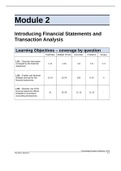
Module 2
Introducing Financial Statements and
Transaction Analysis
Learning Objectives – coverage by question
True/False Multiple Choice Exercises Problems Essays
LO1 – Describe information
conveyed by the financial 1-11 1-15 1-8 1-8 1-3
statements.
LO2 – Explain and illustrate
linkages among the four 12-14 16-24 810 8-10 4
financial statements.
LO3 – Illustrate use of the
financial statement effects
15 25-30 11-15 11-15 -
template to summarize
accounting transactions.
©Cambridge Business Publishers, 2015
Test Bank, Module 2 2-1
,Module 2: Introducing Financial Statements and Transaction Analysis
True/False
Topic: Definition of an Asset
LO: 1
1. In order for an asset to be reported on the balance sheet, it must be owned by the company and be
expected to provide future benefits.
Answer: False
Rationale: Assets reported on the balance sheet must be owned OR CONTROLLED by the company
and must be expected to provide future benefits. These benefits can relate to the expected receipt of
cash or another asset, or the expected decrease in a liability.
Topic: Historical Cost
LO: 1
2. Assets are reported on the balance sheet at their current market value.
Answer: False
Rationale: Assets are generally reported at historical costs. An exception is marketable securities.
Topic: Book vs. Market Value
LO: 1
3. The book value of stockholders’ equity (the amount reported on the balance sheet) is most typically
equal to the market value of the equity of a company.
Answer: False
Rationale: Book value and market value differ for many reasons, including reporting assets at
historical costs instead of current market value, and differences between the accounting periods in
which transactions are recognized in the financial statements and when the value implications of
those transactions are recognized by the capital markets.
Topic: Reporting of Assets and Liabilities
LO: 1
4. Assets are listed on the balance sheet in order of liquidity and liabilities are listed in order of maturity.
Answer: True
Rationale: Assets are reported in the order that they are generally expected to be converted into
cash. Receivables are, thus, reported before inventories, and inventories before PPE. Liabilities are
reported in order of maturity, with current liabilities expected to be paid within one year and long-term
liabilities expected to be paid over a longer period of time.
©Cambridge Business Publishers, 2015
2-2 Financial & Managerial Accounting for MBAs, 4th Edition
,Topic: Unrecorded Assets
LO: 1
5. In addition to purchased assets like inventories and equipment, companies also may report on their
balance sheets intangible assets such as the value of a brand name.
Answer: True
Rationale: Companies may report intangible assets if they acquired them in an arms’ length
transaction. But if the intangible was not purchased, if it was internally generated it may not be
included on the balance sheet because its future economic benefits cannot be reliably measured. So,
all internally generated intangible assets are excluded from the balance sheet under GAAP.
Topic: Liabilities
LO: 1
6. Liabilities and equities are both claims against the assets of a company.
Answer: True
Rationale: Both liabilities and equity are claims against the assets. In the event of default of a
company, liabilities are settled first against the assets of the company. The owners, however, still
have an interest in the remaining assets.
Topic: Unearned Revenue and Revenue Recognition Principle
(more challenging – involves unearned revenue and recognition thereof.)
LO: 1
7. A customer’s prepayment for services not yet rendered is initially recorded as unearned revenue (a
liability). Then, at the end of the accounting period, the unearned revenue is moved from the balance
sheet to the income statement. This is an example of the revenue recognition principle.
Answer: False
Rationale: Unearned revenue is recorded for customer prepayments. But it is only moved to the
income statement when the services have been rendered and not automatically at the end of the
accounting period.
Topic: Revenue Recognition Principle and Cash
LO: 1
8. According to the revenue recognition principle, companies are required to record revenue when cash
is received as this provides the most objective evidence for the auditors.
Answer: False
Rationale: The revenue recognition principle states that revenue may be recognized in the income
statement when it is earned and realized or realizable. Cash is objective but not necessary for
revenue to be earned.
Topic: Accrual Accounting for Expenses
LO: 1
9. Under accrual accounting principles, the cost of inventory should be reported as an expense in the
income statement when it is sold, regardless of when it was purchased.
Answer: True
Rationale: Under accrual accounting, the cost of inventory is reported as expense in the period in
which it is used up, typically at the point of sale. Purchased inventories that have not yet been sold
are reported as assets, notwithstanding whether or not they have been paid for.
©Cambridge Business Publishers, 2015
Test Bank, Module 2 2-3
, Topic: Statement of Cash Flows
LO: 1
10. The statement of cash flows has two main sections: cash flows from operating activities and cash
flows from investing activities.
Answer: False
Rationale: The statement of cash flows has three sections: cash flows from operating activities, cash
flows from investing activities, and cash flows from financing activities
Topic: Net working Capital
LO: 1
11. Net working capital = Current assets + current liabilities
Answer: False
Rationale: Net working capital = Current assets less current liabilities.
Topic: Articulation in General
LO: 2
12. Articulation refers to the concept that financial statements are linked to each other and linked across
time.
Answer: True
Rationale: Balance sheets are linked over time because the permanent accounts’ closing balance last
period becomes the opening balance in the current period. The statements are linked to each other
via cash (statements of cash flow and balance sheets), via retained earnings (income statements and
balance sheets), and via equity accounts (statements of stockholders’ equity and balance sheets).
Topic: Articulation in General
LO: 2
13. The income statements of the prior and current year are linked via the balance sheet.
Answer: False
Rationale: The balance sheets of the prior and current year are linked via the income statement.
Topic: Articulation of Retained Earnings
LO: 2
14. Retained earnings articulate across time which means that last period’s retained earnings plus current
period net income (or loss) is equal to the current period’s retained earnings.
Answer: False
Rationale: Last period’s retained earnings plus current period net income (or loss) less any dividends
paid, is equal to the current period’s retained earnings.
Topic: Preparing Financial Statements
LO: 3
15. Preparing financial statements involves two steps: recording transactions during the period and
adjusting records to ensure all events are properly recorded.
Answer: True
Rationale: Both steps are required to prepare accrual based financial statements.
©Cambridge Business Publishers, 2015
2-4 Financial & Managerial Accounting for MBAs, 4th Edition
Introducing Financial Statements and
Transaction Analysis
Learning Objectives – coverage by question
True/False Multiple Choice Exercises Problems Essays
LO1 – Describe information
conveyed by the financial 1-11 1-15 1-8 1-8 1-3
statements.
LO2 – Explain and illustrate
linkages among the four 12-14 16-24 810 8-10 4
financial statements.
LO3 – Illustrate use of the
financial statement effects
15 25-30 11-15 11-15 -
template to summarize
accounting transactions.
©Cambridge Business Publishers, 2015
Test Bank, Module 2 2-1
,Module 2: Introducing Financial Statements and Transaction Analysis
True/False
Topic: Definition of an Asset
LO: 1
1. In order for an asset to be reported on the balance sheet, it must be owned by the company and be
expected to provide future benefits.
Answer: False
Rationale: Assets reported on the balance sheet must be owned OR CONTROLLED by the company
and must be expected to provide future benefits. These benefits can relate to the expected receipt of
cash or another asset, or the expected decrease in a liability.
Topic: Historical Cost
LO: 1
2. Assets are reported on the balance sheet at their current market value.
Answer: False
Rationale: Assets are generally reported at historical costs. An exception is marketable securities.
Topic: Book vs. Market Value
LO: 1
3. The book value of stockholders’ equity (the amount reported on the balance sheet) is most typically
equal to the market value of the equity of a company.
Answer: False
Rationale: Book value and market value differ for many reasons, including reporting assets at
historical costs instead of current market value, and differences between the accounting periods in
which transactions are recognized in the financial statements and when the value implications of
those transactions are recognized by the capital markets.
Topic: Reporting of Assets and Liabilities
LO: 1
4. Assets are listed on the balance sheet in order of liquidity and liabilities are listed in order of maturity.
Answer: True
Rationale: Assets are reported in the order that they are generally expected to be converted into
cash. Receivables are, thus, reported before inventories, and inventories before PPE. Liabilities are
reported in order of maturity, with current liabilities expected to be paid within one year and long-term
liabilities expected to be paid over a longer period of time.
©Cambridge Business Publishers, 2015
2-2 Financial & Managerial Accounting for MBAs, 4th Edition
,Topic: Unrecorded Assets
LO: 1
5. In addition to purchased assets like inventories and equipment, companies also may report on their
balance sheets intangible assets such as the value of a brand name.
Answer: True
Rationale: Companies may report intangible assets if they acquired them in an arms’ length
transaction. But if the intangible was not purchased, if it was internally generated it may not be
included on the balance sheet because its future economic benefits cannot be reliably measured. So,
all internally generated intangible assets are excluded from the balance sheet under GAAP.
Topic: Liabilities
LO: 1
6. Liabilities and equities are both claims against the assets of a company.
Answer: True
Rationale: Both liabilities and equity are claims against the assets. In the event of default of a
company, liabilities are settled first against the assets of the company. The owners, however, still
have an interest in the remaining assets.
Topic: Unearned Revenue and Revenue Recognition Principle
(more challenging – involves unearned revenue and recognition thereof.)
LO: 1
7. A customer’s prepayment for services not yet rendered is initially recorded as unearned revenue (a
liability). Then, at the end of the accounting period, the unearned revenue is moved from the balance
sheet to the income statement. This is an example of the revenue recognition principle.
Answer: False
Rationale: Unearned revenue is recorded for customer prepayments. But it is only moved to the
income statement when the services have been rendered and not automatically at the end of the
accounting period.
Topic: Revenue Recognition Principle and Cash
LO: 1
8. According to the revenue recognition principle, companies are required to record revenue when cash
is received as this provides the most objective evidence for the auditors.
Answer: False
Rationale: The revenue recognition principle states that revenue may be recognized in the income
statement when it is earned and realized or realizable. Cash is objective but not necessary for
revenue to be earned.
Topic: Accrual Accounting for Expenses
LO: 1
9. Under accrual accounting principles, the cost of inventory should be reported as an expense in the
income statement when it is sold, regardless of when it was purchased.
Answer: True
Rationale: Under accrual accounting, the cost of inventory is reported as expense in the period in
which it is used up, typically at the point of sale. Purchased inventories that have not yet been sold
are reported as assets, notwithstanding whether or not they have been paid for.
©Cambridge Business Publishers, 2015
Test Bank, Module 2 2-3
, Topic: Statement of Cash Flows
LO: 1
10. The statement of cash flows has two main sections: cash flows from operating activities and cash
flows from investing activities.
Answer: False
Rationale: The statement of cash flows has three sections: cash flows from operating activities, cash
flows from investing activities, and cash flows from financing activities
Topic: Net working Capital
LO: 1
11. Net working capital = Current assets + current liabilities
Answer: False
Rationale: Net working capital = Current assets less current liabilities.
Topic: Articulation in General
LO: 2
12. Articulation refers to the concept that financial statements are linked to each other and linked across
time.
Answer: True
Rationale: Balance sheets are linked over time because the permanent accounts’ closing balance last
period becomes the opening balance in the current period. The statements are linked to each other
via cash (statements of cash flow and balance sheets), via retained earnings (income statements and
balance sheets), and via equity accounts (statements of stockholders’ equity and balance sheets).
Topic: Articulation in General
LO: 2
13. The income statements of the prior and current year are linked via the balance sheet.
Answer: False
Rationale: The balance sheets of the prior and current year are linked via the income statement.
Topic: Articulation of Retained Earnings
LO: 2
14. Retained earnings articulate across time which means that last period’s retained earnings plus current
period net income (or loss) is equal to the current period’s retained earnings.
Answer: False
Rationale: Last period’s retained earnings plus current period net income (or loss) less any dividends
paid, is equal to the current period’s retained earnings.
Topic: Preparing Financial Statements
LO: 3
15. Preparing financial statements involves two steps: recording transactions during the period and
adjusting records to ensure all events are properly recorded.
Answer: True
Rationale: Both steps are required to prepare accrual based financial statements.
©Cambridge Business Publishers, 2015
2-4 Financial & Managerial Accounting for MBAs, 4th Edition

