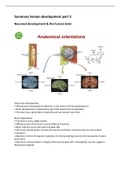
Summary human development part 3
Neuronal development & the human brain
Early brain development
• All behavioral development depends on the extent of brain development
• Brain development is dependent upon both experience and genetics
• The brain has a great deal of plasticity and can recover over time.
Brain organization
• The brain is not a single system
• Different parts of the brain control different functions
• Brain cells are nerve (neurons) and glial cells
• Info from outside body is stored into neurons and their communication to one another
(‘network’)
• Reaction to this info requires networks of communicating neurons (not necessarily in same
brain part)
• Neuronal communication is largely influenced by glial cells ‘enwrapping’ neurons (against
the Neuron-Dogma)
,Prenatal development of the brain
Postnatal development of the brain
Piaget’s object permanence task
Infants < 9 months are not aware of the object
when hidden
The Brain’s Composition
• Growth of the brain occurs from the inside out and the bottom up
• Born with 100 billion (0.1x10¹²) neurons
• There are ~1,000 synaptic connections for each cell
The brain is comprised of three main areas:
,Organization of the nervous system: an overview
(Prenatal) Brain development
The human central nervous system begins to form when the embryo is ~ 2 weeks old.
– The dorsal surface thickens forming a neural tube surrounding a fluid filled cavity.
– The forward end enlarges and differentiates into the hindbrain, midbrain and forebrain.
– The rest of the neural tube becomes the spinal cord.
What happens to the embryo at the third week?
→ Recapitulation: Week two-four→ Primitive Streak
(primitive axis; notochord)
, Prenatal brain: The anteroposterior axis
The embryonic brain is segmented along its anteroposterior (rostrocaudal) axis
– Six forebrain segments (prosomeres): Telencephalon & Diencephalon
– One midbrain segment: Mesencephalon
– Eight hindbrain segments (rhombomeres): Metencephalon, Myelencephalon
Neuronal development & the human brain
Early brain development
• All behavioral development depends on the extent of brain development
• Brain development is dependent upon both experience and genetics
• The brain has a great deal of plasticity and can recover over time.
Brain organization
• The brain is not a single system
• Different parts of the brain control different functions
• Brain cells are nerve (neurons) and glial cells
• Info from outside body is stored into neurons and their communication to one another
(‘network’)
• Reaction to this info requires networks of communicating neurons (not necessarily in same
brain part)
• Neuronal communication is largely influenced by glial cells ‘enwrapping’ neurons (against
the Neuron-Dogma)
,Prenatal development of the brain
Postnatal development of the brain
Piaget’s object permanence task
Infants < 9 months are not aware of the object
when hidden
The Brain’s Composition
• Growth of the brain occurs from the inside out and the bottom up
• Born with 100 billion (0.1x10¹²) neurons
• There are ~1,000 synaptic connections for each cell
The brain is comprised of three main areas:
,Organization of the nervous system: an overview
(Prenatal) Brain development
The human central nervous system begins to form when the embryo is ~ 2 weeks old.
– The dorsal surface thickens forming a neural tube surrounding a fluid filled cavity.
– The forward end enlarges and differentiates into the hindbrain, midbrain and forebrain.
– The rest of the neural tube becomes the spinal cord.
What happens to the embryo at the third week?
→ Recapitulation: Week two-four→ Primitive Streak
(primitive axis; notochord)
, Prenatal brain: The anteroposterior axis
The embryonic brain is segmented along its anteroposterior (rostrocaudal) axis
– Six forebrain segments (prosomeres): Telencephalon & Diencephalon
– One midbrain segment: Mesencephalon
– Eight hindbrain segments (rhombomeres): Metencephalon, Myelencephalon