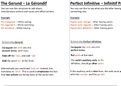
The Gerund – Le Gérondif Perfect Infinitive – Infinitif Pa
You can use this structure to talk about You can use this to say what you did after having
simultaneous actions and cause and effect actions. something else
Example Example
•En mangeant – While eating. •Après avoir mangé – After having eaten.
•En regardant – While watching. •Après avoir regardé – After having seen.
•En achetant – While buying •Après être allé(e)(s) – After having gone.
To form the Gerund: To form the Perfect Infinitive:
Conjugate the verb into the Conjugate the verb into the
present tense, with nous. perfect tense.
Take off the –ons, and add –ant. Put après at the start.
Add the word ‘En’ at the front. The verb’s auxiliary verb, in it’s
infinitive, should go after après.
Alternatively you could add ‘tout en’ instead, this
translates to ‘all in’. This is used to emphasise the fact If the auxiliary verb is être then, the verb must ag
that two actions are being done at the same time. with the number and the gender.
You can use this structure to talk about You can use this to say what you did after having
simultaneous actions and cause and effect actions. something else
Example Example
•En mangeant – While eating. •Après avoir mangé – After having eaten.
•En regardant – While watching. •Après avoir regardé – After having seen.
•En achetant – While buying •Après être allé(e)(s) – After having gone.
To form the Gerund: To form the Perfect Infinitive:
Conjugate the verb into the Conjugate the verb into the
present tense, with nous. perfect tense.
Take off the –ons, and add –ant. Put après at the start.
Add the word ‘En’ at the front. The verb’s auxiliary verb, in it’s
infinitive, should go after après.
Alternatively you could add ‘tout en’ instead, this
translates to ‘all in’. This is used to emphasise the fact If the auxiliary verb is être then, the verb must ag
that two actions are being done at the same time. with the number and the gender.