Chapter 17 Streams and floods: The geology of running water
Geologists use the term stream for any body of running water that flows in a channel, an elongate
depression or through – the edges of the channel are the stream’s banks, the floor of the channel is the
streambed, and a length of the channel is called a reach. Water in a stream overall flows from the
upstream region closer to the source or headwaters of the stream to the downstream region, closer to the
end or mouth of the stream. When the supply of water entering a stream exceeds the channel’s capacity,
water spills out and covers the surrounding land, causing a flood.
17.2 Draining the land
Water enters the hydrologic cycle by evaporating from the Earth’s surface and rising into the atmosphere.
After a short residence time, atmospheric water condenses and falls back to the Earth’s surface as rain or
snow, accumulating in various reservoirs. Some remains relatively non flowing on the land (puddles,
swamps, lakes, snowfields and glaciers), some flows down the land surface as a thin film called
sheetwash, and some sinks into the ground where it either becomes trapped in soil or descends below the
water table and becomes ground water.
Runoff, water flowing on the surface of the Earth, can collect in channels because a channel is lower than
the surrounding area (gravitation). Channels form at : springs (where groundwater seeps out and starts to
flow on the surface), at a sheetwash; when the sheetwash erodes its substrate and starts to focus in a slight
depression. The efficiency of such erosion depends on the velocity of the flow and the resistance of the
substrate to erosion. With time, the extra flow deepens the channel called downcutting.
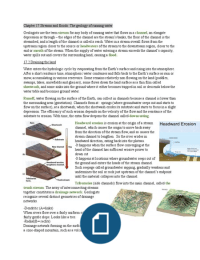
Headward erosion is erosion at the origin of a stream
channel, which causes the origin to move back away
from the direction of the stream flow, and so causes the
stream channel to lengthen. So the river erodes in
headward direction, eating back into the plateau.
-It happens when the surface flow converging at the
head of the channel has sufficient erosive power to
down cut
-It happens at locations where groundwater seeps out of
the ground and enters the heads of the stream channel.
Such seepage called groundwater sapping, gradually weakens and
undermines the soil or rock just upstream of the channel’s endpoint
until the material collapses into the channel.
Tributaries (side channels) flow into the main channel, called the
trunk stream. The array of interconnecting streams
together constitutes a drainage network. Geologists
recognize several distinct geometries of drainage
networks.
-Dendritic (A=links)
When rivers flow over a fairly uniform substrate with a
fairly gentle slope. Looks like a tree.
-Radial(B= rechts)
Drainage network forming on the surface of
a cone-shaped mountain, such as a volcano.
, -Rectangular (C=links)
At places where vertical joints break up the ground.
-Trellis (D=rechts)
At places where a drainage network develops across a landscape of parallel valleys and ridges. The place
where a trunk cuts across a ridge is a water gap.
-Parallel: On a uniform fairly steep slope, several streams with
parallel courses develop simultaneously.
A drainage network collects water from a region called a
drainage basin, catchment or watershed. The highland or ridge
separating one watershed from another I called a drainage
divide. A continental divide separates drainage that flows into
one ocean from drainage that flows into another.
In a gaining steam, the volume of water increases in the
downstream direction, whereas in a losing stream, the volume of water decreases in the downstream
direction. Which system it is depends on: (1) amount of water entering the stream from tributaries,
because water coming from tributaries can replace water lost to evaporation or to infiltration into the
streambed; and (2) depth of water table relative to streambed, because if the streambed lies below the
water table, then groundwater flows up into the stream through springs.
A permanent stream flows all year long, whereas ephemeral streams flow for only part of the year. If
the water table generally lies above the streambed, the stream is permanent. All
ephemeral streams are losing streams (water table lies at depth below the
streambed so water sinks down through the streambed) BUT not all losing
streams are ephemeral. Permanent losing streams are those whose headwaters
lie in wetter region, so the stream receives more water from its upper reaches
than it loses to infiltration or evaporation in its lower reaches. The dry channel
of ephemeral streams are called dry wash, wadi or arroyo.
Since streambeds are permeable, water from a permanent stream mixes with
groundwater in a region beneath the streambed called the hyporheic zone.
Water in this zone flows in the same direction as the stream but not so fast. Wadi
17.3 Describing flow in streams; Discharge and turbulence
Discharge: the volume of water passing a reference point in a given
time.
D= Ac x va (Ac= crossectional area in m3 and Va= average velocity)
Discharge depends on the size of the watershed, on whether the stream
is gaining or losing and on the amount of rain or snow falling in the
watershed. Velocity differs at a certain pint because friction along the
sides and bed of the stream slows the flow at those points. The amount by which friction slows the flow
depends both on the roughness of the walls and bed and on channel shape. Rougher walls slow the floor
more and a wide shallow stream channel has a larger wetted perimeter (the area in which water touches
the channel walls) than does a semicircular channels, so water flows more slowly in the shallow stream.
Geologists use the term stream for any body of running water that flows in a channel, an elongate
depression or through – the edges of the channel are the stream’s banks, the floor of the channel is the
streambed, and a length of the channel is called a reach. Water in a stream overall flows from the
upstream region closer to the source or headwaters of the stream to the downstream region, closer to the
end or mouth of the stream. When the supply of water entering a stream exceeds the channel’s capacity,
water spills out and covers the surrounding land, causing a flood.
17.2 Draining the land
Water enters the hydrologic cycle by evaporating from the Earth’s surface and rising into the atmosphere.
After a short residence time, atmospheric water condenses and falls back to the Earth’s surface as rain or
snow, accumulating in various reservoirs. Some remains relatively non flowing on the land (puddles,
swamps, lakes, snowfields and glaciers), some flows down the land surface as a thin film called
sheetwash, and some sinks into the ground where it either becomes trapped in soil or descends below the
water table and becomes ground water.
Runoff, water flowing on the surface of the Earth, can collect in channels because a channel is lower than
the surrounding area (gravitation). Channels form at : springs (where groundwater seeps out and starts to
flow on the surface), at a sheetwash; when the sheetwash erodes its substrate and starts to focus in a slight
depression. The efficiency of such erosion depends on the velocity of the flow and the resistance of the
substrate to erosion. With time, the extra flow deepens the channel called downcutting.
Headward erosion is erosion at the origin of a stream
channel, which causes the origin to move back away
from the direction of the stream flow, and so causes the
stream channel to lengthen. So the river erodes in
headward direction, eating back into the plateau.
-It happens when the surface flow converging at the
head of the channel has sufficient erosive power to
down cut
-It happens at locations where groundwater seeps out of
the ground and enters the heads of the stream channel.
Such seepage called groundwater sapping, gradually weakens and
undermines the soil or rock just upstream of the channel’s endpoint
until the material collapses into the channel.
Tributaries (side channels) flow into the main channel, called the
trunk stream. The array of interconnecting streams
together constitutes a drainage network. Geologists
recognize several distinct geometries of drainage
networks.
-Dendritic (A=links)
When rivers flow over a fairly uniform substrate with a
fairly gentle slope. Looks like a tree.
-Radial(B= rechts)
Drainage network forming on the surface of
a cone-shaped mountain, such as a volcano.
, -Rectangular (C=links)
At places where vertical joints break up the ground.
-Trellis (D=rechts)
At places where a drainage network develops across a landscape of parallel valleys and ridges. The place
where a trunk cuts across a ridge is a water gap.
-Parallel: On a uniform fairly steep slope, several streams with
parallel courses develop simultaneously.
A drainage network collects water from a region called a
drainage basin, catchment or watershed. The highland or ridge
separating one watershed from another I called a drainage
divide. A continental divide separates drainage that flows into
one ocean from drainage that flows into another.
In a gaining steam, the volume of water increases in the
downstream direction, whereas in a losing stream, the volume of water decreases in the downstream
direction. Which system it is depends on: (1) amount of water entering the stream from tributaries,
because water coming from tributaries can replace water lost to evaporation or to infiltration into the
streambed; and (2) depth of water table relative to streambed, because if the streambed lies below the
water table, then groundwater flows up into the stream through springs.
A permanent stream flows all year long, whereas ephemeral streams flow for only part of the year. If
the water table generally lies above the streambed, the stream is permanent. All
ephemeral streams are losing streams (water table lies at depth below the
streambed so water sinks down through the streambed) BUT not all losing
streams are ephemeral. Permanent losing streams are those whose headwaters
lie in wetter region, so the stream receives more water from its upper reaches
than it loses to infiltration or evaporation in its lower reaches. The dry channel
of ephemeral streams are called dry wash, wadi or arroyo.
Since streambeds are permeable, water from a permanent stream mixes with
groundwater in a region beneath the streambed called the hyporheic zone.
Water in this zone flows in the same direction as the stream but not so fast. Wadi
17.3 Describing flow in streams; Discharge and turbulence
Discharge: the volume of water passing a reference point in a given
time.
D= Ac x va (Ac= crossectional area in m3 and Va= average velocity)
Discharge depends on the size of the watershed, on whether the stream
is gaining or losing and on the amount of rain or snow falling in the
watershed. Velocity differs at a certain pint because friction along the
sides and bed of the stream slows the flow at those points. The amount by which friction slows the flow
depends both on the roughness of the walls and bed and on channel shape. Rougher walls slow the floor
more and a wide shallow stream channel has a larger wetted perimeter (the area in which water touches
the channel walls) than does a semicircular channels, so water flows more slowly in the shallow stream.