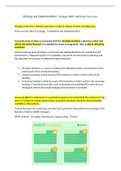
Strategy and implementation - Strategy, SWOT and Porters five forces.
Strategy is the way a business operates in order to achieve its aims and objectives.
There are two sides of strategy – formulation and implementation.
Corporate level strategy is concerned with the strategic decisions a business makes that
affects the entire business. It is decided by senior management. Also, it aids in allocating
resources.
At the corporate level, strategy is concerned with setting objectives for overall financial
performance, proposed mergers or acquisitions, long term human resource planning and
the allocation of resources to different business divisions.
Strategic direction is a course of action that ultimately leads to achievement of the
stated goals of the corporate strategy.
Divisional strategy is used by part of the business to help it achieve the overall
strategy.
Functional strategy it used by a part of the business to help it achieve the corporate
strategy. A functional operation such as production/marketing/HR creates its own
strategy to ensure the overall strategy of the business is achieved.
Corporate plan is a statement of organisational goals to be achieved in the medium to long
term. It’s based-on market opportunities, economic situation, resources and technology
available to the business.
Tactical decisions are small steps and short term goals that help achieve the strategy of the
business made by middle managers.
SWOT analysis - Strengths, Weaknesses, Opportunities, Threats.
, Porters five forces model was created by Michael Porter.
Porters five forces model is an analysis tool that uses five industry forces to determine the
intensity of competition in an industry and its profitability level.
Porters five forces are:
Threat of new entrants
Power of suppliers
Power of buyers
Competitive rivalry
Threat of substitutes
These five forces show how profitable a market is.
Threat of new entrants:
If there is a high threat of new entrants it means the market has low barriers to entry
and low start-up costs which means it has low profitability.
If there is a low threat of new entrants it means the market has high barriers to entry
and high start-up costs which means it has high profitability.
Evaluation – customer loyalty, offers and discounts (from businesses already in the
market.)
Power of suppliers:
If suppliers have high levels of power, they are able to push up prices of raw
materials and components, hence it lowers profit margins for the business.
If suppliers have low levels of power due to competition for example, they aren’t
able to push up price of raw materials and components, hence it increases profit
margins for the business.
Evaluation – may affect quality of service, reliability of service, consumers may not
like the materials from new suppliers.
Power of buyers:
If the buyer has a lot of power, the business can’t increase prices. This decreases the
potential for businesses to make the prices.
If the buyer has less power, the business can increase prices. This increases the
potential for businesses to make the prices.
Strategy is the way a business operates in order to achieve its aims and objectives.
There are two sides of strategy – formulation and implementation.
Corporate level strategy is concerned with the strategic decisions a business makes that
affects the entire business. It is decided by senior management. Also, it aids in allocating
resources.
At the corporate level, strategy is concerned with setting objectives for overall financial
performance, proposed mergers or acquisitions, long term human resource planning and
the allocation of resources to different business divisions.
Strategic direction is a course of action that ultimately leads to achievement of the
stated goals of the corporate strategy.
Divisional strategy is used by part of the business to help it achieve the overall
strategy.
Functional strategy it used by a part of the business to help it achieve the corporate
strategy. A functional operation such as production/marketing/HR creates its own
strategy to ensure the overall strategy of the business is achieved.
Corporate plan is a statement of organisational goals to be achieved in the medium to long
term. It’s based-on market opportunities, economic situation, resources and technology
available to the business.
Tactical decisions are small steps and short term goals that help achieve the strategy of the
business made by middle managers.
SWOT analysis - Strengths, Weaknesses, Opportunities, Threats.
, Porters five forces model was created by Michael Porter.
Porters five forces model is an analysis tool that uses five industry forces to determine the
intensity of competition in an industry and its profitability level.
Porters five forces are:
Threat of new entrants
Power of suppliers
Power of buyers
Competitive rivalry
Threat of substitutes
These five forces show how profitable a market is.
Threat of new entrants:
If there is a high threat of new entrants it means the market has low barriers to entry
and low start-up costs which means it has low profitability.
If there is a low threat of new entrants it means the market has high barriers to entry
and high start-up costs which means it has high profitability.
Evaluation – customer loyalty, offers and discounts (from businesses already in the
market.)
Power of suppliers:
If suppliers have high levels of power, they are able to push up prices of raw
materials and components, hence it lowers profit margins for the business.
If suppliers have low levels of power due to competition for example, they aren’t
able to push up price of raw materials and components, hence it increases profit
margins for the business.
Evaluation – may affect quality of service, reliability of service, consumers may not
like the materials from new suppliers.
Power of buyers:
If the buyer has a lot of power, the business can’t increase prices. This decreases the
potential for businesses to make the prices.
If the buyer has less power, the business can increase prices. This increases the
potential for businesses to make the prices.