Taylor’s Notes Aromatic (Arenes) Chemistry
Benzene
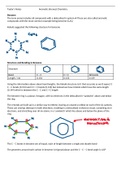
The term arene includes all compounds with a delocalised π-system These are also called aromatic
compounds with the most common example being benzene (C6H6)
Kekulé suggested the following structure for benzene
Structure and Bonding in Benzene
Structure
Bond C–C C=C All bonds
Length / nm 0.154 0.133 0.139
Using the information above about bond lengths, the Kekulé structure isn’t that accurate as we’d expect 3
C – C bonds (0.154) and 3 C = C bonds (0.133) but instead we have 6 binds which have the same length
(0.149) which is between the C – C and C = C length
The benzene ring is a planar, hexagon, with six electrons in the delocalised π-‘sandwich’ above and below
the ring
The σ-bonds are built up in a similar way to ethene, leaving an unused p orbital on each of the six carbons.
These can overlap sideways in both directions, resulting in a delocalized π-electron cloud, containing six π-
electrons, and stretching over all six atoms, in a ‘sandwich’ which lies above and below the plane of the
ring.
The C – C bonds in benzene are all equal, each of length between a single and double bond
The geometry around each carbon in benzene is trigonal planar and the C – C – C bond angle is 120°
, Taylor’s Notes Aromatic (Arenes) Chemistry
Thermochemical Evidence
Evidence for the ‘delocalised’ structure for benzene is provided by thermochemical evidence
Hydrogenation Reactions
In the presence of a nickel catalyst hydrogen can be added to a double bond
When this is carried out with cyclohexene the following reaction takes place:
The reaction should be used to predict the enthalpy change for a similar reaction for cyclohexa-1,3,5-triene
The predicted enthalpy change for this hydrogenation of benzene is 3(-120) = -360 kJ mol -1
However, the measured value for this hydrogenation of benzene is actually -208 kJ mol -1
Therefore, there is an extra stability associated with the delocalisation of the π electrons in benzene:
Benzene
The term arene includes all compounds with a delocalised π-system These are also called aromatic
compounds with the most common example being benzene (C6H6)
Kekulé suggested the following structure for benzene
Structure and Bonding in Benzene
Structure
Bond C–C C=C All bonds
Length / nm 0.154 0.133 0.139
Using the information above about bond lengths, the Kekulé structure isn’t that accurate as we’d expect 3
C – C bonds (0.154) and 3 C = C bonds (0.133) but instead we have 6 binds which have the same length
(0.149) which is between the C – C and C = C length
The benzene ring is a planar, hexagon, with six electrons in the delocalised π-‘sandwich’ above and below
the ring
The σ-bonds are built up in a similar way to ethene, leaving an unused p orbital on each of the six carbons.
These can overlap sideways in both directions, resulting in a delocalized π-electron cloud, containing six π-
electrons, and stretching over all six atoms, in a ‘sandwich’ which lies above and below the plane of the
ring.
The C – C bonds in benzene are all equal, each of length between a single and double bond
The geometry around each carbon in benzene is trigonal planar and the C – C – C bond angle is 120°
, Taylor’s Notes Aromatic (Arenes) Chemistry
Thermochemical Evidence
Evidence for the ‘delocalised’ structure for benzene is provided by thermochemical evidence
Hydrogenation Reactions
In the presence of a nickel catalyst hydrogen can be added to a double bond
When this is carried out with cyclohexene the following reaction takes place:
The reaction should be used to predict the enthalpy change for a similar reaction for cyclohexa-1,3,5-triene
The predicted enthalpy change for this hydrogenation of benzene is 3(-120) = -360 kJ mol -1
However, the measured value for this hydrogenation of benzene is actually -208 kJ mol -1
Therefore, there is an extra stability associated with the delocalisation of the π electrons in benzene: