Taylor Notes Structure and Bonding
Ionic Bonding
An ionic bond is defined as a strong electrostatic attraction between oppositely charged ions
Ionic compounds have high melting points as lots of energy is required to break the strong ionic bonds and
as charge on the ions increases there is a stronger attraction
Ionic compounds conduct electricity when molten or aqueous as the ions are free to move
Ionic compounds do not conduct electricity when solid as the ions are not free to move
Ionic compounds are brittle as when there is a shift in ions in a plane the like charges repel each other
Formulae of Ions
Sulphate – SO42- Hydroxide – OH- Nitrate – NO3-
Carbonate CO32- Ammonium – NH4+ Phosphate PO43-
Ionic Formulae
Magnesium Fluoride is MgF2 Ammonium Phosphate is (NH4)3PO4 Aluminium Sulphate is Al2(SO4)3
Ionic Dot and Cross Diagrams
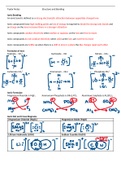
Magnesium Chloride (MgCl2) Magnesium Oxide (MgO)
Lithium Hydroxide (LiOH) Sodium Cyanide (NaCN)
, Taylor Notes Structure and Bonding
Metallic Bonding
A metallic bond is defined as a strong electrostatic attraction between a sea of delocalised electrons and
the positive ions in the nucleus
The strength of the metallic bond increases with:
Charge on the metal ions as the number of delocalised electrons increases and so there is a
stronger attraction
The size of the metal ions as the smaller the metal ion, the higher the charge density so there is a
stronger attraction
Metallic compounds conduct as they have a sea of delocalised electrons which are free to move
Alloys are hard as the different sized atoms distort the layers of atoms and so a greater force is required for
the layers to side over each other
Covalent Bonding
A covalent bond is defined as a strong electrostatic attraction between the bonding nuclei and a shared
pair of electrons
Most covalently bonded compounds have low boiling points as they are often simple molecular and so
have weak intermolecular forces which require little energy to overcome
Giant covalent compounds have a high boiling point as there are lots of strong covalent bonds which
require lots of energy to break and so will have a high melting point
Covalent compounds do not conduct electricity as they have no free moving electrons except between the
layers in graphite
Covalent Dot and Cross Diagrams
Ammonia (NH3) Carbon Dioxide (CO2)
Phosphoryl Chloride (POCl3) Sulphuric Acid (H2SO4)
Carbon Allotropes
Diamond and Sand
They have high melting points due to the many strong covalent bonds which need to be broken and they
do not conduct as there are no charged carriers which are free to move
Graphite
It has a high melting point due to the many strong covalent bond which need to be broken and it conducts
electricity as there are delocalised electrons between layers which are free to move
Ionic Bonding
An ionic bond is defined as a strong electrostatic attraction between oppositely charged ions
Ionic compounds have high melting points as lots of energy is required to break the strong ionic bonds and
as charge on the ions increases there is a stronger attraction
Ionic compounds conduct electricity when molten or aqueous as the ions are free to move
Ionic compounds do not conduct electricity when solid as the ions are not free to move
Ionic compounds are brittle as when there is a shift in ions in a plane the like charges repel each other
Formulae of Ions
Sulphate – SO42- Hydroxide – OH- Nitrate – NO3-
Carbonate CO32- Ammonium – NH4+ Phosphate PO43-
Ionic Formulae
Magnesium Fluoride is MgF2 Ammonium Phosphate is (NH4)3PO4 Aluminium Sulphate is Al2(SO4)3
Ionic Dot and Cross Diagrams
Magnesium Chloride (MgCl2) Magnesium Oxide (MgO)
Lithium Hydroxide (LiOH) Sodium Cyanide (NaCN)
, Taylor Notes Structure and Bonding
Metallic Bonding
A metallic bond is defined as a strong electrostatic attraction between a sea of delocalised electrons and
the positive ions in the nucleus
The strength of the metallic bond increases with:
Charge on the metal ions as the number of delocalised electrons increases and so there is a
stronger attraction
The size of the metal ions as the smaller the metal ion, the higher the charge density so there is a
stronger attraction
Metallic compounds conduct as they have a sea of delocalised electrons which are free to move
Alloys are hard as the different sized atoms distort the layers of atoms and so a greater force is required for
the layers to side over each other
Covalent Bonding
A covalent bond is defined as a strong electrostatic attraction between the bonding nuclei and a shared
pair of electrons
Most covalently bonded compounds have low boiling points as they are often simple molecular and so
have weak intermolecular forces which require little energy to overcome
Giant covalent compounds have a high boiling point as there are lots of strong covalent bonds which
require lots of energy to break and so will have a high melting point
Covalent compounds do not conduct electricity as they have no free moving electrons except between the
layers in graphite
Covalent Dot and Cross Diagrams
Ammonia (NH3) Carbon Dioxide (CO2)
Phosphoryl Chloride (POCl3) Sulphuric Acid (H2SO4)
Carbon Allotropes
Diamond and Sand
They have high melting points due to the many strong covalent bonds which need to be broken and they
do not conduct as there are no charged carriers which are free to move
Graphite
It has a high melting point due to the many strong covalent bond which need to be broken and it conducts
electricity as there are delocalised electrons between layers which are free to move