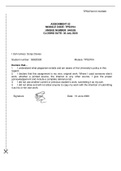
NAME&SURNAME : MTHETHWA
NOKUBONGA SBUSISIWE
STUDENT NUMBER : 13659626
ASSIGNMENT NUMBER : 01
SEMESTER NUMBER : 02
UNIQUE NUMBER : 752803
1. Discuss the four approaches to a safety management system. (10)
, Safety policy and objectives
This first pillar forms the base of an effective safety management system and consists of
documentation that lays out the intention of the SMS and the company’s commitment to
upholding it.
MAIN ELEMENTS
The management commitment: A statement of commitment by the company
management to providing the necessary resources, following procedures for
reporting incidents, and supplying information to employees where needed. This is
agreed to and signed by a responsible executive.
Safety accountabilities: A document that clearly lays out and defines the
responsibilities of various managers and employees at different levels. This should
include the appointment of key safety personnel.
Safety risk management
A crucial step to safety is identifying risks to equip those in charge to head off incidents
before they happen. This applies not just in aviation but in just about any industry—even an
office undergoes risk management to reduce any health and safety risks such as tripping and
RSI to an acceptable level. Of course, in an industry like construction which includes some
very dangerous roles, safety risk management is essential.
The process starts with hazard identification. On a construction site, this is a tall order!
Knowing the hazards, however, is the only way to pre-emptively make things safe for
workers—otherwise, safety measures would only be implemented after an accident or near-
miss situation. Things to consider in a construction setting include machinery, heights,
ladders and scaffolding, vehicles, electricity, flammable materials, exposure to heat and
cold… the list is almost endless and will depend on the site and project. Hazards can be
assessed according to severity and plans to mitigate risk made around these and
incorporated into the SMS program.
Safety assurance
This pillar is about evaluation—it ensures that the safety management system is constantly
being evaluated and adapted to new challenges. The system should be continuously
assessed, situational changes addressed, and improvements made according to feedback or
audits.
These internal evaluation processes are particularly important on a construction site, where
things change and develop as the project progresses. The feedback from workers on the
ground is invaluable to a safety management plan, and with good safety management
software that allows digital form submission, like SafetyTek’s digital safety forms, it’s easy to
collect and collate the necessary information.
Safety promotion
NOKUBONGA SBUSISIWE
STUDENT NUMBER : 13659626
ASSIGNMENT NUMBER : 01
SEMESTER NUMBER : 02
UNIQUE NUMBER : 752803
1. Discuss the four approaches to a safety management system. (10)
, Safety policy and objectives
This first pillar forms the base of an effective safety management system and consists of
documentation that lays out the intention of the SMS and the company’s commitment to
upholding it.
MAIN ELEMENTS
The management commitment: A statement of commitment by the company
management to providing the necessary resources, following procedures for
reporting incidents, and supplying information to employees where needed. This is
agreed to and signed by a responsible executive.
Safety accountabilities: A document that clearly lays out and defines the
responsibilities of various managers and employees at different levels. This should
include the appointment of key safety personnel.
Safety risk management
A crucial step to safety is identifying risks to equip those in charge to head off incidents
before they happen. This applies not just in aviation but in just about any industry—even an
office undergoes risk management to reduce any health and safety risks such as tripping and
RSI to an acceptable level. Of course, in an industry like construction which includes some
very dangerous roles, safety risk management is essential.
The process starts with hazard identification. On a construction site, this is a tall order!
Knowing the hazards, however, is the only way to pre-emptively make things safe for
workers—otherwise, safety measures would only be implemented after an accident or near-
miss situation. Things to consider in a construction setting include machinery, heights,
ladders and scaffolding, vehicles, electricity, flammable materials, exposure to heat and
cold… the list is almost endless and will depend on the site and project. Hazards can be
assessed according to severity and plans to mitigate risk made around these and
incorporated into the SMS program.
Safety assurance
This pillar is about evaluation—it ensures that the safety management system is constantly
being evaluated and adapted to new challenges. The system should be continuously
assessed, situational changes addressed, and improvements made according to feedback or
audits.
These internal evaluation processes are particularly important on a construction site, where
things change and develop as the project progresses. The feedback from workers on the
ground is invaluable to a safety management plan, and with good safety management
software that allows digital form submission, like SafetyTek’s digital safety forms, it’s easy to
collect and collate the necessary information.
Safety promotion