Advanced Organic Chemistry
Chapter 1: Introduction to radical Chemistry
1.1. History on free radical chemistry
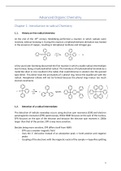
At the end of the 19th century Heidelberg performed a reaction in which radicals were
involved, without knowing it. During this reaction a triphenylmethane derivative was heated
in the presence of copper, resulting in tetraphenyl methane and nitrogen gas.
A few years later Gomberg discovered the first reaction in which a stable radical intermediate
was formed, being a triphenylmethyl radical. The homolysis of triphenylmethyl bromide by a
metal like silver or zinc resulted in the radial, that could dimerise in solution into the quinoid
type dimer. This dimer loses the aromaticity of 1 phenyl ring, hence the equilibrium with the
radical. Hexaphenyl ethane will not be formed because the phenyl rings induce too much
sterical constraints.
1.2. Detection of a radical intermediate
The detection of radicals nowadays occurs using electron spin resonance (ESR) and electron
paramagnetic resonance (EPR) spectroscopy. While NMR focusses on the spin of the nucleus,
EPR focusses on the spin of the electron and because the electron spin moment is 1000x
larger than that of the proton, EPR is way more sensitive.
Besides being more sensitive, EPR differs itself from NMR:
- EPR uses a weaker magnetic field
- Uses the 1° derivative instead of an absorption peak => both positive and negative
peaks
- Coupling of the electrons with the magnetic nuclei of the sample => hyperfine splitting
1
,Example) Regioselectivity
The ionic mechanism follows the Markovnikov rule (the addition of HX to an alkene, ads the
H-atom to the C-atom that has the most H-atoms => most stable carbocation will be formed).
On the other hand, the peroxide effect follows the anti-Markovnikov orientation, but requires
a peroxide initiator like BPO (dibenzoylperoxide).
1.3. Radical stability
The stability of compounds can be described using the bond dissociation energy (BDE) of the
C-H bond, compared to that of methane (104 Kcal/mol) as a reference.
Radicals can be divided into 3 categories, based on their stability:
The reactive and short-lived radicals: most of the radicals, with short half-lives (10-3s)
and are involved in chain reactions.
The stable radicals: are stable due to the π-delocalization factors (e.g. triphenylmethyl
radical)
The persistent radicals: are kinetically stable, mainly due to steric
hindrance. E.g. is the radical TEMPO: the delocalization of the lone
pair on nitrogen provides some stability, but the main kinetic stability
is due to the methyl substituents that cause the difficult accessibility
of the oxygen-radical.
1.3.1. Thermodynamic stability
The thermodynamic product will be the product that is the most stable, while the kinetic
product will be determined by the relative speed of the reaction and therefore mostly
controlled by sterical hindrance.
A first effect is the hyperconjugation: the delocalization of the electrons of an σ orbital with
an adjacent unpopulated non-bonding p or antibonding σ* or π* orbital.
No hyperconjugation is possible in the methyl radical, hence it is the less stable one of the
list. The more methylene substituents that are added, the more stable the radical becomes.
Besides hyperconjugation, mesomerism also influences the stability of the radical. The more
canonical forms that can exist, the more stable the radical.
2
,Finally, the effect of hybridization also affects the stability of the radical. The higher the S-
character of the orbital, the more EN and therefore the more the lone electron will be
withdrawn close to the nucleus. But because a radical only has 1 lone electron, the orbital is
not filled, hence this is energetically not favourable to be withdrawn towards the centre.
Simply put, the higher the S-character the more unstable the radical. σ-radicals are less stable
than π-radicals because the σ-bond is a result of only s-orbitals, while the π orbital of both s
and p-orbitals.
A methyl radical is planar because it has a pure p-orbital. A sp3 orbital is less stable and
tetrahedral (≠ planar) because of the cyclopropane ring strain.
1.3.1.1. Radical stability
The lower the BDE, the more stable the compound because less energy that will be released
upon cleavage of the bond.
Delocalization can stabilize radicals, in both π donors and π acceptors:
If 1 single compound has both π acceptors as π donors the radical will be way more stable
than the sum of the individual effects => captodative effect is a synergistic effect.
The π acceptor stabilization is 9 kcal/mol (ref to CH4) and the π donor stabilization 7 kcal/mol.
Both effects together would be 16 kcal/mol, while in this case a 28 kcal/mol stabilization was
observed.
3
, 1.3.2. Kinetic stability
The kinetic stability is mostly determined by the steric effects. Remember the triphenylmethyl
radical which has a BDE of 111 kcal/mol. This value suggest that the radical should be highly
reactive, but a long half-life is observed as a result of the phenyl substituents that are sterically
demanding (kinetic effect) + possible delocalization (TD effect).
In order to understand the sterics of this compound we have to look at the 3D system. All
phenyl rings can’t be in the same plane because the C-H groups would crush each other. In
reality the phenyl rings as twisted, hence the delocalization will be reduced, but the sterical
shielding will be more important.
The reason for the compound association in the way it is shown is because the
triphenylmethyl radical is only reactive at the end => only sterically assessable.
1.4. Polar effect
Most radicals are unpolar ( ions), but some polar
effects can still be present.
EDG increase the nucleophilicity of the compound and therefore stabilize the carbocations.
EWG destabilize carbocations because they withdraw electrons in electron poor regions.
Oxygen is more EN than Carbon, hence will be more reactive (more electrophilic) than carbon
radicals. Some reactions are kinetically favoured, depending on the nature of the radical:
The polar effect favours the reaction of a nucleophilic radical with an electrophilic bond and
vice versa. A favoured TS means that the reaction will occur kinetically faster, hence less
possible side reactions.
4
Chapter 1: Introduction to radical Chemistry
1.1. History on free radical chemistry
At the end of the 19th century Heidelberg performed a reaction in which radicals were
involved, without knowing it. During this reaction a triphenylmethane derivative was heated
in the presence of copper, resulting in tetraphenyl methane and nitrogen gas.
A few years later Gomberg discovered the first reaction in which a stable radical intermediate
was formed, being a triphenylmethyl radical. The homolysis of triphenylmethyl bromide by a
metal like silver or zinc resulted in the radial, that could dimerise in solution into the quinoid
type dimer. This dimer loses the aromaticity of 1 phenyl ring, hence the equilibrium with the
radical. Hexaphenyl ethane will not be formed because the phenyl rings induce too much
sterical constraints.
1.2. Detection of a radical intermediate
The detection of radicals nowadays occurs using electron spin resonance (ESR) and electron
paramagnetic resonance (EPR) spectroscopy. While NMR focusses on the spin of the nucleus,
EPR focusses on the spin of the electron and because the electron spin moment is 1000x
larger than that of the proton, EPR is way more sensitive.
Besides being more sensitive, EPR differs itself from NMR:
- EPR uses a weaker magnetic field
- Uses the 1° derivative instead of an absorption peak => both positive and negative
peaks
- Coupling of the electrons with the magnetic nuclei of the sample => hyperfine splitting
1
,Example) Regioselectivity
The ionic mechanism follows the Markovnikov rule (the addition of HX to an alkene, ads the
H-atom to the C-atom that has the most H-atoms => most stable carbocation will be formed).
On the other hand, the peroxide effect follows the anti-Markovnikov orientation, but requires
a peroxide initiator like BPO (dibenzoylperoxide).
1.3. Radical stability
The stability of compounds can be described using the bond dissociation energy (BDE) of the
C-H bond, compared to that of methane (104 Kcal/mol) as a reference.
Radicals can be divided into 3 categories, based on their stability:
The reactive and short-lived radicals: most of the radicals, with short half-lives (10-3s)
and are involved in chain reactions.
The stable radicals: are stable due to the π-delocalization factors (e.g. triphenylmethyl
radical)
The persistent radicals: are kinetically stable, mainly due to steric
hindrance. E.g. is the radical TEMPO: the delocalization of the lone
pair on nitrogen provides some stability, but the main kinetic stability
is due to the methyl substituents that cause the difficult accessibility
of the oxygen-radical.
1.3.1. Thermodynamic stability
The thermodynamic product will be the product that is the most stable, while the kinetic
product will be determined by the relative speed of the reaction and therefore mostly
controlled by sterical hindrance.
A first effect is the hyperconjugation: the delocalization of the electrons of an σ orbital with
an adjacent unpopulated non-bonding p or antibonding σ* or π* orbital.
No hyperconjugation is possible in the methyl radical, hence it is the less stable one of the
list. The more methylene substituents that are added, the more stable the radical becomes.
Besides hyperconjugation, mesomerism also influences the stability of the radical. The more
canonical forms that can exist, the more stable the radical.
2
,Finally, the effect of hybridization also affects the stability of the radical. The higher the S-
character of the orbital, the more EN and therefore the more the lone electron will be
withdrawn close to the nucleus. But because a radical only has 1 lone electron, the orbital is
not filled, hence this is energetically not favourable to be withdrawn towards the centre.
Simply put, the higher the S-character the more unstable the radical. σ-radicals are less stable
than π-radicals because the σ-bond is a result of only s-orbitals, while the π orbital of both s
and p-orbitals.
A methyl radical is planar because it has a pure p-orbital. A sp3 orbital is less stable and
tetrahedral (≠ planar) because of the cyclopropane ring strain.
1.3.1.1. Radical stability
The lower the BDE, the more stable the compound because less energy that will be released
upon cleavage of the bond.
Delocalization can stabilize radicals, in both π donors and π acceptors:
If 1 single compound has both π acceptors as π donors the radical will be way more stable
than the sum of the individual effects => captodative effect is a synergistic effect.
The π acceptor stabilization is 9 kcal/mol (ref to CH4) and the π donor stabilization 7 kcal/mol.
Both effects together would be 16 kcal/mol, while in this case a 28 kcal/mol stabilization was
observed.
3
, 1.3.2. Kinetic stability
The kinetic stability is mostly determined by the steric effects. Remember the triphenylmethyl
radical which has a BDE of 111 kcal/mol. This value suggest that the radical should be highly
reactive, but a long half-life is observed as a result of the phenyl substituents that are sterically
demanding (kinetic effect) + possible delocalization (TD effect).
In order to understand the sterics of this compound we have to look at the 3D system. All
phenyl rings can’t be in the same plane because the C-H groups would crush each other. In
reality the phenyl rings as twisted, hence the delocalization will be reduced, but the sterical
shielding will be more important.
The reason for the compound association in the way it is shown is because the
triphenylmethyl radical is only reactive at the end => only sterically assessable.
1.4. Polar effect
Most radicals are unpolar ( ions), but some polar
effects can still be present.
EDG increase the nucleophilicity of the compound and therefore stabilize the carbocations.
EWG destabilize carbocations because they withdraw electrons in electron poor regions.
Oxygen is more EN than Carbon, hence will be more reactive (more electrophilic) than carbon
radicals. Some reactions are kinetically favoured, depending on the nature of the radical:
The polar effect favours the reaction of a nucleophilic radical with an electrophilic bond and
vice versa. A favoured TS means that the reaction will occur kinetically faster, hence less
possible side reactions.
4