CHAPTER 16
Applied Maximum and
Minimum Problems
16.1 A rectangular field is to be fenced in so that the resulting area is c square units. Find the dimensions of that field
(if any) for which the perimeter is a minimum, and the dimensions (if any) for which the perimeter is a maximum.
I Let f be the length and w the width. Then f w = c. The perimeter p = 2( + 2w = 2( + 2c/f. ( can be
any positive number. D(p = 2-2c/f2, and D2ep=4c/f3. Hence, solving 2-2c/f2 = 0, we see that
f = Vc is a critical number. The second derivative is positive, and, therefore, there is a relative minimum at
t = Vc. Since that is the only critical number and the function 2f + 2c/f is continuous for all positive f ,
there is an absolute minimum at f = Vc. (If p achieved a still smaller value at some other point f0, there would
have to be a relative maximum at some point between Vc and f0, yielding another critical number.) When
( = Vc, w = Vc. Thus, for a fixed area, the square is the rectangle with the smallest perimeter. Notice that
the perimeter does not achieve a maximum, since p = 2f + 2c//—» +00 as f—»+00.
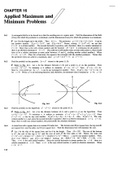
16.2 Find the point(s) on the parabola 2x = y2 closest to the point (1,0).
I Refer to Fig. 16-1. Let u be the distance between (1,0) and a point (x, y) on the parabola. Then
u = V(* - I) 2 + y2. To minimize u it suffices to minimize u2 = (x - I) 2 + y2. Now, u2 = (x - I)2 + 2x.
Since (x, y) is a point on 2x = y2, x can be any nonnegative number. Now, Dx(u2) = 2(x - 1) + 2 = 2x > 0
for *>0. Hence, u2 is an increasing function, and, therefore, its minimum value is attained at x = 0, y = 0.
Fig. 16-1 Fig. 16-2
16.3 Find the point(s) on the hyperbola x2-y2 = 2 closest to the point (0,1).
I Refer to Fig. 16-2. Let u be the distance between (0,1) and a point (x, y) on the hyperbola. Then
M = V*2 + (.y ~!) 2 - To minimize M, it suffices to minimize u2 = x2 + (y - I)2 = 2 + y2 + (y - I)2. Since
*2 = y 2 + 2, y can be any real number. Dy(u2) = 2y + 2(y - 1) = 4y -2. Also, D 2 (M 2 ) = 4. The only
critical number is |, and, since the second derivative is positive, there is a relative minimum at y = \, x=±\.
Since there is only one critical number, this point yields the absolute minimum.
16.4 A closed box with a square base is to contain 252 cubic feet. The bottom costs $5 per square foot, the top costs $2
per square foot, and the sides cost $3 per square foot. Find the dimensions that will minimize the cost.
I Let s be the side of the square base and let h be the height. Then s2h = 252. The cost of the bottom
is 5s2, the cost of the top is 2s2, and the cost of each of the four sides is 3sh. Hence, the total cost
C = 5s2 + 2s2 + 4(3sfc) = 7s2 + I2sh = 7s2 + 12s(252/s2) = 7s2 + 3024/s. s can be any positive number. Now,
DsC = 14s- 3024/s2, and D2C= 14 +6048/s3. Solving 14s - 3024/s2 = 0, 14s3 = 3024, s3 = 216, s = 6.
Thus, s = 6 is the only critical number. Since the second derivative is always positive for s>0, there is a
relative minimum at s = 6. Since s = 6 is the only critical number, it yields an absolute minimum. When
s = 6, h =1.
118
, APPLIED MAXIMUM AND MINIMUM PROBLEMS 0 119
16.5 A printed page must contain 60 cm2 of printed material. There are to be margins of 5 cm on either side and
margins of 3 cm on the top and bottom (Fig. 16-3). How long should the printed lines be in order to minimize the
amount of paper used?
Fig. 16-3
I Let x be the length of the line and let y be the height of the printed material. Then xy = 60. The amount
of paper A = (x + W)(y + 6) = (x + 10)(60/x + 6) = 6(10 + x + 100/x + 10) = 6(20 +x + 100/x). x can be
any positive number. Then DXA = 6(1 - 100/x2) and D2/l = 1200/.X3. Solving 1 - 100/x2 = 0, we see
that the only critical number is 10. Since the second derivative is positive, there is a relative minimum at
x = 10, and, since this is the only critical number, there is an absolute minimum at x = 10.
16.6 A farmer wishes to fence in a rectangular field of 10,000 ft2. The north-south fences will cost $1.50 per foot, while
the east-west fences will cost $6.00 per foot. Find the dimensions of the field that will minimize the cost.
I Let x be the east-west dimension, and let y be the north-south dimension. Then xy = 10,000. The cost
C = 6(2x) + 1.5(2v) = 12x + 3y = Ux + 3( 10,000Ix) = Ux + 30,000/x. x can be any positive number. DXC =
12 -30,000/x2. D 2 C = 60,000/x3. Solving 12 - 30,000/x2 = 0, 2500 = x2, x = 50. Thus, 50 is the only
critical number. Since the second derivative is positive, there is a relative minimum at x = 50. Since this is the
only critical number, this is an absolute minimum. When x = 50, y = 200.
16.7 Find the dimensions of the closed cylindrical can that will have a capacity of k units of volume and will use the
minimum amount of material. Find the ratio of the height h to the radius r of the top and bottom.
I The volume k = irr2h. The amount of material M = 2irr2 + 2irrh. (This is the area of the top and
bottom, plus the lateral area.) So M = 2irr2 + 2irr(kiirr2) = 2irr2 + 2klr. Then DrM = 4trr - 2k/r2,
D2rM = 477 + 4k/r*. Solving 47rr - 2Jt/r 2 = 0, we find that the only critical number is r = 3/kl2Tr. Since
the second derivative is positive, this yields a relative minimum, which, by the uniqueness of the critical number, is
an absolute minimum. Note that k = irr2h = Trr3(h/r) = ir(kl2it)(hlr). Hence, hlr = 2.
16.8 In Problem 16.7, find the ratio hlr that will minimize the amount of material used if the bottom and top of the can
have to be cut from square pieces of metal and the rest of these squares are wasted. Also find the resulting ratio
of height to radius.
I k=Trr2h. Now M = 8r2 + 2-irrh = 8r2 + 2irr(k/Trr2) = 8r2 + 2klr. D,M = 16r - 2k/r2. D2M = 16 +
4fc/r3. Solving for the critical number, r3 = k/8, r = 3/~ki2. As before, this yields an absolute minimum.
Again, k = irr2h = Trr\h/r) = ir(k/8)(h/r). So, h/r = 8/ir.
16.9 A thin-walled cone-shaped cup (Fig. 16-4) is to hold 367T in3 of water when full. What dimensions will minimize
the amount of material needed for the cup?
I Let r be the radius and h be the height. Then the volume 36TT = \irr2h. The lateral surface area
A = irrs, where s is the slant height of the cone. s2 = r2 + h2 and h = W8/r2. Hence, A=
Then,
Applied Maximum and
Minimum Problems
16.1 A rectangular field is to be fenced in so that the resulting area is c square units. Find the dimensions of that field
(if any) for which the perimeter is a minimum, and the dimensions (if any) for which the perimeter is a maximum.
I Let f be the length and w the width. Then f w = c. The perimeter p = 2( + 2w = 2( + 2c/f. ( can be
any positive number. D(p = 2-2c/f2, and D2ep=4c/f3. Hence, solving 2-2c/f2 = 0, we see that
f = Vc is a critical number. The second derivative is positive, and, therefore, there is a relative minimum at
t = Vc. Since that is the only critical number and the function 2f + 2c/f is continuous for all positive f ,
there is an absolute minimum at f = Vc. (If p achieved a still smaller value at some other point f0, there would
have to be a relative maximum at some point between Vc and f0, yielding another critical number.) When
( = Vc, w = Vc. Thus, for a fixed area, the square is the rectangle with the smallest perimeter. Notice that
the perimeter does not achieve a maximum, since p = 2f + 2c//—» +00 as f—»+00.
16.2 Find the point(s) on the parabola 2x = y2 closest to the point (1,0).
I Refer to Fig. 16-1. Let u be the distance between (1,0) and a point (x, y) on the parabola. Then
u = V(* - I) 2 + y2. To minimize u it suffices to minimize u2 = (x - I) 2 + y2. Now, u2 = (x - I)2 + 2x.
Since (x, y) is a point on 2x = y2, x can be any nonnegative number. Now, Dx(u2) = 2(x - 1) + 2 = 2x > 0
for *>0. Hence, u2 is an increasing function, and, therefore, its minimum value is attained at x = 0, y = 0.
Fig. 16-1 Fig. 16-2
16.3 Find the point(s) on the hyperbola x2-y2 = 2 closest to the point (0,1).
I Refer to Fig. 16-2. Let u be the distance between (0,1) and a point (x, y) on the hyperbola. Then
M = V*2 + (.y ~!) 2 - To minimize M, it suffices to minimize u2 = x2 + (y - I)2 = 2 + y2 + (y - I)2. Since
*2 = y 2 + 2, y can be any real number. Dy(u2) = 2y + 2(y - 1) = 4y -2. Also, D 2 (M 2 ) = 4. The only
critical number is |, and, since the second derivative is positive, there is a relative minimum at y = \, x=±\.
Since there is only one critical number, this point yields the absolute minimum.
16.4 A closed box with a square base is to contain 252 cubic feet. The bottom costs $5 per square foot, the top costs $2
per square foot, and the sides cost $3 per square foot. Find the dimensions that will minimize the cost.
I Let s be the side of the square base and let h be the height. Then s2h = 252. The cost of the bottom
is 5s2, the cost of the top is 2s2, and the cost of each of the four sides is 3sh. Hence, the total cost
C = 5s2 + 2s2 + 4(3sfc) = 7s2 + I2sh = 7s2 + 12s(252/s2) = 7s2 + 3024/s. s can be any positive number. Now,
DsC = 14s- 3024/s2, and D2C= 14 +6048/s3. Solving 14s - 3024/s2 = 0, 14s3 = 3024, s3 = 216, s = 6.
Thus, s = 6 is the only critical number. Since the second derivative is always positive for s>0, there is a
relative minimum at s = 6. Since s = 6 is the only critical number, it yields an absolute minimum. When
s = 6, h =1.
118
, APPLIED MAXIMUM AND MINIMUM PROBLEMS 0 119
16.5 A printed page must contain 60 cm2 of printed material. There are to be margins of 5 cm on either side and
margins of 3 cm on the top and bottom (Fig. 16-3). How long should the printed lines be in order to minimize the
amount of paper used?
Fig. 16-3
I Let x be the length of the line and let y be the height of the printed material. Then xy = 60. The amount
of paper A = (x + W)(y + 6) = (x + 10)(60/x + 6) = 6(10 + x + 100/x + 10) = 6(20 +x + 100/x). x can be
any positive number. Then DXA = 6(1 - 100/x2) and D2/l = 1200/.X3. Solving 1 - 100/x2 = 0, we see
that the only critical number is 10. Since the second derivative is positive, there is a relative minimum at
x = 10, and, since this is the only critical number, there is an absolute minimum at x = 10.
16.6 A farmer wishes to fence in a rectangular field of 10,000 ft2. The north-south fences will cost $1.50 per foot, while
the east-west fences will cost $6.00 per foot. Find the dimensions of the field that will minimize the cost.
I Let x be the east-west dimension, and let y be the north-south dimension. Then xy = 10,000. The cost
C = 6(2x) + 1.5(2v) = 12x + 3y = Ux + 3( 10,000Ix) = Ux + 30,000/x. x can be any positive number. DXC =
12 -30,000/x2. D 2 C = 60,000/x3. Solving 12 - 30,000/x2 = 0, 2500 = x2, x = 50. Thus, 50 is the only
critical number. Since the second derivative is positive, there is a relative minimum at x = 50. Since this is the
only critical number, this is an absolute minimum. When x = 50, y = 200.
16.7 Find the dimensions of the closed cylindrical can that will have a capacity of k units of volume and will use the
minimum amount of material. Find the ratio of the height h to the radius r of the top and bottom.
I The volume k = irr2h. The amount of material M = 2irr2 + 2irrh. (This is the area of the top and
bottom, plus the lateral area.) So M = 2irr2 + 2irr(kiirr2) = 2irr2 + 2klr. Then DrM = 4trr - 2k/r2,
D2rM = 477 + 4k/r*. Solving 47rr - 2Jt/r 2 = 0, we find that the only critical number is r = 3/kl2Tr. Since
the second derivative is positive, this yields a relative minimum, which, by the uniqueness of the critical number, is
an absolute minimum. Note that k = irr2h = Trr3(h/r) = ir(kl2it)(hlr). Hence, hlr = 2.
16.8 In Problem 16.7, find the ratio hlr that will minimize the amount of material used if the bottom and top of the can
have to be cut from square pieces of metal and the rest of these squares are wasted. Also find the resulting ratio
of height to radius.
I k=Trr2h. Now M = 8r2 + 2-irrh = 8r2 + 2irr(k/Trr2) = 8r2 + 2klr. D,M = 16r - 2k/r2. D2M = 16 +
4fc/r3. Solving for the critical number, r3 = k/8, r = 3/~ki2. As before, this yields an absolute minimum.
Again, k = irr2h = Trr\h/r) = ir(k/8)(h/r). So, h/r = 8/ir.
16.9 A thin-walled cone-shaped cup (Fig. 16-4) is to hold 367T in3 of water when full. What dimensions will minimize
the amount of material needed for the cup?
I Let r be the radius and h be the height. Then the volume 36TT = \irr2h. The lateral surface area
A = irrs, where s is the slant height of the cone. s2 = r2 + h2 and h = W8/r2. Hence, A=
Then,