CHAPTER 5
Functions and their Graphs
In Problems 5.1-5.19, find the domain and range, and draw the graph, of the function determined by the given formula.
5.1 h(x) = 4-x2.
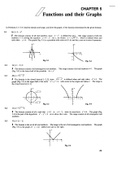
The domain consists of all real numbers, since 4 — x2 is defined for all x. The range consists of all real
numbers < 4: solving the equation y = 4 — x2 for x, we obtain x = ±\/4 — y, which is defined when and
only when y < 4. The graph (Fig. 5-1) is a parabola with vertex at (0, 4) and the y-axis as its axis of symmetry.
Fig. 5-1 Fig. 5-2
5.2 G(x) = -2Vx.
The domain consists of all nonnegative real numbers. The range consists of all real numbers s 0. The graph
(Fig. 5-2) is the lower half of the parabola 4x = y2.
5.3
The domain is the closed interval [-2,2], since V4-x 2 is defined when and only when * 2 s4. The
graph (Fig. 5-3) is the upper half of the circle x2 + y2 - 4 with center at the origin and radius 2. The range is
the closed interval [0,2].
Fig. 5-3 Fig. 5-4
5.4
omain consists of all x such that x SL 2 or x ^ —2, since we must have x2 SL 4. The graph (Fig.I The domain consists of all x such that x SL 2 or x ^ —2, since we must have x2 SL 4. The graph (Fig.
5-4) is the part of the hyperbola x 2 - y 2 = 4 on or above the x-axis. The range consists of all nonnegative real
numbers.
5.5 V(x) = \x-l\.
The domain is the set of all real numbers. The range is the set of all nonnegative real numbers. The graph
(Fig. 5-5) is the graph of y = \x\ shifted one unit to the right.
Fig.5.5
23
, 24 CHAPTER 5
5.6 f(x) = [2x] = the greatest integer :£ 2x.
The domain consists of all real numbers. The range is the set of all integers. The graph (Fig. 5-6) is the
graph of a step function, with each step of length | and height 1.
Fig. 5-6 Fig. 5-7
5.7 g(jc) = [x/3] (see Problem 5.6).
The domain is the set of all real numbers and the range is the set of all integers. The graph (Fig. 5-7) is the
graph of a step function with each step of length 3 and height 1.
5.8
The domain is the set of all nonzero real numbers, and the range is the same set. The graph (Fig. 5-8) is the
hyperbola xy = 1.
Fig. 5-8 Fig. 5-9
5.9
The domain is the set of all real numbers ^ 1. The graph (Fig. 5-9) is Fig. 5-8 shifted one unit to the right.
The range consists of all nonzero real numbers.
5.10
The domain is the set of all real numbers, and the range is the same set. See Fig. 5-10.
Fig. 5-10 Fig. 5-11
5.11 J(x)=-x\x\.
The domain and range are the set of all real numbers. The graph (Fig. 5-11) is obtained by reflecting in the
jc-axis that part of the parabola y = x2 that lies to the right of the >>-axis.
Functions and their Graphs
In Problems 5.1-5.19, find the domain and range, and draw the graph, of the function determined by the given formula.
5.1 h(x) = 4-x2.
The domain consists of all real numbers, since 4 — x2 is defined for all x. The range consists of all real
numbers < 4: solving the equation y = 4 — x2 for x, we obtain x = ±\/4 — y, which is defined when and
only when y < 4. The graph (Fig. 5-1) is a parabola with vertex at (0, 4) and the y-axis as its axis of symmetry.
Fig. 5-1 Fig. 5-2
5.2 G(x) = -2Vx.
The domain consists of all nonnegative real numbers. The range consists of all real numbers s 0. The graph
(Fig. 5-2) is the lower half of the parabola 4x = y2.
5.3
The domain is the closed interval [-2,2], since V4-x 2 is defined when and only when * 2 s4. The
graph (Fig. 5-3) is the upper half of the circle x2 + y2 - 4 with center at the origin and radius 2. The range is
the closed interval [0,2].
Fig. 5-3 Fig. 5-4
5.4
omain consists of all x such that x SL 2 or x ^ —2, since we must have x2 SL 4. The graph (Fig.I The domain consists of all x such that x SL 2 or x ^ —2, since we must have x2 SL 4. The graph (Fig.
5-4) is the part of the hyperbola x 2 - y 2 = 4 on or above the x-axis. The range consists of all nonnegative real
numbers.
5.5 V(x) = \x-l\.
The domain is the set of all real numbers. The range is the set of all nonnegative real numbers. The graph
(Fig. 5-5) is the graph of y = \x\ shifted one unit to the right.
Fig.5.5
23
, 24 CHAPTER 5
5.6 f(x) = [2x] = the greatest integer :£ 2x.
The domain consists of all real numbers. The range is the set of all integers. The graph (Fig. 5-6) is the
graph of a step function, with each step of length | and height 1.
Fig. 5-6 Fig. 5-7
5.7 g(jc) = [x/3] (see Problem 5.6).
The domain is the set of all real numbers and the range is the set of all integers. The graph (Fig. 5-7) is the
graph of a step function with each step of length 3 and height 1.
5.8
The domain is the set of all nonzero real numbers, and the range is the same set. The graph (Fig. 5-8) is the
hyperbola xy = 1.
Fig. 5-8 Fig. 5-9
5.9
The domain is the set of all real numbers ^ 1. The graph (Fig. 5-9) is Fig. 5-8 shifted one unit to the right.
The range consists of all nonzero real numbers.
5.10
The domain is the set of all real numbers, and the range is the same set. See Fig. 5-10.
Fig. 5-10 Fig. 5-11
5.11 J(x)=-x\x\.
The domain and range are the set of all real numbers. The graph (Fig. 5-11) is obtained by reflecting in the
jc-axis that part of the parabola y = x2 that lies to the right of the >>-axis.