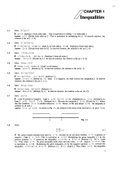
HAPTER 1
nequalities
1.1 Solve 3 + 2*<7.
2x < 4 [Subtract 3 from both sides. This is equivalent to adding -3 to both sides.]
Answer x<2 [Divide both sides by 2. This is equivalent to multiplying by 5.] In interval notation, the
solution is the set (—°°, 2).
1.2 Solve 5 - 3* < 5x + 2.
5-3>x<5x + 2, 5<8* + 2 [Add 3x to both sides.], 3<8* [Subtract 2 from both sides.]
Answer 1 <x [Divide both sides by 8.] In interval notation, the solution is the set (|,°°).
1.3 Solve -7<2x + 5<9.
-7 < 2* + 5 < 9, -12 < 2x < 4 [Subtract 5 from all terms.]
Answer — 6 < x < 2 [Divide by 2.] In interval notation, the solution is the set (—6,2).
1.4 Solve 3 < 4 x - l < 5 .
3<4x-l<5, 4<4x<6 [Add 1 to all terms.]
Answer 1 s x < \ [Divide by 4.] In interval notation, the solution is the set [1, |).
1.5 Solve 4<-2x + 5<7.
4<-2x + 5<7, -K-2jc<2 [Subtracts.]
Answer \ >*>-! [Divide by -2. Since -2 is negative, we must reverse the inequalities.] In interval
notation, the solution is the set [-1, |).
1.6 Solve 5 < \x. + 1 s 6.
5<|x + l<6, 4<|*s5 [Subtract 1.]
Answer 12<^sl5 [Multiply by 3.] In interval notation, the solution is the set [12,15].
1.7 Solve 2/jc<3.
x may be positive or negative. Case 1. x>0. 2/x<3. 2<3x [Multiply by AC.], |<jc [Divide by 3.]
Case 2. x<0. 2/x<3. 2>3x [Multiply by jr. Reverse the inequality.], |>jc [Divide by 3.] Notice
that this condition |>x is satisfied whenever jc<0. Hence, in the case where x < 0 , the inequality is
satisfied by all such x.
Answer f < x or x < 0. As shown in Fig. 1-1, the solution is the union of the intervals (1,«) and (—°°, 0).
Fig. 1-1
1.8 Solve
We cannot simply multiply both sides by x - 3, because we do not know whether x - 3 is positive or
negative. Case 1. x-3>0 [This is equivalent to x>3.] Multiplying the given inequality (1) by the
positive quantity x-3 preserves the inequality: * + 4<2;t-6, 4 < x - 6 [Subtract jr.], 10<x [Add
6.] Thus, when x>3, the given inequality holds when and only when x>10. Case 2. x-3<0 [This
is equivalent to x<3]. Multiplying the given inequality (1) by the negative quantity x — 3 reverses the
inequality: * + 4>2*-6, 4>x-6 [Subtract*.], 10>x [Add 6.] Thus, when x<3, the inequality
1
nequalities
1.1 Solve 3 + 2*<7.
2x < 4 [Subtract 3 from both sides. This is equivalent to adding -3 to both sides.]
Answer x<2 [Divide both sides by 2. This is equivalent to multiplying by 5.] In interval notation, the
solution is the set (—°°, 2).
1.2 Solve 5 - 3* < 5x + 2.
5-3>x<5x + 2, 5<8* + 2 [Add 3x to both sides.], 3<8* [Subtract 2 from both sides.]
Answer 1 <x [Divide both sides by 8.] In interval notation, the solution is the set (|,°°).
1.3 Solve -7<2x + 5<9.
-7 < 2* + 5 < 9, -12 < 2x < 4 [Subtract 5 from all terms.]
Answer — 6 < x < 2 [Divide by 2.] In interval notation, the solution is the set (—6,2).
1.4 Solve 3 < 4 x - l < 5 .
3<4x-l<5, 4<4x<6 [Add 1 to all terms.]
Answer 1 s x < \ [Divide by 4.] In interval notation, the solution is the set [1, |).
1.5 Solve 4<-2x + 5<7.
4<-2x + 5<7, -K-2jc<2 [Subtracts.]
Answer \ >*>-! [Divide by -2. Since -2 is negative, we must reverse the inequalities.] In interval
notation, the solution is the set [-1, |).
1.6 Solve 5 < \x. + 1 s 6.
5<|x + l<6, 4<|*s5 [Subtract 1.]
Answer 12<^sl5 [Multiply by 3.] In interval notation, the solution is the set [12,15].
1.7 Solve 2/jc<3.
x may be positive or negative. Case 1. x>0. 2/x<3. 2<3x [Multiply by AC.], |<jc [Divide by 3.]
Case 2. x<0. 2/x<3. 2>3x [Multiply by jr. Reverse the inequality.], |>jc [Divide by 3.] Notice
that this condition |>x is satisfied whenever jc<0. Hence, in the case where x < 0 , the inequality is
satisfied by all such x.
Answer f < x or x < 0. As shown in Fig. 1-1, the solution is the union of the intervals (1,«) and (—°°, 0).
Fig. 1-1
1.8 Solve
We cannot simply multiply both sides by x - 3, because we do not know whether x - 3 is positive or
negative. Case 1. x-3>0 [This is equivalent to x>3.] Multiplying the given inequality (1) by the
positive quantity x-3 preserves the inequality: * + 4<2;t-6, 4 < x - 6 [Subtract jr.], 10<x [Add
6.] Thus, when x>3, the given inequality holds when and only when x>10. Case 2. x-3<0 [This
is equivalent to x<3]. Multiplying the given inequality (1) by the negative quantity x — 3 reverses the
inequality: * + 4>2*-6, 4>x-6 [Subtract*.], 10>x [Add 6.] Thus, when x<3, the inequality
1