CHAPTER 36
Infinite Sequences
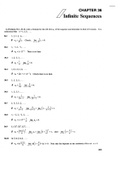
In Problems 36.1-36.18, write a formula for the nth term «„ of the sequence and determine its limit (if it exists). It is
understood that n = 1,2,3,....
36.1
Clearly.
36.2 1,-I, !,-!,....
There is no limit.
36.3
36.4 1,0,1,0,1,0,
Clearly there is no limit.
36.5
36.6
36.7
36.8
36.9
since
36.10
In In Note that this depends on the continuity of In x at x = 1.
305
, 306 CHAPTER 36
36.11 0.9, 0.99, 0.999, 0.9999,
36.12
For Since
36.13
Let K be the least integer For
Each of Therefore,
as So
36.14
Hence,
36.15
Here we have used the fact that which follows by
L'Hopital's rule.
36.16
36.17
36.18 COS 77, COS (7T/2), COS (7T/3), COS (17/4), . . . .
an = cos (ir/n) —» cos 0 = 1.
In Problems 36.19-36.45, determine whether the given sequence converges, and, if it does, find the limit.
36.19 an = sin(rt7r/4).
The sequence takes on the values V2/2,1, V2/2,0, -V2/2, -1, - V2/2,0, and then keeps repeating in this
manner. Hence, there is no limit.
36.20 an = nle".
As L'Hopital's rule yields
36.21 an = (Inn) In.
The sequence converges to 0 (see Problem 36.15).
Infinite Sequences
In Problems 36.1-36.18, write a formula for the nth term «„ of the sequence and determine its limit (if it exists). It is
understood that n = 1,2,3,....
36.1
Clearly.
36.2 1,-I, !,-!,....
There is no limit.
36.3
36.4 1,0,1,0,1,0,
Clearly there is no limit.
36.5
36.6
36.7
36.8
36.9
since
36.10
In In Note that this depends on the continuity of In x at x = 1.
305
, 306 CHAPTER 36
36.11 0.9, 0.99, 0.999, 0.9999,
36.12
For Since
36.13
Let K be the least integer For
Each of Therefore,
as So
36.14
Hence,
36.15
Here we have used the fact that which follows by
L'Hopital's rule.
36.16
36.17
36.18 COS 77, COS (7T/2), COS (7T/3), COS (17/4), . . . .
an = cos (ir/n) —» cos 0 = 1.
In Problems 36.19-36.45, determine whether the given sequence converges, and, if it does, find the limit.
36.19 an = sin(rt7r/4).
The sequence takes on the values V2/2,1, V2/2,0, -V2/2, -1, - V2/2,0, and then keeps repeating in this
manner. Hence, there is no limit.
36.20 an = nle".
As L'Hopital's rule yields
36.21 an = (Inn) In.
The sequence converges to 0 (see Problem 36.15).