CHAPTER 27
Inverse Trigonometric Functions
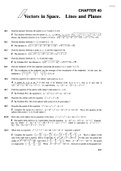
27.1 Draw the graph of y = sin ' x.
By definition, as x varies from -1 to l,y varies from -ir/2 to ir/2. The graph of y = sin" J x is obtained
from the graph of y = sin x [Fig. 27-l(a)] by reflection in the line y = x. See Fig. 27-l(fc).
Fig. 27-1
27.2 Show that D^(sin x)
Let y = sin ' x. Then sin>' = x. By implicit differentiation, cos y • Dxy = 1, Dxy = I/cosy. But
cos Since, by definition, —TT/2^y^ir/2, cosysO, and, therefore.
cos and
Fig. 27-2
220
, INVERSE TRIGONOMETRIC FUNCTIONS 221
27.3 Draw the graph of y = tan * x.
As Jt varies from-oo to+<», tan ' x varies from - ir/2 to 7r/2. The graph of >> = tan x is obtained from
that of .y = tanx [Fig. 27-2(a)] by reflection in the line y = x. See Fig. 27-2(6).
27.4 Show that Detail"1 x) = !/(! + x2).
Let y = tan l x. Then tan .>> = *. By implicit differentiation, sec y-Dxy = l, D,y = I/sec y =
l/(l + tan 2 y) = l/(l + x2).
In Problems 27.5-27.13, find the indicated number.
27.5 cos"1 (-V3/2).
cos 1(-V5/2) is the angle 0 between 0 and ir for which cos0 = -V3/2. It is seen from Fig. 27-3 that 0 is
the supplement of ir/6, that is, 0 = 5ir/6.
Fig. 27-3
27.6 sin"1 (V2/2).
sin l V2/2 is the angle 0 between-77/2 and ir/2 for which sin0 = V2/2. Clearly, 0 = i r / 4 .
27.7 sin"1 (-V2/2).
sin (-V2/2) is the angle 0 between -ir/2 and ir/2 for which sin 0 = -V2/2. Clearly, 0 = -w/4.
27.8 tan'11.
1
tan 1 is the angle 0 between - IT 12 and it 12 for which tan 0 = 1, that is, 0=ir/4.
27.9 tan"1 (V3/3).
7T/6 is the angle 0 between-ir/2 and 7T/2 for which tan0 = (V3/3). So tan (V3/3) = 77/6.
27.10 sec 'V2.
By definition, the value of sec ' x is either an angle in the first quadrant (for positive arguments) or an angle in
the third quadrant (for negative arguments). In this case, the value is in the first quadrant, so sec"1 V2 =
cos~ 1 l/V2=7r/4.
27.11 sec'1 (-2V5/3).
The value 0 must be in the third quadrant. Since sec0 = -2V3/3, cos 0 = -3/2V3 = -V3/2. Thus
(see *'?. 27-4), e = it + ir/6 = 77T/6.
Fig. 27-4
Inverse Trigonometric Functions
27.1 Draw the graph of y = sin ' x.
By definition, as x varies from -1 to l,y varies from -ir/2 to ir/2. The graph of y = sin" J x is obtained
from the graph of y = sin x [Fig. 27-l(a)] by reflection in the line y = x. See Fig. 27-l(fc).
Fig. 27-1
27.2 Show that D^(sin x)
Let y = sin ' x. Then sin>' = x. By implicit differentiation, cos y • Dxy = 1, Dxy = I/cosy. But
cos Since, by definition, —TT/2^y^ir/2, cosysO, and, therefore.
cos and
Fig. 27-2
220
, INVERSE TRIGONOMETRIC FUNCTIONS 221
27.3 Draw the graph of y = tan * x.
As Jt varies from-oo to+<», tan ' x varies from - ir/2 to 7r/2. The graph of >> = tan x is obtained from
that of .y = tanx [Fig. 27-2(a)] by reflection in the line y = x. See Fig. 27-2(6).
27.4 Show that Detail"1 x) = !/(! + x2).
Let y = tan l x. Then tan .>> = *. By implicit differentiation, sec y-Dxy = l, D,y = I/sec y =
l/(l + tan 2 y) = l/(l + x2).
In Problems 27.5-27.13, find the indicated number.
27.5 cos"1 (-V3/2).
cos 1(-V5/2) is the angle 0 between 0 and ir for which cos0 = -V3/2. It is seen from Fig. 27-3 that 0 is
the supplement of ir/6, that is, 0 = 5ir/6.
Fig. 27-3
27.6 sin"1 (V2/2).
sin l V2/2 is the angle 0 between-77/2 and ir/2 for which sin0 = V2/2. Clearly, 0 = i r / 4 .
27.7 sin"1 (-V2/2).
sin (-V2/2) is the angle 0 between -ir/2 and ir/2 for which sin 0 = -V2/2. Clearly, 0 = -w/4.
27.8 tan'11.
1
tan 1 is the angle 0 between - IT 12 and it 12 for which tan 0 = 1, that is, 0=ir/4.
27.9 tan"1 (V3/3).
7T/6 is the angle 0 between-ir/2 and 7T/2 for which tan0 = (V3/3). So tan (V3/3) = 77/6.
27.10 sec 'V2.
By definition, the value of sec ' x is either an angle in the first quadrant (for positive arguments) or an angle in
the third quadrant (for negative arguments). In this case, the value is in the first quadrant, so sec"1 V2 =
cos~ 1 l/V2=7r/4.
27.11 sec'1 (-2V5/3).
The value 0 must be in the third quadrant. Since sec0 = -2V3/3, cos 0 = -3/2V3 = -V3/2. Thus
(see *'?. 27-4), e = it + ir/6 = 77T/6.
Fig. 27-4