NR 507 WEEK 3 QUIZ 1 – QUESTION AND ANSWERS
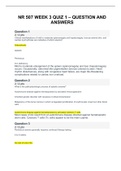
NR 507 WEEK 3 QUIZ 1 – QUESTION AND ANSWERS NR 507 WEEK 3 QUIZ 1 – QUESTION AND ANSWERS Question 1 2 / 2 pts Clinical manifestations of mild to moderate splenomegaly and hepatomegaly, bronze-colored skin, and cardiac dysrhythmias are indicative of which anemia? Sideroblastic Aplastic You Answered Pernicious Iron deficiency Mild to moderate enlargement of the spleen (splenomegaly) and liver (hepatomegaly) occurs. Occasionally, abnormal skin pigmentation (bronze colored) is seen. Heart rhythm disturbances, along with congestive heart failure, are major life-threatening complications related to cardiac iron overload. Question 2 2 / 2 pts What is the pathophysiologic process of aplastic anemia? Autoimmune disease against hematopoiesis by activated immunoglobulins Inherited genetic disorder with recessive X-linked transmission Malignancy of the bone marrow in which unregulated proliferation of erythrocytes crowd out other blood cells Correct! Autoimmune disease against hematopoiesis by activated cytotoxic T cells Most cases of AA result from an autoimmune disease directed against hematopoietic stem cells. Cytotoxic T cells (Tc cells) appear to be the main culprits. Question 3 2 / 2 pts Pernicious anemia generally requires continued therapy lasting 6 to 8 weeks. Correct! the rest of one’s life. until the iron level is normal. 8 to 12 months. PA cannot be cured, so maintenance therapy is lifelong. Question 4 2 / 2 pts Symptoms of polycythemia vera are mainly the result of destruction of erythrocytes. Correct! increased blood viscosity. neurologic involvement. a decreased erythrocyte count. As the disease progresses many of the symptoms are related to the increased blood cellularity and viscosity. Question 5 2 / 2 pts The body compensates for anemia by capillary vasoconstriction. kidneys release more erythropoietin. hemoglobin holds on to oxygen more firmly. Correct! increasing rate and depth of breathing. Tissue hypoxia creates additional demands and compensatory actions on the pulmonary and hematologic systems. The rate and depth of breathing increase in an attempt to increase the availability of oxygen. Question 6 2 / 2 pts In hemolytic anemia, jaundice occurs only when the patient has elevations in aspartate transaminase (AST) and alanine transaminase (ALT). Correct! heme destruction exceeds the liver’s ability to conjugate and excrete bilirubin. erythrocytes are destroyed in the spleen. the erythrocytes are coated with an immunoglobulin. Jaundice (icterus) is present when heme destruction exceeds the liver’s ability to conjugate and excrete bilirubin. Question 7 2 / 2 pts Which of the following is a description consistent with acute lymphocytic leukemia (ALL)? It is a progressive neoplasm defined by the presence of greater than 30% lymphoblasts in the bone marrow or blood. The translocation of genetic material from genes 9 and 22 create an abnormal, fused gene identified as BCR-ABL. You Answered The bone marrow and peripheral blood are characterized by leukocytosis and a predominance of blast cells. As the immature blasts increase, they replace normal myelocytic cells, megakaryocytes, and erythrocytes. There is failure of B cells to mature into plasma cells that synthesize immunoglobulins. ALL is a progressive neoplasm defined by the presence of greater than 30% lymphoblasts in the bone marrow or blood. Question 8 2 / 2 pts What change is seen in leukocytes during an allergic disorder (type I) often caused by asthma, hay fever, and drug reactions? Correct! Eosinophilia Monocytosis Neutrophilia Basophilia Allergic disorders (type I hypersensitivity) associated with asthma, hay fever, and drug reactions, as well as parasitic infections (particularly with metazoal parasites) are often cited as causes. Question 9 2 / 2 pts Heparin-induced thrombocytopenia (HIT) is described as a(n) Correct! IgG immune-mediated adverse drug reaction that reduces circulating platelets. IgE-mediated allergic drug reaction that reduces circulating platelets. hematologic reaction to heparin in which the bone marrow is unable to produce sufficient platelets to meet the body’s needs. cell-mediated drug reaction in which macrophages process the heparin and platelet complexes that are then destroyed by activated cytotoxic T cells. Heparin is a common cause of drug-induced thrombocytopenia. HIT is an immune-mediated, adverse drug reaction caused by IgG antibodies that leads to increased platelet consumption and a decrease in platelet counts. Question 10 2 / 2 pts Local signs and symptoms of Hodgkin disease–related lymphadenopathy are a result of ischemia and pressure. Correct! pressure and obstruction. obstruction and pressure. inflammation and ischemia. Local symptoms caused by pressure and obstruction of the lymph nodes are the result of lymphadenopathy. Question 11 2 / 2 pts Erythroblastosis fetalis is defined as an autoimmune disease in immature nucleated cells that are released into the bloodstream. allergic disease in which maternal blood and fetal blood are antigenically incompatible. Correct! alloimmune disease in which maternal blood and fetal blood are antigenically incompatible. autosomal dominant hereditary disease. HDN is an alloimmune disease in which maternal blood and fetal blood are antigenically incompatible, causing the mother’s immune system to produce antibodies against fetal erythrocytes. Question 12 2 / 2 pts The type of anemia that occurs as a result of thalassemia is Correct! microcytic, hypochromic. macrocytic, normochromic. macrocytic, hyperchromic. microcytic, normochromic. The anemic manifestation of thalassemia is microcytic-hypochromic hemolytic anemia. Question 13 2 / 2 pts The sickle cell trait differs from sickle cell disease in that the child with sickle cell trait has a mild form of sickle cell disease that causes sickling during fever and infection, but not during acidosis or hypoxia, whereas the child with sickle cells disease develops sickling during each of these conditions. has a milder form of the disease that is characterized by vaso-occlusive crises and is believed to result from higher hemoglobin values and viscosity. has the mildest form of the disease with normal hemoglobin and hemoglobin F, which prevents sickling.
Escuela, estudio y materia
- Institución
- Chamberlain College Nursing
- Grado
- ADV PATHO NR 507
Información del documento
- Subido en
- 13 de julio de 2022
- Número de páginas
- 9
- Escrito en
- 2021/2022
- Tipo
- Examen
- Contiene
- Preguntas y respuestas
Temas
-
nr 507 week 3 quiz 1
-
nr 507 week 3wers
-
nr 507 week 3 quiz 1 – question and answers
-
nr 507 week 3 quiz 1 – question and answers question 1 2 2 pts clinical manifestations of mild to moderate splenom
Documento también disponible en un lote