Topic 1: Causes, practices and effects of wars
Chapter Two: World War Two
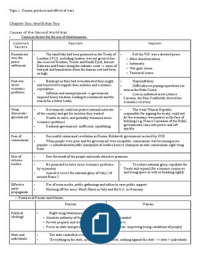
Causes of the Second World War
• Common factors for the rise of totalitarianism:
Common Fascism Nazism
Factors
Resentment • The land Italy had been promised in the Treaty of • Felt the ToV was a dictated peace:
over the London (1915), including Austria, was not given to her - • Mass demilitarisation
peace she received Trentino, Treiste and South Tyrol, but not
• Indemnity
settlement Dalmatia and Fiume along the Adriatic coast → sense of
betrayal and humiliation when the human cost had been • War guilt clause
so high • Territorial losses
Post-war • Bankrupt as they had overestimated their might, • Hyperinflation
socio- and borrowed to support their military and economic • Difficulties in paying reparations (as
economic expenditure seen in the Ruhr Crisis)
problems • Inflation and unemployment → government • Loss in industrial areas (Alsace-
imposed heavy taxation, leading to resentment and the Lorraine, the Saar Coalfields) slowed her
search for a better leader economic recovery
Weak • Government could not protect national interests • The weak Weimar Republic:
democratic of the country and get the territory they wanted responsible for signing the treaty, could not
government • Unable to solve, and probably worsened socio- fix the economy, was passive in the face of
economic problems bullying (e.g. France’s invasion of the Ruhr);
Coalition government: inefficient, squabbling governments came into power and left
•
quickly
Fear of • Successful communist revolution in Russia, Bolshevik government secured by 1920
communism • When people were poor and the government were incapable, communism was becoming more
popular → industrialists/middle class/political leaders keen to champion an anti-communism right-wing
front
Rise of • Saw the needs of the people and made attractive promises
extreme
leaders • He promised to solve socio-economic problems • To restore national glory, repudiate the
by expansion Treaty and expand (for economic resources
• Aimed to revive the national glory of Italy (‘of and living space as well as boasting rights)
ancient Rome’)
Effective • Use of mass media, public gatherings and rallies to raise public support
party • Showing off the army: Black Shirts in Italy and the S.A. in Germany
propaganda
• Features of Facism and Nazism:
Fascism Nazism
Political • Right-wing totalitarianism
ideology • Absolute authority of the government, often very nationalist
• Private property and clear social hierarchy, conservative
• Focus on state and government (as opposed to socialism: improving living conditions of people)
State and • The state controlled every aspect of society
individuals • ‘Everything in the state, nothing outside the state, nothing against the state’ → state > individuals
, Fascism Nazism
Power of the • Authoritarian, supreme (i.e. dictatorship), e.g. the Führer having control over administration,
ruler constitution and military, the ‘supreme judge of the nation’
• Often worshipped; divine image promoted through propaganda
• Only ever room for one leader: Il Duce and the Führer
Form of • Single-party dictatorship (all other political parties were banned)
government
Ways to deal • Strict censorship
with opposition • Use of terror and violence to suppress opponents or even just potential challenges, e.g. secret
police, labour camps, breeding a culture of informants
Views towards • Anti-democracy: portrayed their countries’ difficulties as products of the weak democratic
democracy governments
Views towards • Anti-communist: saw the idea of class struggle as undermining national unity; financial support
communism had been gained from the industrial classes
Use of • Creating a cult of leader-worship: Mussolini portraying himself as a saviour; Hitler’s personality
propaganda cult
Foreign policy • Expansionist
• Promoting war as a means to achieve national glory (militaristic)
• Did not believe in international cooperation or pacifism
Attitudes • No specific ideas of racial superiority • Strong racial superiority of the Aryans
towards race • Anti-Semitism (Jews as inferior) → from
removing rights and nationality to genocide
Economic • Cooperative state: government- • No fully developed corporation system
policy monitored corporations formed by employers • Some government plans to tackle
and employees (22 corporations) unemployment
• Relatively well-structured • Military-oriented economy
• Failed attempts at collective security:
• The League of Nations:
• Lacked military strength or a central authority, relied upon France and Britain
• Ineffective means to achieve peace, as seen in the Manchurian and Abyssinian Crises → unable to stop aggressors,
ceased to function as members left
• In particular the Abyssinian Crisis involved France and Britain making an offer to Italy to take two-thirds of
Abyssinia in exchange for halting invasion, showing the League’s lack of power
• Unfairness, e.g. in the Corfu Incident and the Greek-Bulgaria War, showing the difference in treatment of different
members, which undermined the League’s authority
• It ended up encouraging aggression
• Failure of disarmament conferences:
• Parties were reluctant to be the first to disarm
• Rearmament increased with insecurity over hostile neighbours
• Germany knew that no one would disarm to her level, and thus began to rely on her own military force to ensure her
security
• The Locarno Treaty:
• Gave Germany the false hope that the Treaty of Versailles could be revised → convinced the Germans they needed to
take matters into their own hands to resolve the matter (and hence increased support for Hitler)
• Impact of the Great Depression:
• Countries became more inward-looking and less concerned with anything else
, • Financial difficulties → less money to spend on international affairs or military strength, and economic sanctions on
others would harm themselves → adoption of the appeasement policy, reluctance to take firm action against aggressors
• The economic downturn in Japan and Germany:
• Militarists and the Nazis could seize power from the weak democrats
• Notably, Japan did have the prowess to expand: at the Washington Conference she was the only Asian power
with a recognisably powerful navy
• Aggressive countries began promoting expansionist foreign policies as a means to resolve economic problems
• Aggression of Axis Powers:
Japan Italy Germany
Foreign Militarist expansion (Tanaka Expansion: Revenge and regain/restore national glory
policy Memorial, 1927): • Glory of Rome Repudiate the Treaty of Versailles
aims • National glory Divert the public’s Expand:
•
• Resources (to also attention from internal • More resources and living space
expand her foreign exports problems (hence more (to resolve economic problems)
for trade) aggressive after the Great • To enjoy the principle of national
• Living space Depression self-determination (with Germans under
• Corfu Incident (1923) foreign rule)
1931 Manchurian Crisis and the •
establishment of Manzhouguo
in 1932
1933 Withdrawal from the League of • Withdrew from the Geneva Conference and
Nations following the League (Oct)
condemnation
1935 • Abyssinian Crisis Rearmament: introduction of conscription,
violating the Treaty of Versailles
1936 • Remilitarisation of the Rhineland
Intervention in the Spanish Civil War
Signed the Anti-Comintern Pact with Japan
Berlin-Rome Axis (October)
1937 Full-scale war with China Withdrawal from the League over •
her unhappiness with the outcome
of the Abyssinian Crisis (limited
expansion)
Italy joined the Anti-Comintern Pact (originally signed between Germany and Japan in 1936)
1938 • • Occupation of Austria (Mar)
Annexation of Sudetenland (Sept)
1939 • Pact of Steel (military alliance)
Annexation of Albania (along the Annexation of Bohemia and Moravia
Adriatic coast) (Czechoslovakia) in March
Nazi-Soviet Non-aggression Pact (Aug)
Invasion of Poland and the start of WWII
• Germany’s aggression:
Chapter Two: World War Two
Causes of the Second World War
• Common factors for the rise of totalitarianism:
Common Fascism Nazism
Factors
Resentment • The land Italy had been promised in the Treaty of • Felt the ToV was a dictated peace:
over the London (1915), including Austria, was not given to her - • Mass demilitarisation
peace she received Trentino, Treiste and South Tyrol, but not
• Indemnity
settlement Dalmatia and Fiume along the Adriatic coast → sense of
betrayal and humiliation when the human cost had been • War guilt clause
so high • Territorial losses
Post-war • Bankrupt as they had overestimated their might, • Hyperinflation
socio- and borrowed to support their military and economic • Difficulties in paying reparations (as
economic expenditure seen in the Ruhr Crisis)
problems • Inflation and unemployment → government • Loss in industrial areas (Alsace-
imposed heavy taxation, leading to resentment and the Lorraine, the Saar Coalfields) slowed her
search for a better leader economic recovery
Weak • Government could not protect national interests • The weak Weimar Republic:
democratic of the country and get the territory they wanted responsible for signing the treaty, could not
government • Unable to solve, and probably worsened socio- fix the economy, was passive in the face of
economic problems bullying (e.g. France’s invasion of the Ruhr);
Coalition government: inefficient, squabbling governments came into power and left
•
quickly
Fear of • Successful communist revolution in Russia, Bolshevik government secured by 1920
communism • When people were poor and the government were incapable, communism was becoming more
popular → industrialists/middle class/political leaders keen to champion an anti-communism right-wing
front
Rise of • Saw the needs of the people and made attractive promises
extreme
leaders • He promised to solve socio-economic problems • To restore national glory, repudiate the
by expansion Treaty and expand (for economic resources
• Aimed to revive the national glory of Italy (‘of and living space as well as boasting rights)
ancient Rome’)
Effective • Use of mass media, public gatherings and rallies to raise public support
party • Showing off the army: Black Shirts in Italy and the S.A. in Germany
propaganda
• Features of Facism and Nazism:
Fascism Nazism
Political • Right-wing totalitarianism
ideology • Absolute authority of the government, often very nationalist
• Private property and clear social hierarchy, conservative
• Focus on state and government (as opposed to socialism: improving living conditions of people)
State and • The state controlled every aspect of society
individuals • ‘Everything in the state, nothing outside the state, nothing against the state’ → state > individuals
, Fascism Nazism
Power of the • Authoritarian, supreme (i.e. dictatorship), e.g. the Führer having control over administration,
ruler constitution and military, the ‘supreme judge of the nation’
• Often worshipped; divine image promoted through propaganda
• Only ever room for one leader: Il Duce and the Führer
Form of • Single-party dictatorship (all other political parties were banned)
government
Ways to deal • Strict censorship
with opposition • Use of terror and violence to suppress opponents or even just potential challenges, e.g. secret
police, labour camps, breeding a culture of informants
Views towards • Anti-democracy: portrayed their countries’ difficulties as products of the weak democratic
democracy governments
Views towards • Anti-communist: saw the idea of class struggle as undermining national unity; financial support
communism had been gained from the industrial classes
Use of • Creating a cult of leader-worship: Mussolini portraying himself as a saviour; Hitler’s personality
propaganda cult
Foreign policy • Expansionist
• Promoting war as a means to achieve national glory (militaristic)
• Did not believe in international cooperation or pacifism
Attitudes • No specific ideas of racial superiority • Strong racial superiority of the Aryans
towards race • Anti-Semitism (Jews as inferior) → from
removing rights and nationality to genocide
Economic • Cooperative state: government- • No fully developed corporation system
policy monitored corporations formed by employers • Some government plans to tackle
and employees (22 corporations) unemployment
• Relatively well-structured • Military-oriented economy
• Failed attempts at collective security:
• The League of Nations:
• Lacked military strength or a central authority, relied upon France and Britain
• Ineffective means to achieve peace, as seen in the Manchurian and Abyssinian Crises → unable to stop aggressors,
ceased to function as members left
• In particular the Abyssinian Crisis involved France and Britain making an offer to Italy to take two-thirds of
Abyssinia in exchange for halting invasion, showing the League’s lack of power
• Unfairness, e.g. in the Corfu Incident and the Greek-Bulgaria War, showing the difference in treatment of different
members, which undermined the League’s authority
• It ended up encouraging aggression
• Failure of disarmament conferences:
• Parties were reluctant to be the first to disarm
• Rearmament increased with insecurity over hostile neighbours
• Germany knew that no one would disarm to her level, and thus began to rely on her own military force to ensure her
security
• The Locarno Treaty:
• Gave Germany the false hope that the Treaty of Versailles could be revised → convinced the Germans they needed to
take matters into their own hands to resolve the matter (and hence increased support for Hitler)
• Impact of the Great Depression:
• Countries became more inward-looking and less concerned with anything else
, • Financial difficulties → less money to spend on international affairs or military strength, and economic sanctions on
others would harm themselves → adoption of the appeasement policy, reluctance to take firm action against aggressors
• The economic downturn in Japan and Germany:
• Militarists and the Nazis could seize power from the weak democrats
• Notably, Japan did have the prowess to expand: at the Washington Conference she was the only Asian power
with a recognisably powerful navy
• Aggressive countries began promoting expansionist foreign policies as a means to resolve economic problems
• Aggression of Axis Powers:
Japan Italy Germany
Foreign Militarist expansion (Tanaka Expansion: Revenge and regain/restore national glory
policy Memorial, 1927): • Glory of Rome Repudiate the Treaty of Versailles
aims • National glory Divert the public’s Expand:
•
• Resources (to also attention from internal • More resources and living space
expand her foreign exports problems (hence more (to resolve economic problems)
for trade) aggressive after the Great • To enjoy the principle of national
• Living space Depression self-determination (with Germans under
• Corfu Incident (1923) foreign rule)
1931 Manchurian Crisis and the •
establishment of Manzhouguo
in 1932
1933 Withdrawal from the League of • Withdrew from the Geneva Conference and
Nations following the League (Oct)
condemnation
1935 • Abyssinian Crisis Rearmament: introduction of conscription,
violating the Treaty of Versailles
1936 • Remilitarisation of the Rhineland
Intervention in the Spanish Civil War
Signed the Anti-Comintern Pact with Japan
Berlin-Rome Axis (October)
1937 Full-scale war with China Withdrawal from the League over •
her unhappiness with the outcome
of the Abyssinian Crisis (limited
expansion)
Italy joined the Anti-Comintern Pact (originally signed between Germany and Japan in 1936)
1938 • • Occupation of Austria (Mar)
Annexation of Sudetenland (Sept)
1939 • Pact of Steel (military alliance)
Annexation of Albania (along the Annexation of Bohemia and Moravia
Adriatic coast) (Czechoslovakia) in March
Nazi-Soviet Non-aggression Pact (Aug)
Invasion of Poland and the start of WWII
• Germany’s aggression: