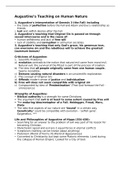
Augustine’s Teaching on Human Nature
1. Augustine’s interpretation of Genesis 3 (the Fall) including
• the state of perfection before the Fall and Adam and Eve’s relationship as
friends
• lust and selfish desires after the Fall
2. Augustine’s teaching that Original Sin is passed on through
sexual intercourse and is the cause of:
• human selfishness and lack of free will
• lack of stability and corruption in all human societies.
3. Augustine’s teaching that only God’s grace, his generous love,
can overcome sin and the rebellious will to achieve the greatest
(summum bonum)
Criticisms of Augustine:
1. Scientific Problems:
a) evolution contradicts the notion that natural evil came from moral evil.
Natural evil, the survival of the fittest is part of the process of creation.
b) The idea that all people originally came from one human couple.
Seems incredible.
c) Demons causing natural disasters is an unscientific explanation.
2. The concept of Original Sin:
a) Offends modern sense of justice and individualism
b) Free will does not seem compatible with original sin
c) Compounded by idea of ‘Predestination’ (That God foresaw the Fall -
omniscience)
Strengths of Augustine:
• Biblical authority is a strength for some Christians.
• The argument that evil is at least to some extent caused by free will
• The enduring idea/metaphor of a Fall. Heidegger, Freud, Marx,
Plato
• The idea that aspects of our nature are ‘bound’ in a certain way.
Genetically? could be compatible with evolution - ‘selfish gene’.
Epigenetics. ***
Life and Philosophies of Augustine of Hippo (354-430):
• Searching for an answer to the problem of evil was part of his reason for
becoming Christian.
• Manicheism (good and evil are 2 equal forces in eternal conflict)
• Scepticism (nothing can be known about anything)
• Platonism (World of Forms VS World of Appearances)
• Converted to Christianity but kept some Platonic elements. Lived during
the collapse of Roman Empire. Looked for a City of God.
, Manicheism:
1. Good and evil are equal opposites in eternal conflict.
2. Evil comes from an evil God.
3. The body is created by the evil God.
4. The goal of salvation is to liberate the pure soul from the evil body
and rise to pure light.
5. This can be achieved through prayer and abstinence from pleasure.
Only a few select people achieve this (esoteric).
Comparing Manicheism with Augustine:
• Differences:
• Augustine rejects the argument that the body is evil, arguing instead that
the body cannot be sinful because it was created to be good by God.
The weak and divided will is what makes the body unmoderated.
• This effect on the body causes it to crave power, food, money and
sexual intercourse.
• So, the will is corrupt, not the body.
• Augustine disputes the key teaching the salvation can be achieved
through prayer and abstinence, as he dismisses the idea that self-
control allows humans to live without struggle.
• Augustine places significant emphasis on the good will of God, almost in
complete opposition to the Manichaean belief of the soul desiring God,
but having to contend with a lower power (Satan) responsible for evil on
earth.
• Similarities:
• Manicheism informed Augustine’s ideas on the problem of evil and
suffering.
Modern Version - ‘Surd’ Evil:
1. Edgar S. Brightman:
• Argued that some evil is real and has no purpose. It is ‘surd’ evil.
(More similar to Manichees’ view which Augustine abandoned).
2. J.S Mill (1806-1873):
• God is an artist limited by his materials (like Plato’s Demiurge).
Therefore Mill denies the ‘omnipotent’ of the triangle.
• “Nearly all things which men are hanged for or imprisoned for doing to one
another are nature’s everyday performances.”
Friedrich Nietzsche:
• “sinfulness in humans is not a factual state but rather only the
interpretation of a factual state, namely of being physiologically out of
sorts - the latter seen from a moral-religious perspective that is no longer
binding on us. That someone feels “guilty”, “sinful” does not at all prove
he is right in feeling so…” - On the Genealogy of Morality
• Meaning: that sinfulness is more of a feeling/emotion than a physical thing
Nietzsche against Augustine:
1. Augustine’s interpretation of Genesis 3 (the Fall) including
• the state of perfection before the Fall and Adam and Eve’s relationship as
friends
• lust and selfish desires after the Fall
2. Augustine’s teaching that Original Sin is passed on through
sexual intercourse and is the cause of:
• human selfishness and lack of free will
• lack of stability and corruption in all human societies.
3. Augustine’s teaching that only God’s grace, his generous love,
can overcome sin and the rebellious will to achieve the greatest
(summum bonum)
Criticisms of Augustine:
1. Scientific Problems:
a) evolution contradicts the notion that natural evil came from moral evil.
Natural evil, the survival of the fittest is part of the process of creation.
b) The idea that all people originally came from one human couple.
Seems incredible.
c) Demons causing natural disasters is an unscientific explanation.
2. The concept of Original Sin:
a) Offends modern sense of justice and individualism
b) Free will does not seem compatible with original sin
c) Compounded by idea of ‘Predestination’ (That God foresaw the Fall -
omniscience)
Strengths of Augustine:
• Biblical authority is a strength for some Christians.
• The argument that evil is at least to some extent caused by free will
• The enduring idea/metaphor of a Fall. Heidegger, Freud, Marx,
Plato
• The idea that aspects of our nature are ‘bound’ in a certain way.
Genetically? could be compatible with evolution - ‘selfish gene’.
Epigenetics. ***
Life and Philosophies of Augustine of Hippo (354-430):
• Searching for an answer to the problem of evil was part of his reason for
becoming Christian.
• Manicheism (good and evil are 2 equal forces in eternal conflict)
• Scepticism (nothing can be known about anything)
• Platonism (World of Forms VS World of Appearances)
• Converted to Christianity but kept some Platonic elements. Lived during
the collapse of Roman Empire. Looked for a City of God.
, Manicheism:
1. Good and evil are equal opposites in eternal conflict.
2. Evil comes from an evil God.
3. The body is created by the evil God.
4. The goal of salvation is to liberate the pure soul from the evil body
and rise to pure light.
5. This can be achieved through prayer and abstinence from pleasure.
Only a few select people achieve this (esoteric).
Comparing Manicheism with Augustine:
• Differences:
• Augustine rejects the argument that the body is evil, arguing instead that
the body cannot be sinful because it was created to be good by God.
The weak and divided will is what makes the body unmoderated.
• This effect on the body causes it to crave power, food, money and
sexual intercourse.
• So, the will is corrupt, not the body.
• Augustine disputes the key teaching the salvation can be achieved
through prayer and abstinence, as he dismisses the idea that self-
control allows humans to live without struggle.
• Augustine places significant emphasis on the good will of God, almost in
complete opposition to the Manichaean belief of the soul desiring God,
but having to contend with a lower power (Satan) responsible for evil on
earth.
• Similarities:
• Manicheism informed Augustine’s ideas on the problem of evil and
suffering.
Modern Version - ‘Surd’ Evil:
1. Edgar S. Brightman:
• Argued that some evil is real and has no purpose. It is ‘surd’ evil.
(More similar to Manichees’ view which Augustine abandoned).
2. J.S Mill (1806-1873):
• God is an artist limited by his materials (like Plato’s Demiurge).
Therefore Mill denies the ‘omnipotent’ of the triangle.
• “Nearly all things which men are hanged for or imprisoned for doing to one
another are nature’s everyday performances.”
Friedrich Nietzsche:
• “sinfulness in humans is not a factual state but rather only the
interpretation of a factual state, namely of being physiologically out of
sorts - the latter seen from a moral-religious perspective that is no longer
binding on us. That someone feels “guilty”, “sinful” does not at all prove
he is right in feeling so…” - On the Genealogy of Morality
• Meaning: that sinfulness is more of a feeling/emotion than a physical thing
Nietzsche against Augustine: